
What if a resin printer grew the part downward without moving the build plate?
That is the very unusual idea in a recent 3D Systems patent application. Instead of lifting a partially printed object after each layer, the proposed machine keeps its build platen fixed and moves the liquid interface beneath it. The part grows downward into the changing space.
Two Fluids Create A Moving Build Plane
The system uses a transparent plate at the bottom of a build container, with two immiscible fluids above it. The lower fluid is optically clear and denser than the upper photopolymer. The patent gives fluorinated synthetic oils such as perfluoropolyethers as examples for the lower layer, with a specific gravity around 1.7 to 2.0.
Above that sits the photocurable resin. The patent filing talks about water-based photopolymer formulations and hydrogels, including materials relevant to bioink research. Because the fluids do not mix and have different densities, their boundary forms a sharp horizontal build plane. Light passes through the transparent plate and the lower fluid before curing selected pixels in the resin above it. How interesting is that?
A pump connected to a lower port removes transparent fluid from the container. As the volume of that dense fluid decreases, the interface drops. A second pump can add photopolymer through an upper port to maintain the resin surface beneath the stationary build platen.
The Projector Has To Follow The Interface
There is a second moving part: The projector beneath the transparent plate must descend at the same average speed as the build plane. Otherwise, its focal plane would gradually drift away from the curing surface as the fluid boundary moves.
The patent claims cover both stepped operation and continuous movement. In a conventional layer sequence, the pump could lower the interface by one layer height, pause while the light engine exposes the next image, and repeat. The broader version continuously lowers the interface while the projector and exposure process track it.
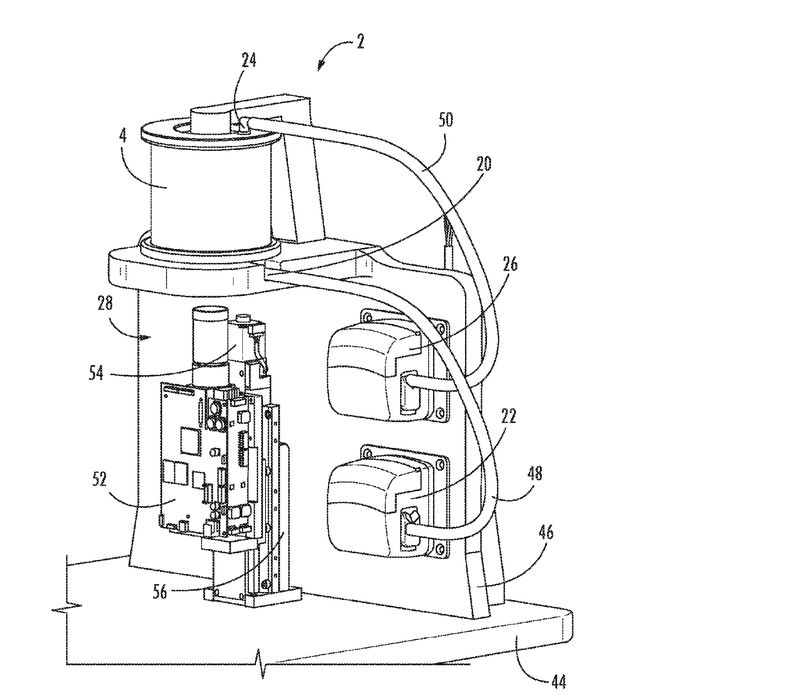
In the patent’s diagrams, the projector rides on a vertical mechanism using a motor and lead screw. The application also allows a variable-focus optical system, or a combination of moving mechanics and adjustable optics. Sensors may monitor the interface position, fluid temperatures, and the upper liquid surface, giving the controller information for synchronizing the pumps, projector, and focus.
For a 3D printer operator, the proposed change is a different kind of separation problem. Traditional bottom-up SLA and DLP systems repeatedly pull a growing object away from a transparent window. That peeling action can stress fragile layers and complicate release from the window. Here, the transparent plate stays below a liquid cushion while the object remains attached to the fixed platen. The print does not stick to the interface, which in this case is fluid.
That arrangement may be especially interesting for delicate hydrogel structures, where mechanical lifting forces are unwelcome. It also avoids the need to raise an increasingly tall object through the vat, potentially allowing the machine frame and platen to remain compact.
The tradeoff is a vat that works more like a fluid-control system than the simple resin tanks of today. The pumps must move precise volumes without disturbing the fluid interface, for example. The two liquids must remain optically precise, chemically compatible, and reliably separated. The projector’s vertical motion also complicates calibration and maintenance demands.
The claims in patent JP2026528420A list a dense transparent fluid controlling the build plane, a lighter photocurable fluid above it, and synchronized downward motion of both the interface and optical focus. 3D Systems has definitely not established a commercial product here, but this patent could lead to a machine architecture that reduces peel forces by making the build surface itself move.
It is a pretty curious inversion of the usual SLA workflow: the part stays put, the liquid boundary travels, and the projector follows along underneath.
Via Espacenet
