
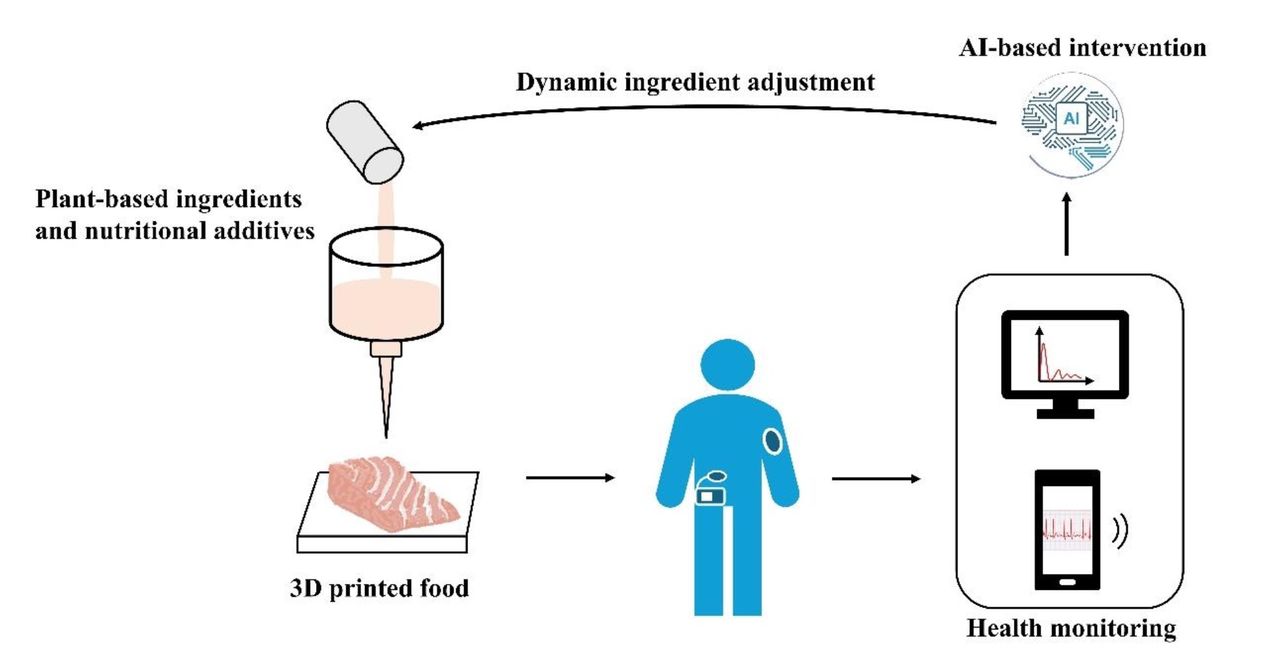
A new research paper lays out how extrusion 3D food printing and AI could deliver truly personalized, plant-based meals.
A group at the University of Saskatchewan synthesized recent work on plant-derived food inks, extrusion mechanics, and closed-loop sensing for precision nutrition. The paper is an engineering roadmap for the future of food printing.
The central idea is straightforward: use extrusion — the dominant method of food printing — to deposit plant-based inks that are tuned for shear-thinning flow, quick structural recovery, and elastic dominance after deposition. Then add a layer of intelligence. With continuous glucose monitoring and other biosensors, AI models could adjust recipes and internal architectures in real time to hit individual dietary targets.
From Plant Proteins To Printability Windows
The researchers list a wide range of materials palette: pea, chickpea and faba bean proteins; flaxseed gum and protein; cereal flours; and lipids such as canola oil for emulsion-gel systems. Each ingredient class supports different rheology and texture outcomes. Chickpea and soy tend to form dense, digestion-resistant gels; pea offers tunable networks responsive to hydrocolloids; faba bean benefits from enzymatic crosslinking for seafood analogs. Fruit and vegetable matrices supply colors and antioxidants but often need hydrocolloids for shape fidelity.
Mechanistically, the paper keeps coming back to four levers that are critical in extrusion-based additive manufacturing: yield stress to resist sag; strong shear-thinning to lower extrusion force; elastic-dominant viscoelasticity for multilayer stability; and fast recovery after shear to sharpen edges and prevent filament fusion. Crosslinking can be ionic, thermal, enzymatic, or composite, but it must be synchronized with deposition — set too early and you clog the nozzle, too late and your walls slump.
AI In The Loop
The paper’s twist is its call for closed-loop AI–printer–sensor platforms. In principle, a system could read CGM curves, predict tomorrow’s glycemic response, and present a new toolpath and formulation — changing infill density, hydrocolloid ratio, or cooling profile — to meet a changing dietary target. In other words, a feedback-controlled diet rather than a static plan.
But there’s one issue. None of this scales without much more work on throughput, sanitation, and software plumbing. Extrusion food printers today are mostly research rigs: pneumatic, piston, or screw systems with nozzles from 0.1 to 2 mm. Post-processing matters as much as the print — baking, steaming, freezing and storage can destroy a perfect rheology.
The researchers are refreshingly blunt about unknowns. Clinical evidence in humans is limited. Standardized “printability windows” are still emerging, making cross-lab reproduction difficult. Microbial safety is nontrivial for high-water-activity gels. Cybersecurity and privacy loom large when printers ingest data streams and health records. And regulations will have to sort out where adaptive, AI-tuned meals sit between food, functional food, and medical nutrition.
If even part of this roadmap lands, it puts 3D printing into hospitals, senior care, and home health with a service model that uses sensing, software and consumables. That should hopefully lead to vendors who can offer validated materials, automated cleaning, audit trails, and open APIs.
