
Researchers have used metal 3D printing to unlock a new method to create and store energy in a “bacteria battery”.
There’s considerable interest in battery technology these days, and a number of research projects involve 3D printed components to increase battery efficiency. This project is quite a bit different, however.
The researchers noted that a particular species of bacteria, Bacillus subtilis, is able to produce electrons. If it were possible to mass them together in some way, it would enable the production of consistent electricity.
This has been challenging in the past because holding the bacteria has been problematic. Metal structures, typically used in batteries, have smooth surfaces that are not ideal for the bacteria to stick to.
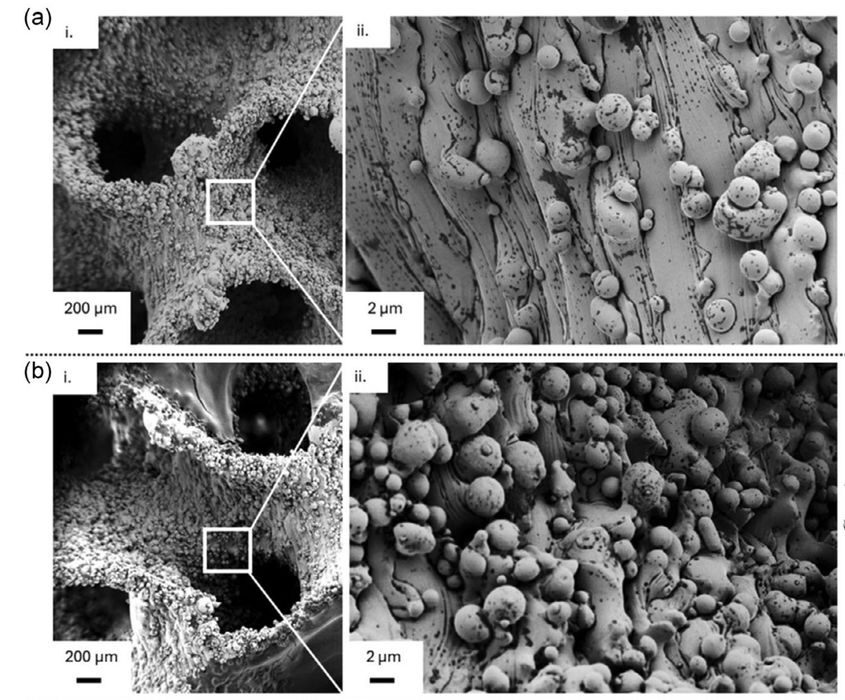
The answer turned out to be using 3D printing. The researchers designed a tiny gyroid structure — yes, it’s similar to the shape that’s often used as an infill pattern for FFF 3D printing. They found that the bacteria would easily stick to the curved and rough surfaces of the 3D printed gyroid. The bacteria would form an even biofilm over the entire surface.
The gyroid was 3D printed in 316L stainless steel using an LPBF process. It’s not clear exactly which machine was used, but several from EOS, Renishaw, Nikon SLM Solutions, Trumpf, and others are all capable of this level of detail.
Interestingly, this particular bacteria is shelf-stable. The bacteria can form spores that are dormant and able to survive rough conditions, including heat, cold, dryness, radiation, and even some chemical exposure.
In other words, we have a biofilm over the top of a 3D printed metal gyroid surface that awaits activation.
Activation is done by simply applying a nutrient solution to the battery. The spores then wake up and begin transforming the nutrients into electrons, which are carried through the metal gyroid.
The battery is designed to channel all the electrons to the collection point, and we have an operational battery supplying power on demand.
This is quite a development. It would mean that you could carry around a supply of “dry” batteries for future use, and then activate them whenever required.
All this is possible because of metal 3D printing.
Via Springer
