
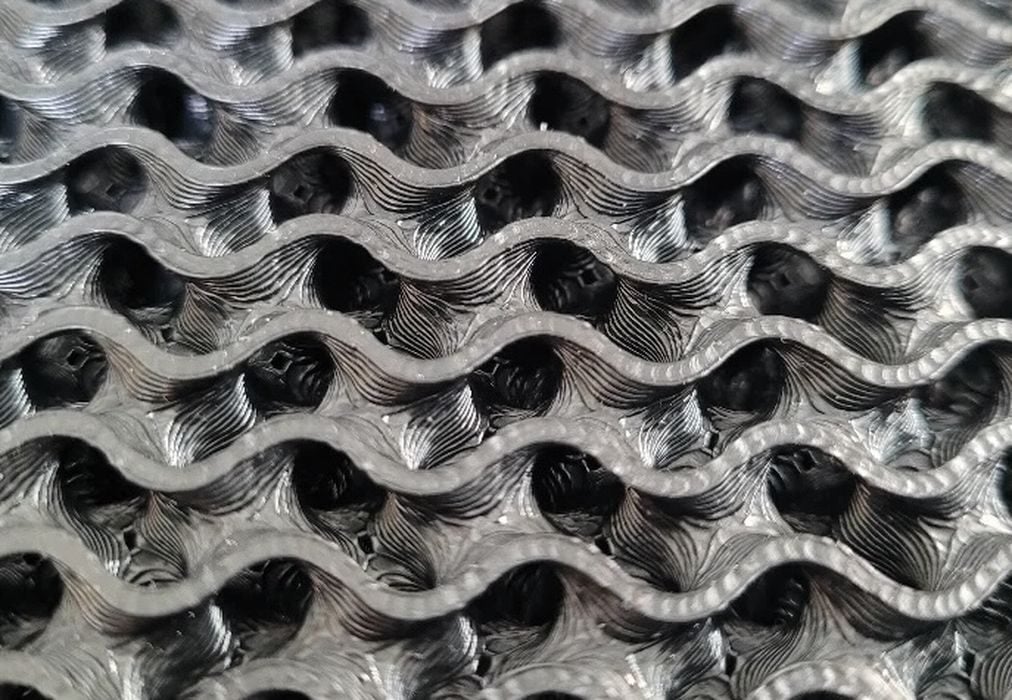
The gyroid infill pattern turns out to be the best infill pattern of them all.
Today’s FFF slicing software offers long lists of infill pattern options. It’s often hard to figure out which one is best for a particular application, and some will simply pick the one that prints the fastest (often rectilinear).
Gyroid is a pattern that is supposedly strong, but it tends to add quite a bit of time to print jobs. That’s because it requires the toolhead to make countless curved movements during infill printing. However, the curves do provide strength in most directions, hopefully making parts more isotropic.
Without knowing the real benefits of the gyroid pattern, many 3D printer operators simply don’t use it.
Researchers at the University of Maine decided to do an investigation of the unusual infill pattern to find out the truth.
They used a series of simulations to predict how gyroid patterns behave when compressed and twisted. They then 3D printed a number of test parts in PETG and Tough PLA in a range of infill densities to see if their predictions were valid.
They determined that simple strength estimation models don’t really work due to the geometric complexities of gyroids, and that more advanced simulations were necessary.
They found that gyroid strength increases with density, which makes sense. However, they found it does so in a predictable way.
Based on that, they developed a simple formula that lets you estimate how strong the gyroid infill will be at any density. This could be very useful for 3D design.
They also found their predictions matched real tests, based on evaluations of real parts, especially for lower and medium densities. High densities had more variation due to printing quirks.
The implications here are interesting.
First, part designers could more accurately predict the strength of those parts if using gyroid infill with specific densities.
Second, the estimation formulas are apparently simple enough to incorporate directly into slicing software. This means it might be possible for an operator to request a strength, and then the necessary gyroid density would be automatically determined.
I’m hoping slicing software developers catch on to this new method, and we’ll then see a new way of 3D printing strong parts.
Via Springer Nature
