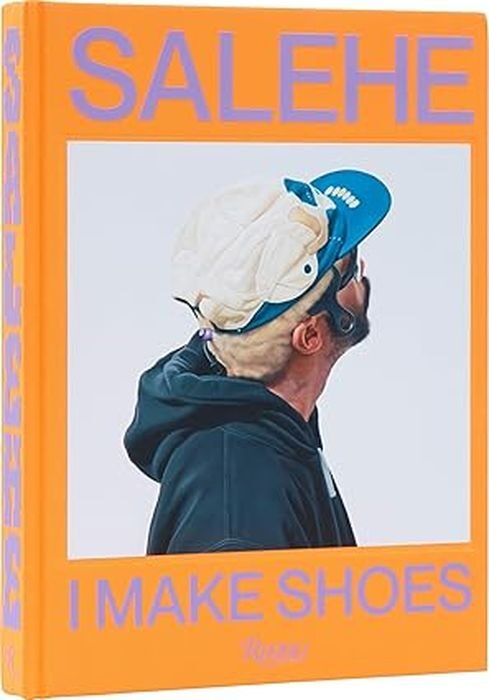
Charles R. Goulding provides commentary on the 3D printing relevance of Salehe Bembury’s new book, “I Make Shoes.”
I was fortunate to be among the first to purchase shoe designer Salehe Bembury’s new book, I Make Shoes. The title alone says it all — direct, confident, and true to his craft. But inside those pages is far more than a portfolio of footwear. The book is an immersive look at the evolution of modern shoe design through the lens of one of the industry’s most inventive minds.
Beyond the insight, I Make Shoes is also visually stunning. The photography is rich, the layout is deliberate, and the art direction feels like an extension of Salehe himself — bold, curious, and unapologetically original. Every image tells a story, every design has purpose. And for those of us who follow the intersection of design, technology, and 3D printing, the book offers a fascinating case study in how digital tools are reshaping creative workflows at the highest levels of product design.
Versace: Making a Statement in 3D
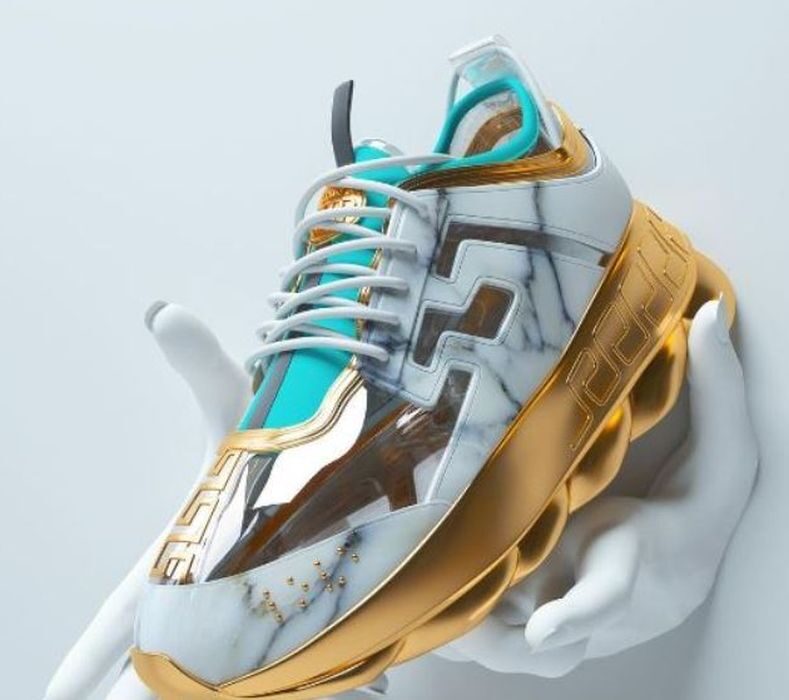
One of the book’s most striking chapters focuses on Salehe’s time at Versace, particularly a period he refers to as “Shoot Your Shot.” At that stage in his career, he was between opportunities, searching for a new creative spark. His “shot” turned out to be one that would redefine his trajectory — and highlight the power of 3D printing as a communication tool in design.
To make his case to Donatella Versace herself, Salehe didn’t rely on sketches or presentations. Instead, he showed up with a 3D printed model of his concept — a tangible prototype he could place directly in her hands.
“That model was what I presented to Donatella the first time I showed her my work as an employee,” he writes.
He goes on to note the key insight that has stuck with him ever since:
“The extreme advantage that 3D printing gives us is that instead of having to point to a piece of paper and talk through design, you can simply hand an object over to someone and say nothing at all.”
That’s the essence of why 3D printing has become indispensable to product development. It transforms ideas into objects instantly. For a design house like Versace — where craftsmanship and visual drama define everything — this immediacy allows designers to show, not tell, which can make all the difference.
Crocs Pollex: When Innovation Gets Playful
Few designs in recent footwear memory have captured attention quite like the Crocs Pollex Clog, Salehe’s now-iconic collaboration with Crocs. In I Make Shoes, he gives readers a rare look behind the scenes — not just the final product, but the process, experimentation, and creative freedom that led to it.
Salehe describes how he and his 3D modeler would “jam” on digital prototypes all day, riffing on ideas the way musicians jam on melodies. They experimented with perforation locations, airflow, and sculptural form — pushing 3D modeling tools to the limit.
When he finally saw the finished 3D model, he knew immediately he had something special. The Pollex went on to become a global sensation, redefining what Crocs could be and setting a new standard for collaboration-driven innovation.
From a 3D printing standpoint, the Pollex is a prime example of how digital fabrication enables both form and function. The shoe’s fingerprint-like ridges provide grip and structure, but also serve as a bold aesthetic signature. Prototyping those organic shapes would have been nearly impossible early on without the flexibility of additive manufacturing.
New Balance: Respecting Tradition, Embracing Technology
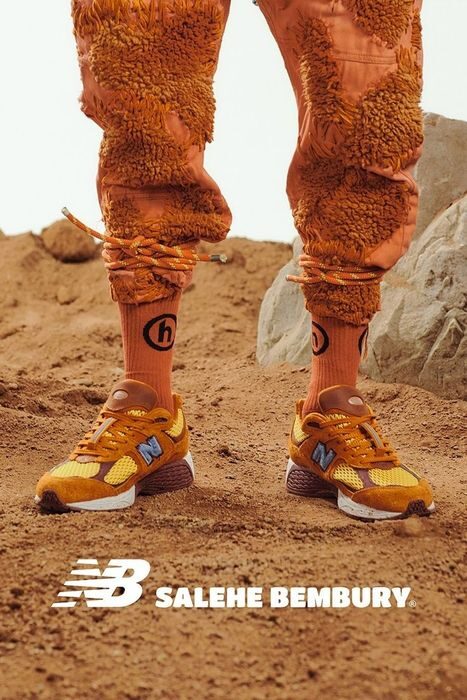
Among Salehe’s many partnerships, his work with New Balance stands out for its longevity and depth. The chapter dedicated to this collaboration is one of the most detailed in I Make Shoes, and it captures a balance between heritage craftsmanship and modern innovation.
Salehe, a New Yorker by upbringing, brings a distinctly urban sensibility to his designs. Yet many of his New Balance concepts draw from the outdoors — rugged, functional, and sculptural. His shoes merge the organic and the engineered, resulting in silhouettes that feel both grounded and futuristic.
We’ve covered New Balance’s 3D printing initiatives at length here at Fabbaloo — including their custom midsoles, performance optimization tools, and advanced manufacturing approaches [Fabbaloo]. Salehe’s work fits seamlessly within that framework. His respect for the brand’s legacy, combined with his forward-thinking design language, exemplifies how 3D design and traditional craft can coexist.
This collaboration also highlights how 3D printing allows designers to take inspiration from natural forms — ridges, textures, fluid geometries — and realize them quickly without being limited by conventional molds or tooling.
Cole Haan: The Foundations of Good Design
Before the collaborations with global brands and celebrity partnerships, Salehe’s early years at Cole Haan laid the foundation for his design philosophy. The opening pages of I Make Shoes feature Cole Haan sketches and breakdowns that double as a masterclass in shoe anatomy and functionality.
Here, Salehe focuses on the fundamentals: the physiology of the foot, the balance between support and flexibility, and the interplay between materials and motion. It’s an education in how good design starts with empathy — understanding how people move, walk, and experience the world through the soles of their feet.
Cole Haan was also an early adopter of digital design tools, experimenting with hybrid manufacturing long before 3D printing became mainstream. This early exposure helped Salehe develop a workflow that fluidly combines art, ergonomics, and technology — a combination that has become his signature.
The Bigger Picture: Art Meets Technology
Throughout I Make Shoes, Salehe connects his work with major brands like Nike, Adidas, and Vans — all companies we’ve featured on Fabbaloo for their pioneering use of additive manufacturing in footwear [Nike], [Adidas]. What’s remarkable is how naturally 3D printing fits into his design process. For Salehe, it’s not a novelty; it’s a language.
Each chapter reinforces a central idea: 3D printing isn’t about replacing the designer — it’s about amplifying creativity. The technology allows for experimentation, iteration, and storytelling at a speed and fidelity that hand sculpting or 2D sketching can’t match.
In many ways, Salehe represents the new generation of designers who treat digital fabrication as an intuitive extension of their thinking. His shoes look organic, almost natural — but they’re born from algorithms, scans, and print tests. That duality between human creativity and machine precision is the future of design.
The Research and Development Tax Credit
The now permanent Research and Development (R&D) Tax Credit is available for companies developing new or improved products, processes, and/or software. 3D printing can help boost a company’s R&D Tax Credits. Wages for technical employees creating, testing, and revising 3D-printed prototypes can be included as a percentage of the eligible time spent on the R&D Tax Credit. Similarly, when used as a method of improving a process, time spent integrating 3D printing hardware and software counts as an eligible activity. Lastly, when used for modeling and preproduction, the costs of filaments consumed during the development process may also be recovered.
Whether it is used for creating and testing prototypes or for final production, 3D printing is a great indicator that R&D Credit-eligible activities are taking place. Companies implementing this technology at any point should consider taking advantage of R&D Tax Credits.
If the Shoe Fits…
At Fabbaloo, we’ve explored countless examples of how 3D printing intersects with fashion, manufacturing, and art. But few stories capture the personal side of that evolution as vividly as Salehe Bembury’s I Make Shoes.
The book is more than a retrospective; it’s a manifesto for creative making in the 21st century. Salehe’s work shows what happens when a designer fully embraces technology — ideas move faster, collaboration becomes more fluid, and innovation becomes more accessible.
For anyone fascinated by how 3D printing empowers design, I Make Shoes is essential reading. It’s both a chronicle of one designer’s journey and a glimpse into the future of how we’ll all create — not just shoes, but everything that connects imagination to reality.