

The SALTGATOR is not a 3D printer, but it’s something 3D printer operators might consider.
What is it, then? It’s a simple desktop injection molding system for soft gel materials. 3D printer operators could 3D print molds that could be used with the SALTGATOR to produce quantities of parts. Injection molding is faster than 3D printing in most cases, and 3D printer operators could take advantage of this property.
It seems like a fairly straightforward device: it includes a heating core at the bottom that can be programmed to specific temperatures, and a plunger system above to push material through the heater to the mold.
Some materials don’t require heat, such as two-part epoxy resins. These are simply mixed, poured into the top of the SALTGATOR, and then pressed into the attached mold. They say this can all be done in only ten minutes.
The device is classed as a “low temperature injection molding system”, with a temperature range of 80-210C, and this includes soft gels.
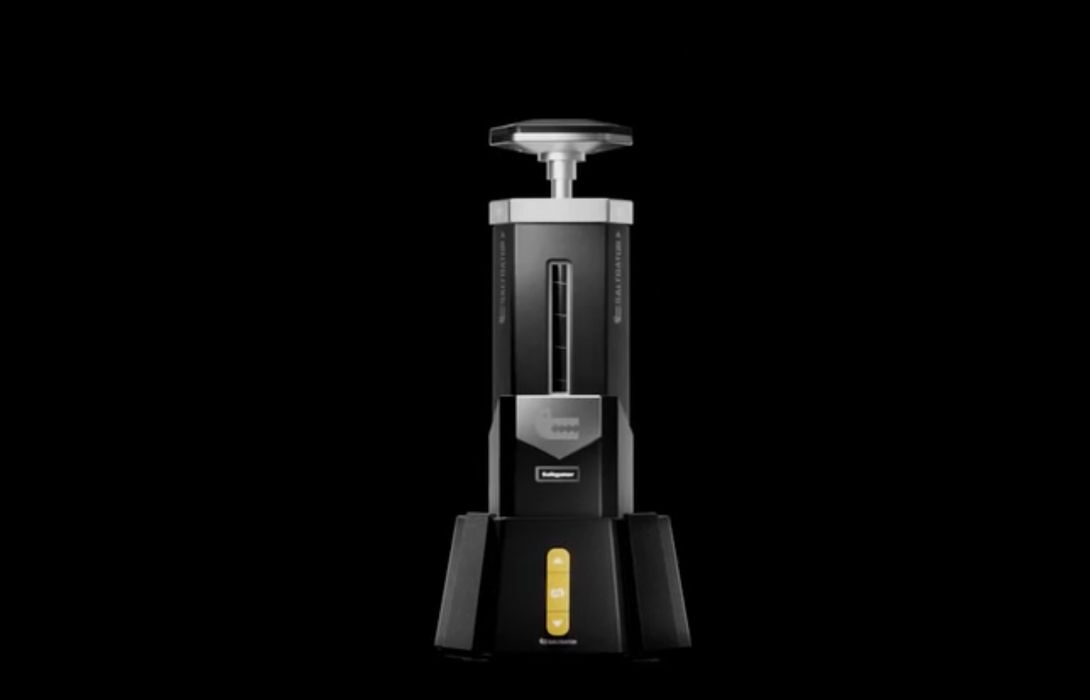
In their campaign video, you can see that it’s also possible to pull the plunger backwards to slurp up resin. The video also seems to show someone recycling old parts by melting them in a microwave and then re-injecting them to create new parts. I’m not sure how feasible that could be in real life, however.
How big is the build volume for the SALTGATOR? Well, that’s an interesting question because the volume is really determined by the mold itself. These can be 3D printed in PETG, ABS or many other 3D printed materials and can be of arbitrary sizes and shapes. I presume that if the volume of a part exceeds the capacity of the SALTGATOR’s plunger system, you’d just add some more material.
The device is on sale on Kickstarter right now, and seems to be gathering attention, as there is almost US$400,000 in pledges.
The launch early-bird price was as low as only US$229, and later prices rise up to US$299 per unit. There are volume discounts available.
Via Kickstarter
