
Researchers 3D printed bioinspired titanium lattices that absorb more energy and fail more gracefully than many prior designs.
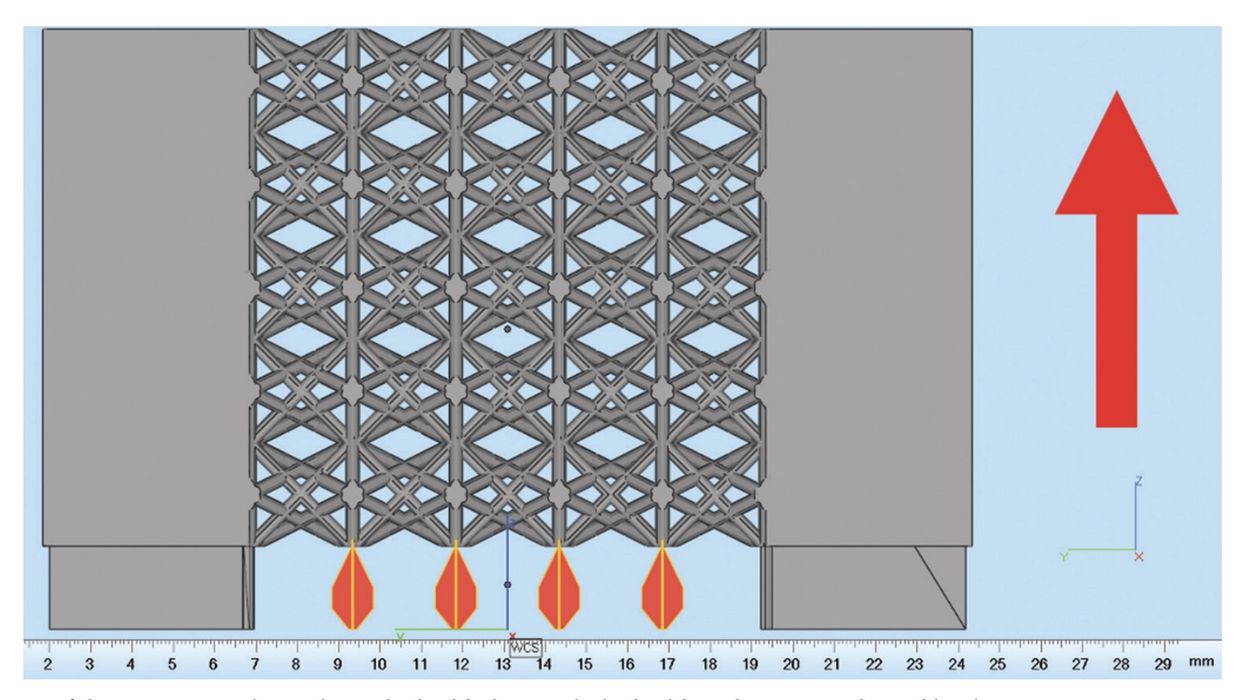
A team at Peter the Great St. Petersburg Polytechnic University fabricated two mechanical metamaterials in Ti6Al4V using Selective Laser Melting (SLM), measuring energy absorption under compression. One unit cell mirrored pomelo peel (S06), while the other traced the forewing microstructure of the Japanese rhinoceros beetle (S08) — two well-studied biological architectures famed for drop and impact protection. The lattices used two point five millimeter unit cells tiled into a five by five by five array, producing twelve point five millimeter cubes with a modeled porosity of eighty percent.
Built on a 3DLAM Mini SLM system with a 150W IPG laser, 0.03mm layers and 0.12mm hatch spacing, parts were oriented horizontally and heat treated at 1050C for two hours. The team paired finite element modeling in ANSYS with lab testing to validate stiffness, yield and compressive strength, and then integrated force–stroke data to calculate energy absorption (EA) and specific energy absorption (SEA).
The beetle-inspired S08 outperformed the pomelo-like S06 in most mechanical metrics and failed more gracefully. Under compression, S08 reached an average conditional compressive strength of 134 MPa and a conditional yield of 111 MPa, versus 115.87 MPa and 102.2 MPa for S06. S08 also sustained about nine percent strain before failure, more than double S06, and its stress–strain curves showed a gradual post-peak descent.
Energy absorption results were rate dependent. Under quasi-static loading, S08 delivered 13.83 J per sample with 4.61 J/g SEA, notably higher than S06 at 7.24 J and 2.72 J/g. Under dynamic compression at 0.7 m/s, S06 showed 7.85 J and 2.95 J/g SEA, topping S08 at 5.24 J and 1.74 J/g. The researchers attribute S08’s quasi-static advantage to its progressive cell-base failure path, while S06 exhibited a sharper break along a forty five degree band through cell centers.
A key manufacturing detail was surfaced: actual porosity dropped to 72.38 percent (S06) and 68.53 percent (S08) due to powder adhesion and remelting, which thickened struts and produced teardrop cross sections, especially on inclined members. That explains why simulations at the nominal eighty percent porosity underpredicted stiffness and strength, yet matched closely when compared to simulated seventy percent porosity.
From Research To Bumper
For automotive, aerospace and defense teams looking for lightweight energy absorbers, the beetle topology’s higher quasi-static SEA and more controlled failure are quite promising. The absolute SEA values are in family with other Ti6Al4V lattices in the literature and below some steel lattices that exploit larger cells and delocalized deformation, but titanium’s strength-to-weight and corrosion resistance may justify the choice in weight-critical or harsh environments.
However, throughput is not stated, but the small build cylinder (ninety millimeters diameter by one hundred millimeters height) and horizontal orientation suggest limited part size and potential support interactions. Post-processing stopped at a high-temperature anneal; hot isostatic pressing could refine strut integrity but adds cost. Rate sensitivity needs broader mapping, as S08’s dynamic SEA lagged its quasi-static performance. Fatigue, temperature effects, and crash pulse shaping also remain open.
The methodology is the most interesting part. By bracketing simulation across porosity bands and then measuring as-built porosity and strut thickness, the team built a workable loop to predict properties despite LPBF thickening. Design-for-AM steps like filleting cell bases to diffuse stresses, intentional gradient porosity, or parameter tuning to counter teardrop growth should raise SEA further. A scaled study with larger tiles, varied orientations and HIP would make the case stronger for service bureaus and OEM crash labs.
