
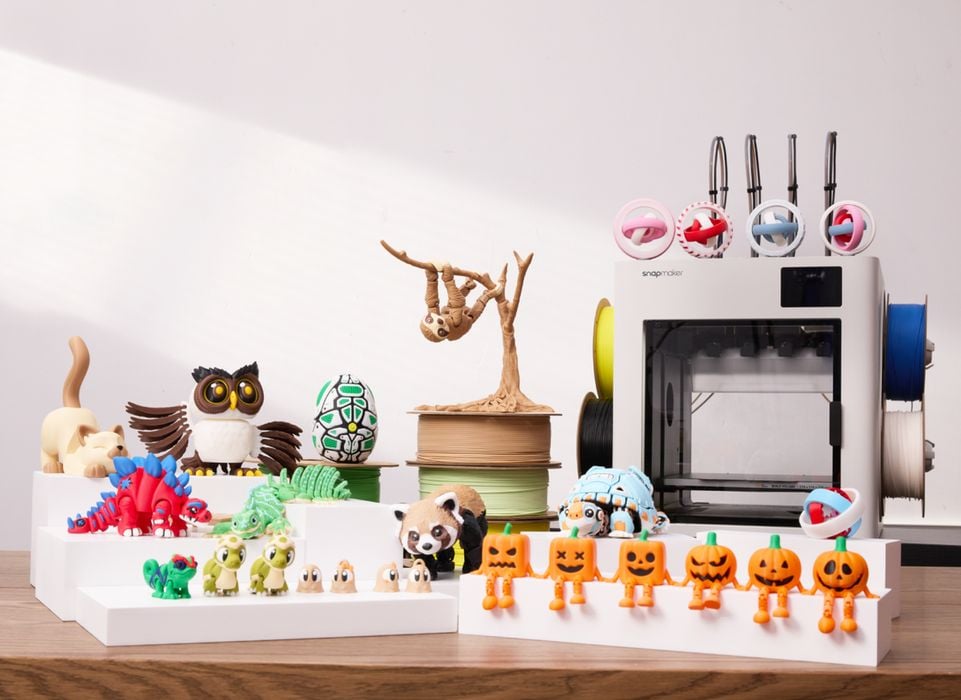
Snapmaker is improving its U1 with more availability, a software bundle of ready-to-print models, and a bigger RFID-enabled filament lineup.
In a brief update posted last week, the company described the Snapmaker U1 as moving into its “next phase” after early momentum from its user community. The changes are not a single breakthrough feature, but a coordinated set of moves that aim to reduce setup friction for new owners and keep existing users engaged with fresh content.
The most concrete shift is simply product availability. Snapmaker says the U1 will be “in stock across all of our global warehouses” by April 10, 2026, which should translate into faster delivery and fewer region-specific purchasing hurdles. The company also confirmed a price change on that date: the pre-order price of US$849 or EUR 849 ends April 10, moving to a regular price of US$899 or EUR 899.
This kind of transition is common for prosumer desktop systems that start with an early-bird push and then later on settle into retail price levels. What matters for buyers is timing: if Snapmaker hits worldwide stock as promised, a U1 order likely won’t suffer from delays.
Software And Content Move Closer Together
Snapmaker also says it is rolling out a software update on March 24 for Snapmaker Orca and the Snapmaker App. The company describes performance improvements and bug fixes, but the more interesting addition is content: thirty “high-quality, print-ready models” built into the software.
Bundled models are not new in consumer 3D printing, but they are usually sample files that show off a printer rather than a curated library tuned for reliable output. Snapmaker claims these models are “finely tuned,” “expertly tested,” and ready to print out of the box, with contributions from community designers, Snapmaker’s own team, and new creators it wants users to discover. While they don’t explicitly say, it is likely these models highly leverage the U1’s multimaterial capabilities.
Instead of sending users to hunt for STL files, profiles, and settings across multiple sites, Snapmaker is trying to pull the first successful prints into a single workflow. That “mini model repository” concept could help reduce support load, too, because Snapmaker can control the combination of geometry, slicing presets, and printer assumptions for those included jobs. It should result in a far more interesting initial experience than just “printing a #3DBenchy”.
RFID Filament Colors And A Platform Pitch
On the materials side, Snapmaker says it is adding fifteen new RFID-enabled filament colors spanning SnapSpeed PLA and Matte PLA, available now with shipping “almost immediately.” RFID-enabled spools try to lower user error by helping the machine identify material type and sometimes suggested parameters, and color expansion is a practical way to make multicolor and multi-material workflows more appealing for everyday users.
3D printer hardware is increasingly becoming the “base layer” in desktop 3D printing, while differentiation shifts to the ecosystem: curated content, integrated slicing, guided material handling, and accessories that keep owners buying into the same workflow. Snapmaker is explicitly tying together hardware, software, materials, and creators, and signaling that U1 will be updated continuously through 2026 with more models, materials, and accessories.
The key question is whether Snapmaker can keep the experience cohesive as it expands. A small embedded model library is quite helpful, but it must stay current, print reliably across firmware revisions, and avoid becoming bloat. If Snapmaker can manage that, the U1 could become an even more popular machine purchase.
Via Snapmaker
