
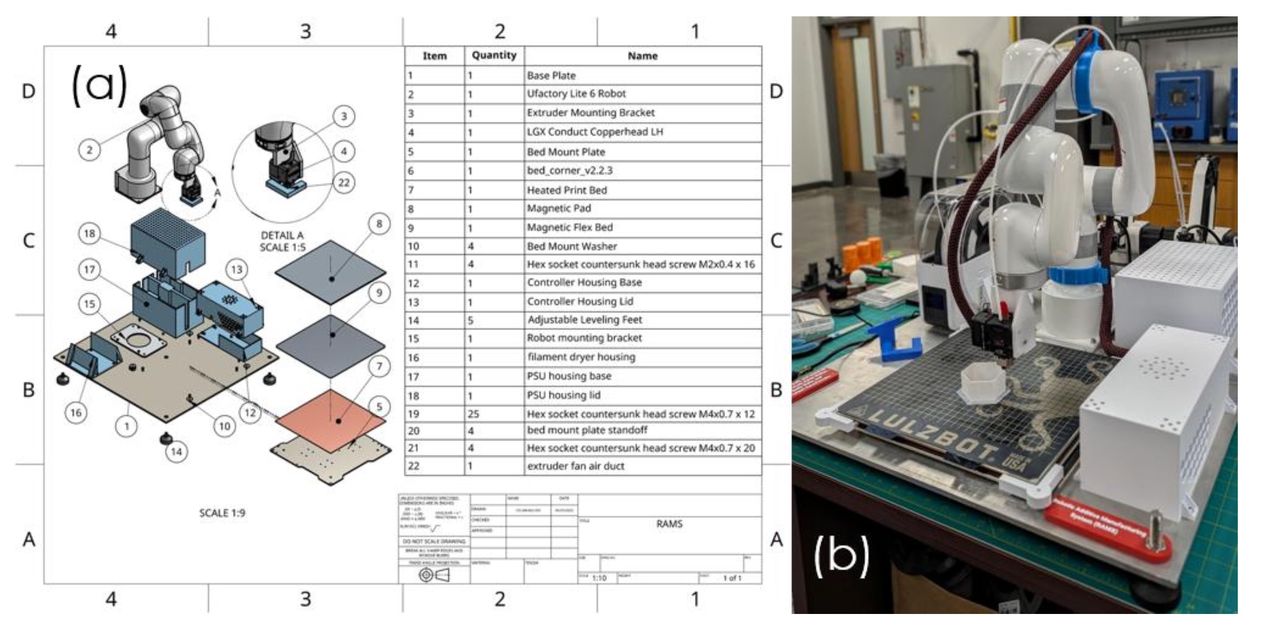
Researchers at Southeastern Louisiana University demonstrated a six axis robotic FFF approach that uses non planar slicing and five axis paths to print support free parts.
Non Planar, Multi Axis FFF
FFF has always required planar slicing and single axis motion, which works, while also leaving those ugly staircase artifacts on curved top surfaces. FFF also is not particularly efficient when printing complex geometries, since curves are transformed into tediously-printed layers. Those things add up and hurt, especially in applications where every gram and watt of power matters, including in space — something that would be of interest to NASA’s In Space Manufacturing efforts. Multi axis deposition and non planar toolpaths should reduce supports, improve surface quality, and align the extrusion orientation with local geometry for much stronger parts.
While industrial robotics already enables large format, multi axis polymer extrusion, commercial non planar path planning for desktop scale FFF remains pretty rare. Most users still export 2D layers from slicers like UltiMaker Cura or PrusaSlicer. This research steps into this gap with a research grade Robotic Additive Manufacturing System (RAMS) that can print complex geometries without requiring support structures.
Inside The Robotic Workflow
The research team integrated a six degree of freedom UFACTORY xArm 850 with an extrusion end effector and heated build plate, then generated toolpaths using a custom nonplanar slicing algorithm built in Rhinoceros and Grasshopper.
Instead of sliced layers, the workflow produces point to point robotic sequences that set extrusion start and stop, vary layer height, and control nozzle orientation relative to the surface. GCODE is exported as text and executed in xArm Studio, where each sequence can be previewed.
Extrusion is synchronized via a separate Python script over GPIO, a which separates robot motion from filament flow. For comparison, the same part configuration is also sliced in Cura using conventional planar parameters to compare build time, support material required, and surface finish. Structured light 3D scanning is done to determine dimensional deviation, and digital microscopy for surface roughness — is done to measure the differences between planar and nonplanar prints.
The RAMS system uses the extra axes to keep the nozzle tangent to the current curvature, bridge local overhangs by reorienting the tool, and reduce the visible steps that would otherwise be visible if printing flat layers. They report successful three axis proofs of concept and initial four and five axis demonstrations that maintain wall consistency, with minor artifacts traceable to flow calibration, speed matching, and cooling — which is expected given this new workflow.
Early Results And Open Questions
Preliminary outcomes in the study show reduced support material usage, shorter build times, and improved surface appearance on curved features when compared to planar slicing, which all makes much sense. However, the paper does not publish the numbers for time saved, grams avoided, or several other improvements. Throughput, build volume, layer thickness, material class, and print speeds are also not specified, which makes it hard to benchmark against advanced planar FFF systems from manufacturers like Bambu or Prusa Research.
The current workflow is intentionally manual to preserve control over robot movements and avoid collisions, but that absolutely increases operator efforts. Automated collision checking, reachability analysis, and closed loop sensing would obviously be necessary if this concept ever reaches production use. Synchronizing the extrusion using GPIO is “OK” for research, but an integrated controller would clearly be better.
If this concept moves forward, any operators looking for smooth surfaces that don’t require post processing, specialty materials with orientation sensitive properties, and in-space manufacturing where support waste is unacceptable. All of this would reuqire better software packaging — like a slicer that generates robot aware GCODE with built in collision avoidance — plus a library of tested motion strategies for common nonplanar scenarios.
This seems to be a decent step toward routine conformal FFF, but, as this is at the research level there is still a lot of work yet to do.
Via OpenAlex
