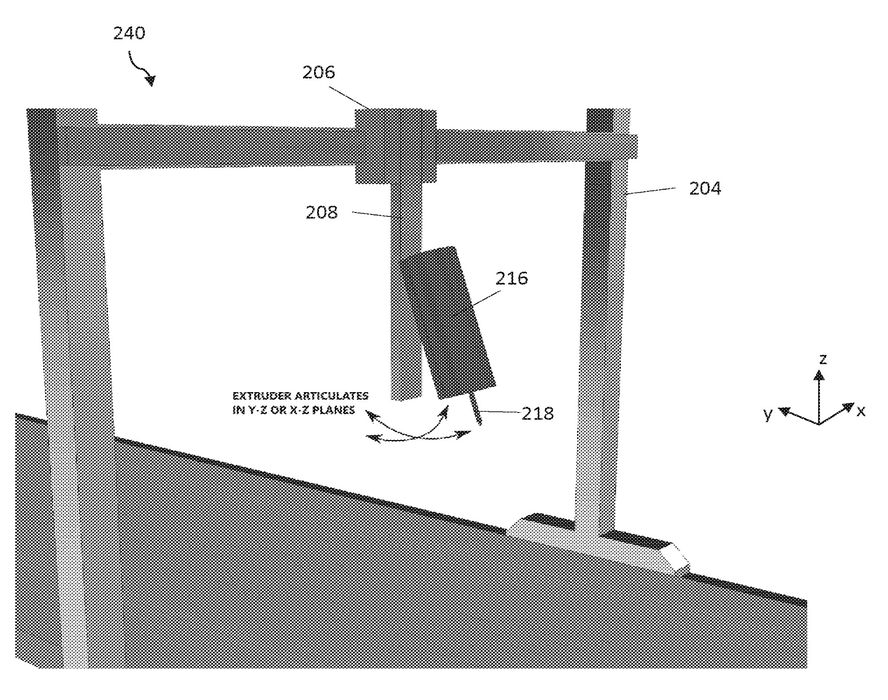
Tilting a 3D printer’s build plate to eliminate supports is hardly a new idea.
In fact, we wrote about precisely that concept back in 2017, when Polish manufacturer VSHAPER demonstrated an experimental five-axis 3D printer at Formnext. The machine could tilt its build plate while coordinating movements with a robotic extruder, allowing objects to be printed without conventional support structures.
The idea goes back even further. A patent application filed by Disney Enterprises in 2014, US20160067740A1, specifically described tilting a build plate during extrusion to handle overhangs without supports.
So I was a little surprised to encounter US20260295937A1, a newly published patent application from the University of Maine describing something remarkably similar.
What’s going on here?
It turns out there’s some history. The application belongs to a patent family dating back to 2018, and Maine has already received patents covering aspects of what it calls non-orthogonal additive manufacturing. The October 2026 publication seems to be a continuation of that patent.
The general concept involves changing the printing plane during material extrusion. In a conventional FFF printer, layers are deposited horizontally, and overhangs eventually require support structures.
By tilting the nozzle or receiving surface, the machine can deposit material against previously printed sections that would otherwise be unsupported. Maine describes articulated extruders, movable beds, and even belt-like receiving surfaces.
None of those concepts is particularly revolutionary by itself. However, Maine’s application includes another idea that I find considerably more interesting: They propose using the printing angle to control layer time.
Consider a large-format extrusion printer producing a massive composite tool. Each layer must be completed within an appropriate thermal window. If the layer takes too long, previously deposited material may cool excessively before the next layer arrives, compromising adhesion. If it’s too short, the material underneath may remain too soft.
Maine’s approach calculates acceptable minimum and maximum layer times using parameters including print speed, cross-sectional area, extrusion width, melt temperature, and glass transition temperature.
The machine can then select a different printing angle, changing the cross-sectional area and consequently the time required to complete each layer. That’s a pretty interesting use of an additional motion axis. The printing angle becomes another process control variable!
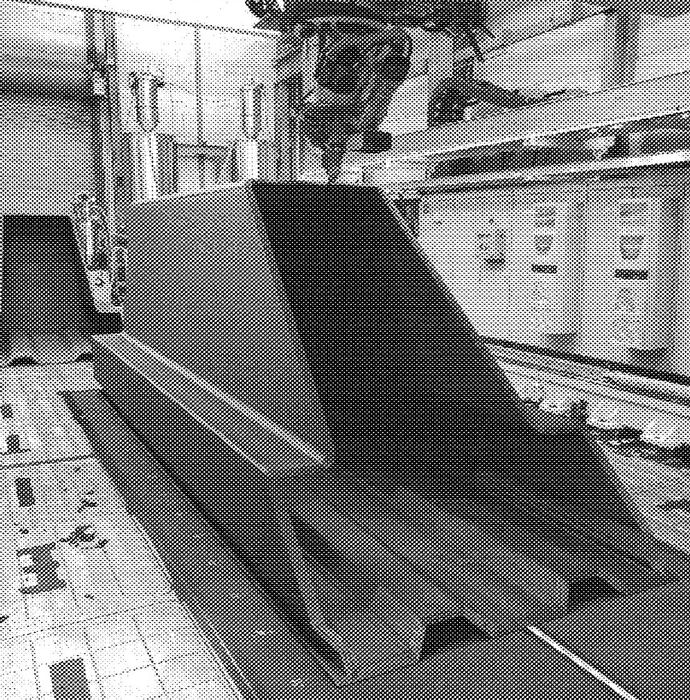
The patent provides a notable example involving a composite tool mold measuring 23 feet long, six feet tall, and five feet wide.
According to the patent, conventional horizontal printing would require approximately 147 hours and 9,574 lb of material, including supports.
Reorienting the part reduces the simulated build time to 80 hours, although the tool must be divided into four pieces. A 45-degree printing angle reportedly permits a single-piece build in just 72 hours, using 4,223 lb of material. These are simulations, not actual production results, but the potential savings seems interesting.
They also describe extending printed objects beyond the machine’s normal build volume and incorporating machining operations. Again, neither concept is entirely new, but integrating these capabilities with angled deposition and thermal optimization could be useful for industrial tooling.
There’s still an obvious patent question.
Five-axis printing, tilting build platforms, and support-free deposition were demonstrated before Maine’s original filing. The university’s claims therefore deserve examination against that earlier work. An existing patent grant doesn’t necessarily establish that every proposed feature is novel, and the latest application has not yet been granted.
The strongest technical argument appears to involve particular combinations of hardware and process control, especially the relationship between printing orientation and thermal behavior.
Whether those combinations are sufficiently inventive to justify additional patent protection remains to be determined, and we will have to wait for USPTO to make a decision.
Meanwhile, I suspect the bigger challenge is how to make all of this work reliably. Coordinating many-axis hardware, extrusion conditions, changing layer orientations, and thermal constraints on a 23-foot tool is way more complicated than tilting a small desktop print.
Via Espacenet