
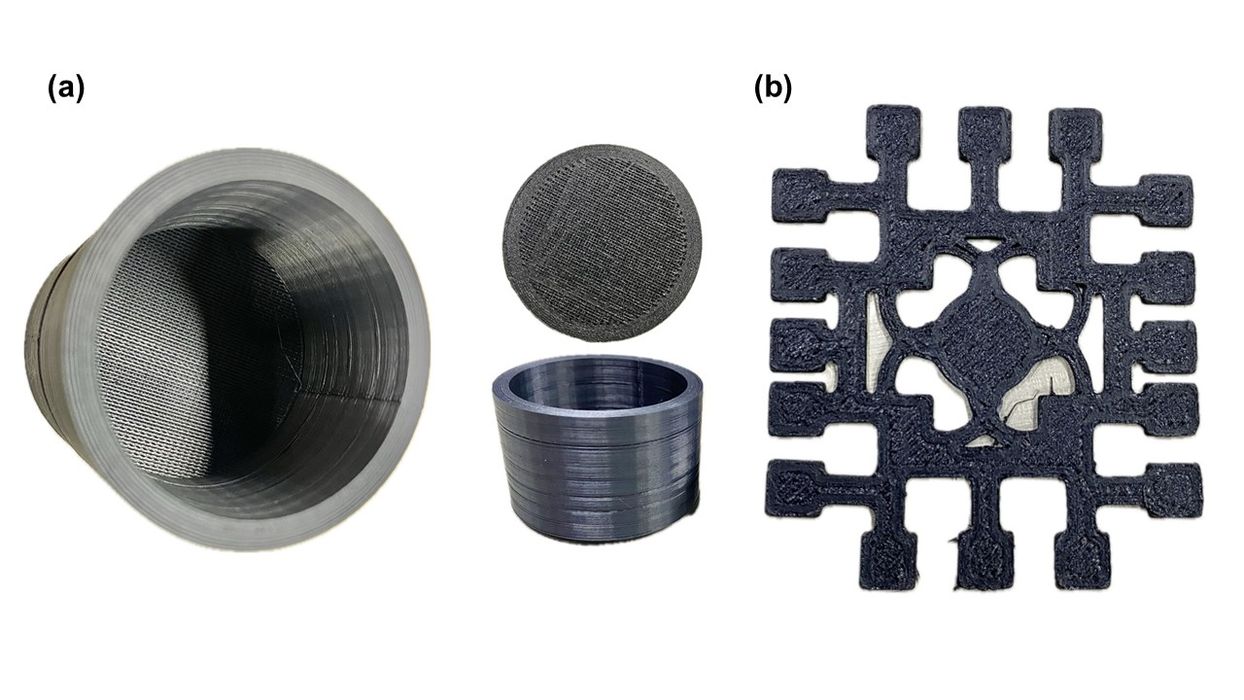
A new materials study examines activated carbon and magnesium oxide as additives in FFF filaments, with implications for thermal stability, strength, and durability.
Composite filaments are now routine in additive manufacturing, with carbon fiber, glass fiber, talc, and ceramic fillers used to tune stiffness, heat resistance, and printability. Activated carbon and magnesium oxide are less common in consumer and prosumer filaments, but both have attractive characteristics: activated carbon is highly porous and conductive enough to influence heat flow and UV absorption, while magnesium oxide is a basic ceramic that can act as a nucleating agent and thermal stabilizer.
The paper focuses on how these two additives affect the thermal, mechanical, and degradation profiles of an extruded filament, which directly maps to print behavior and part lifespan. Thermal analysis such as differential scanning calorimetry and thermogravimetric analysis typically reveals shifts in glass transition, crystallization kinetics, and oxidative onset. Mechanical testing highlights tradeoffs between modulus, tensile strength, and elongation. Degradation studies under heat, UV, or humidity stress point to how parts age on the shelf and in service.
The authors do not disclose all parameters in the abstract-level sources available here, including exact polymer matrix, filler loading, or processing settings, so readers should treat mechanism discussion below as general context rather than a summary of reported values.
Why These Additives Matter For AM
Compared to chopped carbon fiber, activated carbon primarily brings surface chemistry and light absorption rather than high aspect ratio reinforcement. In FFF, that can promote better heat distribution through the bead, potentially smoothing layer fusion, while also darkening the material to reduce internal light scattering and UV-driven degradation. The downside is that porous carbon can adsorb moisture and residual monomers, which may increase voids or cause oozing unless the filament is thoroughly dried.
Magnesium oxide, a ceramic with high thermal conductivity and basicity, often serves as a nucleating agent in semicrystalline polymers. In PLA or nylon, improved nucleation can raise crystallinity at a given cooling rate, stiffening parts and pushing heat deflection temperature higher. MgO can also scavenge acidic species that catalyze chain scission, slowing thermal or oxidative degradation. However, larger or poorly dispersed particles may create stress concentrators that reduce impact strength and interlayer adhesion.
Printability, Throughput, And Tradeoffs
On the process side, both additives will alter melt rheology. Increased viscosity improves shape retention for bridging and overhangs, but it demands higher nozzle temperature and may limit speed and retraction performance on Bowden systems. Abrasion is another constraint: while activated carbon is less aggressive than glass or carbon fiber, ceramic fillers such as MgO can wear brass nozzles over time, making hardened or ruby tips a sensible choice for consistent extrusion.
From a cost and throughput perspective, any additive that improves dimensional stability can reduce failed prints and post processing rework, particularly in print farms and service bureaus. If MgO accelerates crystallization, users might achieve higher build rates with faster cooling on semicrystalline materials. If activated carbon moderates thermal gradients, it may reduce warping on larger parts, expanding usable build volume without enclosures. The flip side is tighter drying protocols and controlled storage to prevent moisture pickup, along with dialed in slicer profiles to preserve interlayer adhesion.
Applications that benefit most include functional end use components that see moderate heat, sunlight, or chemical exposure — think fixtures, small automotive cabin parts, or housings near electronics. Education and labs could also use such filaments to explore property tuning without moving to fiber reinforcement, keeping print parameters within accessible ranges for desktop FFF.
The open questions are the ones that determine real world adoption: exact filler loadings, particle size distribution, dispersion quality, and quantitative deltas in modulus, elongation, heat deflection temperature, and mass loss under accelerated aging. It will also matter whether the formulation targets PLA, PETG, ABS, or nylon, as each responds differently to nucleation and UV absorption. Clear reporting of layer adhesion metrics and surface finish outcomes would help practitioners translate lab data into slicer settings and nozzle choices.
If follow on data shows meaningful gains with modest tradeoffs — for example, single digit percent reductions in elongation for double digit improvements in heat stability — filament makers could productize carbon and MgO blends quickly. Service providers will watch for consistent batch quality and the need for hardened hot ends. In the meantime, this work adds welcome nuance to the composite toolbox beyond the usual fibers and talc.
Maybe a better way to make prints last longer is not more fiber, but just the right dash of carbon and a pinch of oxide.
