
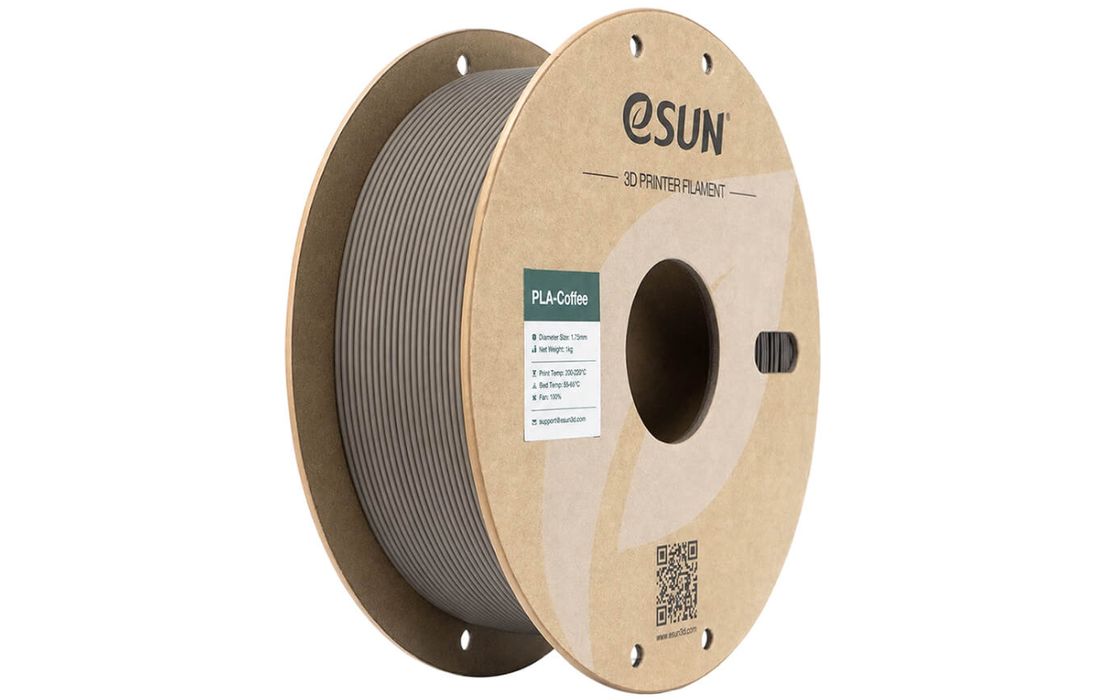
eSUN announced a bizarre 3D printing filament: PLA-Coffee.
I was quite surprised to see this announcement last week, as I had thought this type of material had gone out of fashion.
Perhaps I should do some catch-up here: there’s a bit of a history around filament marketing. Originally over a decade ago, the filaments you’d find available were PLA, ABS, and sometimes PETG. Most of it was of very poor quality and with limited colours. In fact, the primary differentiation between products was simply the colour.
Then a strange practice started, where vendors would announce composite materials made of (usually) PLA and a familiar substance. Typically, you’d see filaments made from wood, walnut shells, bamboo fibres, coconut, and more. I recall seeing more than one “coffee” filament, which were said to smell great when printing. The usual play was to proclaim that the filament was doing the environment some good by using up some otherwise waste material.
The most outrageous filament to emerge during this period was the infamous Algae filament. It printed quite well and had a very nice pastel green shade — but it emitted a horrifying swamp-like odour while printing.
Fortunately, that phase of filament marketing soon ended, as the industry moved on to a more important competition factor: quality.
We then saw vendors touting their diameter tolerances and other quality metrics, since previous filaments were really quite terrible. As machines became more precise, the material had to follow, and that’s exactly what the industry did. Prusament might have been the champion at that time as they went so far as to publish digital records of each spool’s production data.
Today, we see that quality metrics have effectively become an expectation for any filament, and now competition revolves around material type. This is because of an increased demand for different engineering properties. Today, we have choices of different types of TPU, for example, whereas years ago it was just “TPU”, or worse, “flexible filament”.
That’s where we are today.
And then eSUN announces “PLA-Coffee”. They explain:
“PLA-Coffee is a 3D printing material made with natural coffee grounds — a renewable, sustainable choice. It offers easy printing, a smooth surface finish, well-defined layer lines, and a balanced combination of strength, stiffness, and toughness. Blending sustainability with practicality, it is an ideal choice for eco-conscious makers and is suitable for concept models and rapid prototyping.”
For a moment I thought I was back in 2015.
I’m quite sure that PLA-Coffee prints very well, and it probably smells wonderful during printing. Oh, actually, it does:
”Natural Fine Texture Immersive Coffee Aroma Experience: Fine textured surface with a non-reflective finish and smooth touch. Releases a mild coffee aroma during printing, creating a warm and immersive 3D printing experience.”
I’m not sure where eSUN is going with this approach. Are they re-exploring a lost niche in filament marketing? Will this suddenly cause a new wave of coconut, bamboo, sawdust, beet, and eggplant filaments?
Via eSUN
