
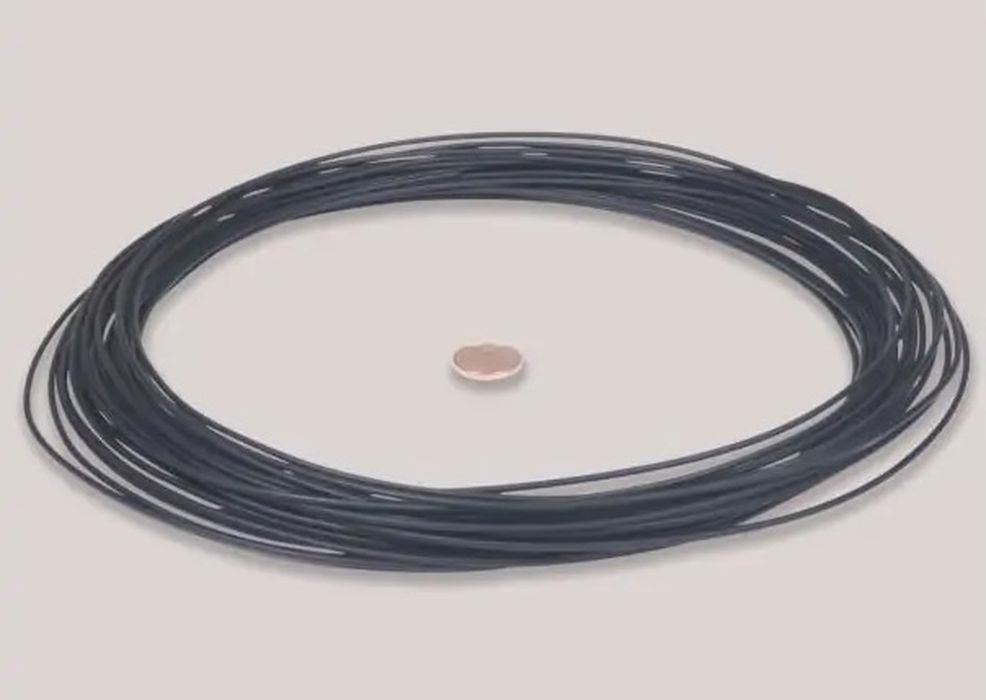
Telemeter Electronic is pushing electromagnetic absorber design into everyday FFF with a new filament tuned for automotive radar frequencies.
As vehicles add more radar and higher frequency sensor packages, labs and integrators keep running into the same practical problem: absorber parts rarely fit the geometry they actually need. Traditional absorber foam and machined fixtures work, but they are often bulky, slow to iterate, and awkward around complex housings and tight measurement setups.
Additive manufacturing has been working on this problem for years, mostly through custom fixtures, housings, and antenna mounts produced on desktop machines. The missing piece has been material performance: common polymers can form the shape, but they do not really dampen electromagnetic energy in the right bands.
Telemeter’s answer is a new 1.75 mm filament, described as a 3D printable absorber targeting the 76 to 81 GHz automotive radar band, while also covering millimeter wave applications from 50 to 100 GHz. That range reaches into the E to W band region used in specialized sensing, research, and advanced RF test setups.
The company explains that the material is straightforward to print on common FFF systems, without requiring any special modifications. Typical parameters listed include a 230C nozzle temperature, a 60C heated bed, and a rather slow 45 mm/s print speed, which is quite similar to regular PLA filament.
Design Freedom Is The Real Product
The main feature is not just the absorption of radio waves, but instead it’s the ability to tune absorber behaviour by geometry. Telemeter says designers can adjust reflection and transmission damping through choices such as shape, wall thickness, and density, effectively turning slicer settings into part of the RF design.
In practice, that points to absorber forms that are hard to find on the shelf but are easy to print: pyramid arrays, honeycomb-like lattices, or custom cavities that sit close to antennas and sensors. The company specifically mentions use cases like resonant cavities, shielding, antenna decoupling, and radar and sensor systems.
Whenever a filament claims electromagnetic damping, the key question is “how much, and under what test conditions?” The announcement does not include the kind of plots RF engineers will want, such as frequency response curves or clear test methods describing sample thickness, surface finish, and measurement setup.
There is also a practical deployment question. Because this material is PLA-based, it might be better used as a prototyping and lab fixture material rather than a long-term under-hood component where it would have to endure thermal and mechanical stresses. However, many absorber parts live in test environments, calibration rigs, and measurement enclosures where fast iteration matters more than heat soak durability.
If Telemeter’s damping claims are real and practical, this could become a useful tool for any shop doing radar validation, sensor integration, or antenna work where fixtures constantly change. It is easy to imagine manufacturers producing custom absorber inserts alongside housings and brackets, bundling RF tuning and mechanical integration into one iteration loop.
The company did not provide pricing, spool sizes, colour options, or regional distribution information, and those basics will influence whether this new PLA becomes a niche lab material or something that quietly spreads across automotive engineering teams.
For many years, “functional” filaments meant strength, temperature resistance, or conductivity, and even those often came with tradeoffs. Materials that directly target high-frequency electromagnetic behavior are a different kind of function: they turn a desktop printer into part of an RF workflow, not just a mechanical one.
That could change if this interesting material catches on.
Via Telemeter (Hat tip to Benjamin)
