
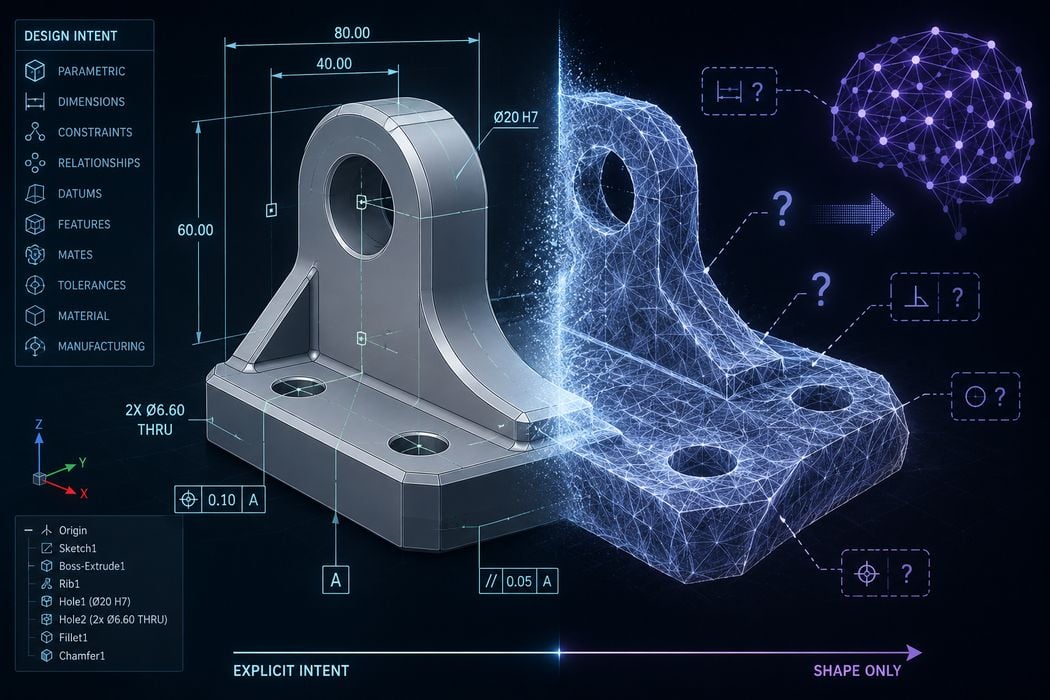
Text-to-CAD tools are beginning to generate useful 3D models from prompts, but the most important missing feature is not geometry — it is intent.
There has been a lot of development around AI-generated 3D models. Some of that work is really text-to-mesh, which might be useful for games, visualization, or concept art — plastic dragons. That is definitely not the same as a true 3D CAD model for a part.
CAD is different because it is not just the shape. A real CAD model carries intent: which dimensions are important, which features relate to other features, how a part would be assembled, and whether the geometry can actually be manufactured using a specific process.
That’s the part where today’s AI generative 3D systems have trouble.
The most practical approach developed so far is not direct “magic” CAD generation. It is a step-by-step approach: an AI system writes a CAD script in a language such as OpenSCAD, CadQuery, FeatureScript, or KCL, and then that code is processed into a true 3D CAD model.
This approach can work surprisingly well for simple 3D printed parts. Think of brackets, boxes, jigs, knobs, adapters, fixtures, and enclosures. These are often parametric objects with relatively simple rules. Give the system some dimensions, hole spacing, wall thickness, etc., and it can sometimes produce something useful. Sometimes.
But there is a big issue here: “useful” is not the same as “correct”.
From Shape To Intent
OpenSCAD has become a common platform for this because it is already text-based and familiar to many in the desktop 3D printing world. CadQuery is another attractive approach because it uses Python and can produce more engineering-friendly results including STEP files.
There are also more integrated efforts. Zoo.dev, previously associated with KittyCAD, appears to be one of the most advanced attempts at a true AI-native CAD workflow. Its approach combines conversational prompting, a CAD scripting language, a geometry engine, and B-rep output rather than just generating a simple mesh.
Meshes are fine for many 3D printing workflows, but they are not editable, and that’s something almost always required for a part design. A STEP file or feature-driven model is far more useful if you want to revise the part, send it into an existing CAD/CAM workflow, etc.
Meanwhile, the large CAD vendors seem to be moving cautiously. Autodesk has presented some experimental generative AI work, including models that can create 3D forms from text or images, while Fusion already has mature generative design tools that can include manufacturing constraints. Onshape is interesting because FeatureScript provides a structured CAD language that an AI system could possibly target. Siemens NX and SOLIDWORKS are also adding AI assistance, but mostly around workflow help, selection, search, mates, sketches, documentation, and repetitive tasks.
The fact that major CAD companies are not rushing to promise autonomous mechanical design is interesting. They know that the hard part is not creating the shape. The hard part is creating a dependable, editable engineering model that matches the original design intent.
Manufacturing Changes the Answer
A good part for production with FFF is usually not a good part for production with SLA, SLS, CNC machining, sheet metal, casting, or injection molding.
For example, an FFF enclosure might need split orientation, chamfers instead of steep unsupported overhangs, wall thickness related to nozzle width, etc. An injection molded version of the same enclosure needs draft angles, ribs, uniform wall thickness, sprues, etc. These are totally different requirements, all dependent on the manufacturing process chosen.
This is where prompt-based CAD becomes tricky. A user can write, “Design this for FFF with a 0.4mm nozzle, no supports, M3 heat-set inserts, and 0.2mm clearance.” That may help. But the generative system is still being led around the manufacturing process by hand, so to speak.
In this example, the generative system is not choosing the best process, finding the weak points, or asking whether the design should be split into multiple parts. Those are things a human designer might ask.
In other words, current text-to-CAD systems can sometimes follow manufacturing instructions, but they do not yet behave like experienced manufacturing engineers.
Academic work is moving in the right direction. Recent research efforts focus on generating editable CAD histories, CadQuery scripts, FeatureScript models, and systems that use solvers or geometric validation to check whether the result matches the request. That is important because it moves the field away from “pretty 3D object” and toward “editable, constrained, reusable CAD”.
The most advanced practical setup today is probably an AI agent connected to a parametric CAD language, a geometry kernel, validation tools, and a human designer. Stepwise, it would look like this:
- The AI proposes geometry via a CAD language.
- The CAD system executes it.
- The designer reviews it.
- Manufacturing-specific checks then determine whether the part makes sense.
That is definitely not a fully autonomous workflow, but that’s what we have today.
The eventual winner will not be the system that simply transforms text prompts into STEP files. Instead, it will be a system that asks the right follow-up questions: What manufacturing process is this for? What loads does it experience? Which dimensions are fixed? What can be changed? Does this need to be assembled? What tolerance is acceptable? Who is using this part? What styling is required? And so on.
Text-to-CAD has already been able to generate 3D models of toys and demonstrations. It can also help with starter geometry and some simple 3D printable parts. But the real breakthrough will come when these systems understand not just what shape to make, but WHY that shape should exist.
