
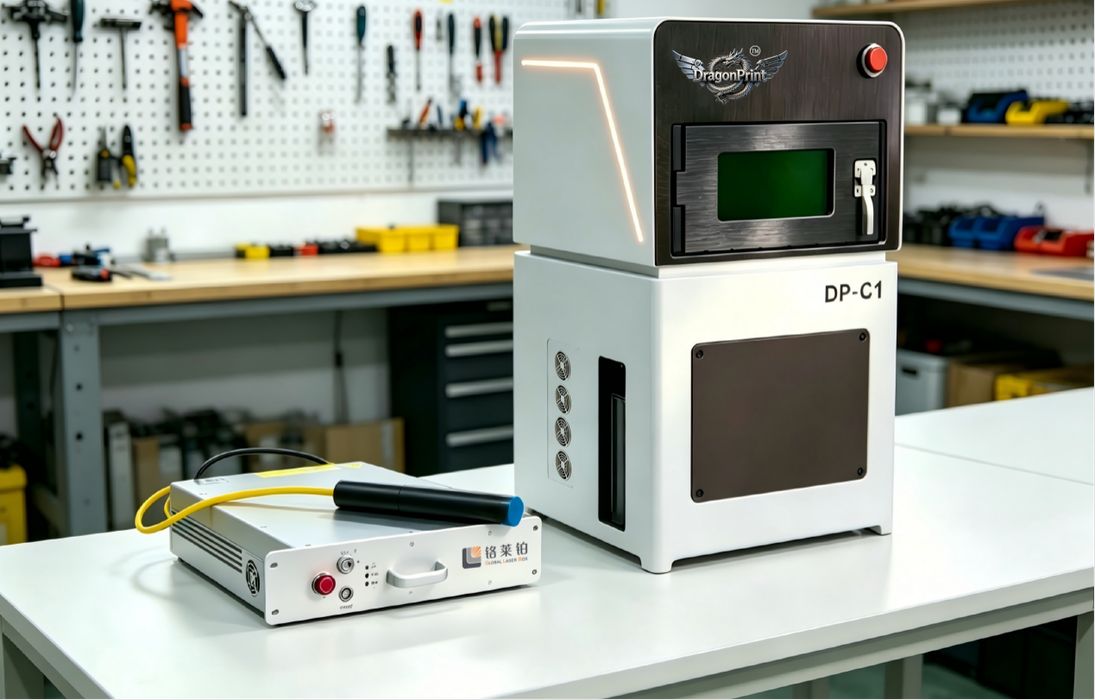
A new consumer-level metal 3D printer has just been announced in China.
The DP-C1 is a product from Global Laser Box, also known as GLB, is the English-facing brand of Jiangsu GLB Digital Technology Co., Ltd. This is a new company, having been founded only in 2023. However, only three years later, the company offers at least eight large-scale industrial metal 3D printers using the SLM process, 150 employees, 20,000 sm (215,000sf) operating space, and more than 180 patents. They claim to have delivered over 200 systems to clients so far.
The news this week is that they announced a very curious system to be shown to the public at the 2026 Global Consumer Electronics Expo in Shenzhen this week. That system is the DP-C1, a “consumer-grade” metal 3D printer using the SLM process.
That means it uses metal powder and a laser system to fuse layers of that powder in a sealed chamber. The build volume is said to be cylindrical, with a diameter of 108mm and height of 100mm. So the build volume is pretty small, but that would be expected on an ultra-low-cost metal 3D printer.
The machine apparently weighs a whopping 140kg, so this is not necessarily a desktop device.
For laser, the system uses a modest 300 W air-cooled fiber laser. The air cooling approach is one of the ways they are reducing the cost of the system. It will require 1kW of power to operate, however, and they say it should work from an ordinary house socket without modification.
They support only stainless steel powder (likely 316 L) at this time.
Oxygen is big trouble for SLM systems, and larger commercial systems go through many steps to ensure the material is not exposed to the air. Oxygen corrupts the metal material and, for some materials, can cause explosions. So what is GLB doing in that respect on the DP-C1?
It seems that the DP-C1 does require an inert gas to purge out air from the build chamber, just like larger systems. However, they apparently envision a future gasless version. I’m not sure how that could work.
The system has some powder handling capability, similar to larger systems, including sieving (for powder recovery and reuse) and a cleaning system.
The DP-C1 does make extensive use of AI. One application is to ensure print quality by performing dynamic scan path optimization, error correction, and anti-warping steps. Another application is for consumers: it has voice/text input capability that will generate 2D, then 3D models for printing. This is the standard text-to-3D workflow we’ve seen elsewhere, but here it’s integrated into the machine, apparently.
Finally, there’s the price. The unit is seemingly positioned as a “consumer” device, including pictures of “metal dragons” (usually we see plastic dragons). The pricing for the system is not yet released, but they have said it will be in the RMB10,000 range — which currently is about US$1500. It’s not at all clear whether that would be the price of the machine or including all the associated equipment required.
I’m a bit baffled about this machine. As described, it would appear to be a small volume LBPF system. If so, it would require all the same powder handling, safety concerns, post-processing, and job setup complications of bigger systems. I’m also wondering about their image rendering, showing what seems to be a small system on a tabletop. How could it weigh 140kg?
That’s not anywhere close to something any consumer would want to experience.
Some of my concerns if this is truly used as a consumer device:
Metal powder is toxic and requires considerable PPE to properly handle.
140kg is far too much for consumers to deal with.
What is the actual operating cost of the system, considering the cost of metal powder?
How do consumers remove metal objects fused to the build plate? (They need special metal equipment.)
How do consumers set up jobs so that they don’t warp? Normally done by engineers or complex software.
Perhaps consumers are different in China, but this would absolutely never fly in the West as a consumer product, even if it is priced at US$1500. The actual cost of the system has to be higher with all the other associated costs included.
My suspicion is that this might be an option for institutions, particularly university labs where they might make use of a low-cost LBPF system, otherwise unaffordable.
Via GLB
