
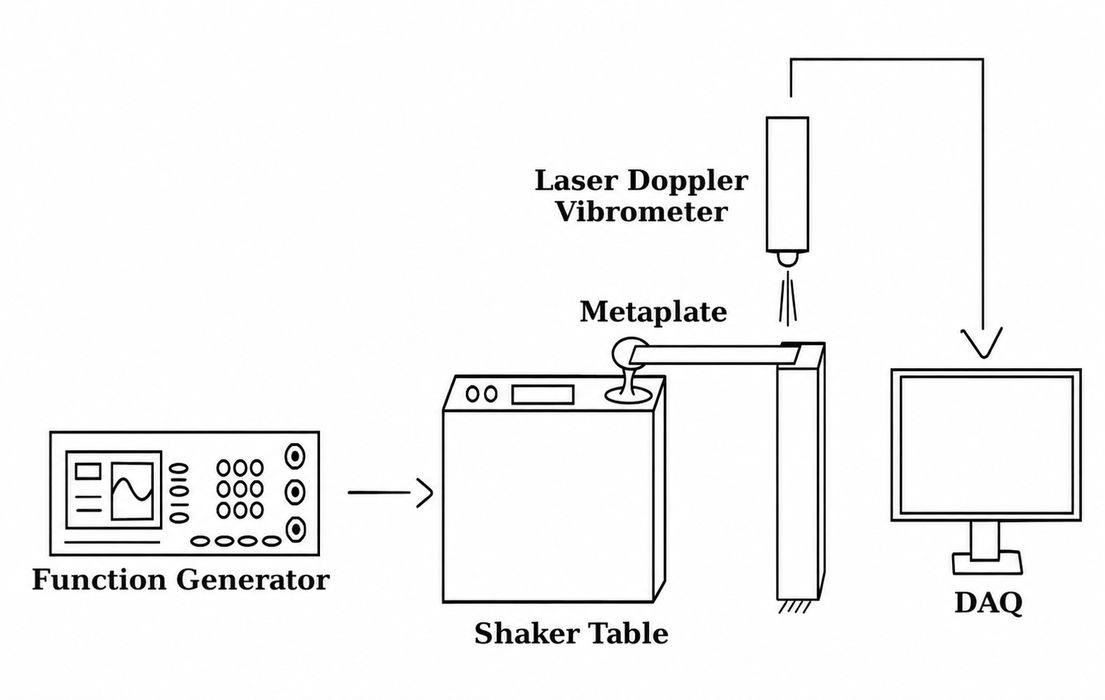
A new study on locally resonant metaplates points to an interesting application for 3D printing: structures that mechanically filter vibration before it reaches a sensor.
The paper, Design and validation of locally resonant metaplate with tunable bandgaps for inertial sensors, examines ways to protect accelerometers, gyroscopes and other inertial sensors from unwanted vibration.
These sensors are designed to detect very small motions, which makes them vulnerable to vibration generated by motors, vehicles, machinery or even the equipment containing the sensor.
The usual solution is mechanical isolation using elastomers, springs, damping materials or relatively massive housings. These approaches work, but they can add bulk and may not be especially selective about which vibration frequencies are suppressed.
Printing A Mechanical Filter
A locally resonant metaplate works differently.
The plate contains repeating resonant structures designed to interfere with mechanical waves moving through the material. At certain frequencies, vibration transmission drops dramatically, creating what researchers call a bandgap.
That effectively turns the structure into a mechanical frequency filter.
For an inertial sensor, this could be quite useful. If a machine produces a strong vibration at a known frequency, the surrounding structure could theoretically be designed to block that frequency before it reaches the sensor.
The interesting part from an additive manufacturing perspective is the geometry required to make this happen.
Locally resonant structures can involve small masses connected by thin flexible sections, cavities, repeating cells, internal features and other arrangements that are awkward to produce using ordinary machining. Some designs could require multiple components and assembly if manufactured conventionally.
With 3D printing, many of these features could potentially be produced as a single part.
Polymer SLS could be useful for larger experimental structures, while resin systems could produce much finer resonator features. Metal LPBF could eventually be appropriate where stiffness, temperature resistance or integration into a structural component is required.
This also opens the door to geometries that would be difficult to manufacture any other way. Instead of attaching a vibration isolator to a sensor housing, designers could potentially print the isolating behavior directly into the housing itself.
Tunable Geometry Makes Things More Interesting
The researchers specifically describe a tunable bandgap.
That matters because a resonant structure designed around one frequency may be ineffective when the vibration environment changes. Motors operate at different speeds, machines have different resonances and mounting conditions can shift the frequencies reaching a sensor.
If the resonator geometry can be adjusted, a family of otherwise similar printed parts could be optimized for different frequency ranges.
This seems particularly well suited to additive manufacturing, where changing internal geometry usually requires only a modified digital model rather than new tooling.
A manufacturer could conceivably produce sensor mounts optimized for particular machines, vehicles or instruments simply by altering resonator dimensions before printing.
There is a catch.
Resonant structures can be extremely sensitive to dimensional accuracy and material properties. Slight changes in beam thickness, stiffness or resonator mass can shift the resulting bandgap.
That could make AM process variation unusually important.
Build orientation, layer characteristics, porosity, cure state, thermal history and post-processing could all alter the vibration response of a printed metaplate. A geometry that performs perfectly in simulation might behave somewhat differently when printed.
For that reason, successful AM production would likely require both dimensional inspection and vibration testing, particularly for precision sensor applications.
We increasingly see 3D printing used to produce components whose shapes create specific mechanical properties rather than merely reproducing conventional parts.
A 3D printed sensor housing that also filters vibration would fit very nicely into that trend.
Via OpenAlex
