
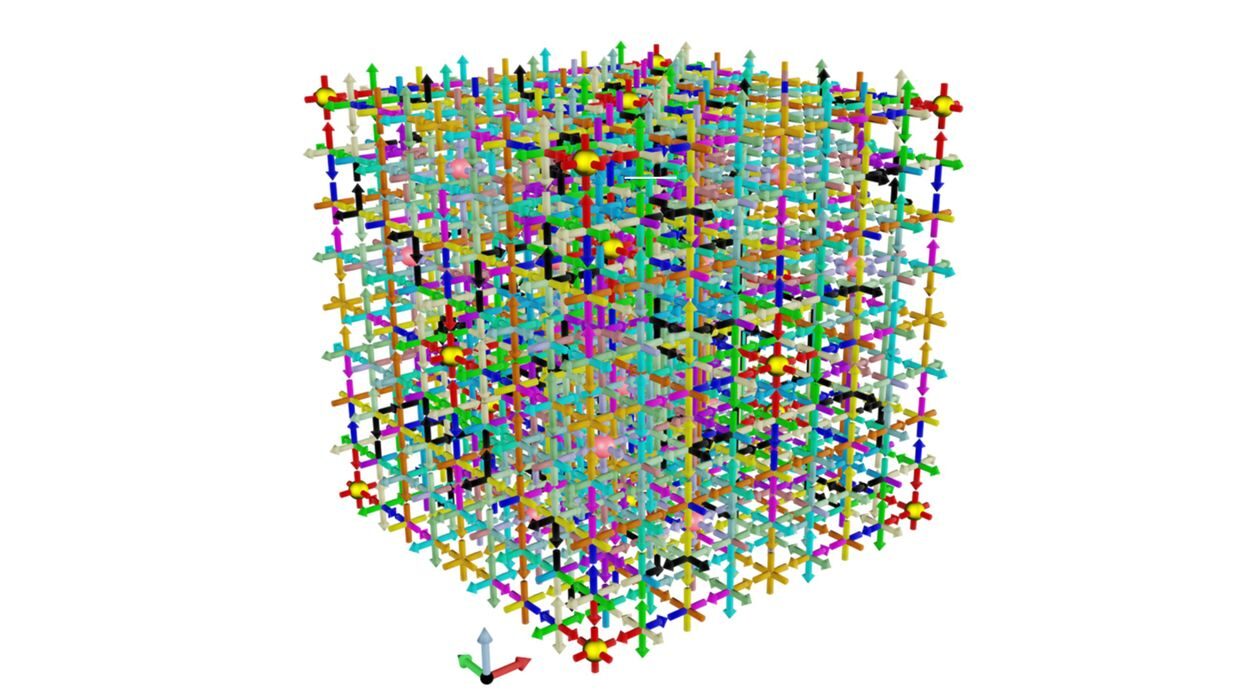
Researchers have developed a unique way to use DNA to create 3D structures at the nanoscale.
DNA is something we all have, and one of the reasons it is used to describe living organisms is that the DNA molecule is so versatile. The base pairs can stick to each other in very specific ways. This is very predictable: If you design two matching strands, they’ll reliably find each other and bind — even in a complex mix.
The researchers wanted to take advantage of this phenomenon by somehow creating DNA that would automatically bond together and result in the desired geometry. This would normally require the creation of countless DNA molecules, each with specific tweaks to ensure the molecules stick to the correct other molecule.
To visualize this, it would be like the heat shield tiles on the now-retired Space Shuttle: each one was unique and serialized. They fit together in only one way. To complete the visualization, imagine putting all those tiles in a large tub, shaking it, and the tiles would assemble themselves in the proper sequences.
The researchers sought to improve this concept by simplifying the process. They designed a kind of standard DNA “voxel”, which could be tweaked to join others in specific ways.
They then developed an algorithm that would analyze a geometry and determine the minimum set of unique DNA voxels that could be used to construct that geometry.
In the Space Shuttle analogy, they’d have only a dozen tile types instead of hundreds.
This makes it far easier to perform this type of assembly in real life, because you’d need to generate a much smaller set of custom DNA molecules. These would then be mixed together and, voila, you’d have your 3D structure as the molecules find and stick to each other.
Another interesting feature of their DNA voxel design is the ability to “carry” a payload. The payload could be enzymes, chemicals, certain particles, etc. That could add some interesting complexity and functionality to the resulting geometry.
While 3D printing was not mentioned in the paper, I believe there are some implications beyond the general interest in this approach. There are always new 3D print processes being developed, and it’s possible this effect could be the basis for one we haven’t seen yet.
If paired with robotic liquid handlers and precision nanofabrication tools, this framework offers a foundation for “printing” functional materials at the molecular level — an emerging frontier in nanomanufacturing. This could be a simple way to rapidly produce very small components and possibly simple machines.
Another approach might be to use the payload concept to arrange a 3D structure of, say, ceramic particles. The DNA molecules might be removed in a post-processing process to leave a pure ceramic structure. This would be similar to the green part process used in some of today’s 3D print processes.
Finally, the software developed to identify the unique voxels is quite different from today’s 3D print slicing software. I wonder if there are ways to leverage the concepts with conventional slicing: is there a group of standard voxels that could simplify a print job?
New technologies emerge from discoveries, and perhaps this is one we will see in the future.
Via ACS
