
Charles R. Goulding and Preeti Sulibhavi drill into recent developments in Venezuela concerning oil & gas investments.
Venezuela is rapidly becoming a focus of the global oil industry again. Following major geopolitical changes in 2026, international energy companies are returning to the country, expanding existing operations or negotiating new projects. The opportunity is enormous, but so is the physical challenge: much of Venezuela’s oil infrastructure has suffered from years of underinvestment, limited maintenance and declining production capacity.
That creates a potentially important role for additive manufacturing.
The U.S. Energy Information Administration has previously identified underinvestment, deteriorating infrastructure and a shortage of technical capacity as major constraints on Venezuela’s oil industry. Much of the country’s production is also extra-heavy crude from the Orinoco Belt, which requires specialized technology and infrastructure.
The current wave of investment is therefore not simply about drilling new wells. Companies will need to rehabilitate mature fields, replace aging equipment, restore processing facilities and rebuild supply chains. That is precisely the sort of environment in which industrial 3D printing can become useful.
Chevron Leads the Way
Chevron is already deeply established in Venezuela rather than being a newcomer. The company traces its Venezuelan operations back more than a century and currently operates three joint ventures with PDVSA, including Petroboscán in western Venezuela and Petropiar and Petroindependencia in the Orinoco Belt.
In April 2026, Chevron increased its interest in Petroindependencia to 49% and obtained rights for its Petropiar venture to develop additional acreage in the Orinoco Belt. In September, Chevron announced updated agreements that are expected to support more than US$7 billion of investment over five years and more than double its Venezuelan production to approximately 600,000 barrels per day.
Chevron also provides one of the clearest examples of how additive manufacturing can support oil and gas operations. In partnership with Lincoln Electric and Stress Engineering Services, the company used large-scale metal 3D printing to manufacture replacement pressure components for a refinery. Nickel wire was deposited using a wire-arc additive manufacturing process, producing more than 2,250 kilograms of material in less than a month. The components were installed in a hydrogen furnace, helping Chevron address a conventional supply-chain bottleneck.
That experience is particularly relevant to Venezuela. When an oilfield or refinery contains decades-old equipment, obtaining an obsolete replacement part can take weeks or months. A qualified digital manufacturing process can potentially turn a replacement part into a local or regional production job.
NABEP and the Scale of the Rebuild
North American Blue Energy Partners (NABEP) represents a different model. The company has emerged as a major participant in the U.S.-backed effort to expand Venezuelan production. Under an agreement announced in August, NABEP received access to 17 oilfields, with the company saying it plans nearly US$100 billion in investment and production of more than 1 million barrels per day.
The fields include assets previously operated by Chinese and Russian interests. The scale of the proposed redevelopment means that equipment, maintenance and supply-chain requirements could be substantial.
There is not, however, a publicly documented recent NABEP-specific oil-and-gas 3D printing project that can be cited with the same confidence as the Chevron examples. That distinction matters. NABEP describes its operations as using advanced technologies and innovative practices, but a specific additive-manufacturing deployment has not been publicly detailed in the sources reviewed for this article.
BP Returns With Additive Manufacturing Experience
BP has also moved back into Venezuela. In April, BP and Venezuela signed a memorandum covering offshore gas exploration in the Deltana Platform. By August, BP Exploration (Caribbean) was among the companies receiving participation rights in the Loran gas project.
BP brings its own experience with additive manufacturing. In September 2026, BP reported that four of its Gulf of America platforms were already using 3D printing to produce parts on site. At Thunder Horse, a replacement motor fan was 3D printed, while engineers at Mad Dog designed and printed a specialized thread protector overnight.
These are relatively modest components compared with a refinery pressure vessel, but they illustrate another important application: producing replacement parts close to where they are needed.
Shell Is Already Using 3D Printing
Shell’s involvement in Venezuela has also expanded substantially. In June 2026, Venezuela announced agreements with Shell covering several oil and gas projects, including development of the Loran offshore gas field and technical work connected with the Monagas North oilfields. BP is also involved in the broader Loran development.
Shell has perhaps the most extensive publicly documented additive-manufacturing program among the companies discussed here. Its Energy Transition Campus Amsterdam operates an in-house 3D printing capability for scanning, reverse engineering, optimizing, printing and post-processing replacement parts.
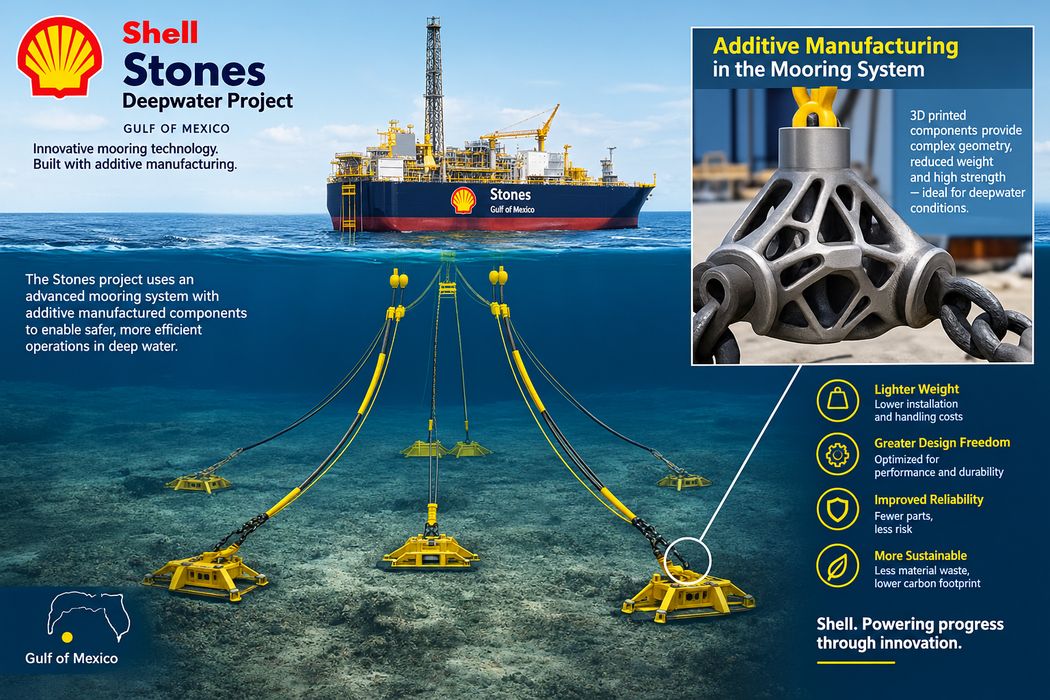
Shell reports that 3D printed impellers are already operating in its assets. The company has also used 3D printed prototypes for major offshore projects. At the Stones deepwater project in the Gulf of Mexico, additive manufacturing helped develop a mooring system for an FPSO and saved several months of delivery time.
For Venezuela, Shell’s experience suggests that additive manufacturing could be useful both for emergency replacement parts and for engineering new equipment for rehabilitated fields.
Repsol and Eni Bring European Expertise
Repsol has operated in Venezuela continuously since 1993 and has significantly expanded its commitments during 2026. In April, it agreed to regain operational control at the Petroquiriquire field and said it was prepared to increase Venezuelan production by 50% within 12 months and potentially triple it within three years, subject to the necessary conditions. In June, Repsol also signed an agreement to assess development of the Horcón area near Lake Maracaibo and examine offshore gas opportunities.
Repsol’s technology organization is already incorporating 3D printing into its industrial processes. Its 2025 Technology Radar identifies additive manufacturing as an adopted technology for exploration and production, with applications including on-demand manufacturing, maintenance and repair, customized components and reduced development times.
Eni has gone further in Venezuela during 2026, signing a 25-year production contract that makes it the exclusive operator of the Junín 5 heavy-oil field. Eni says the field contains 35 billion barrels of certified oil in place and currently produces about 12,000 barrels per day.
Eni is also developing additive manufacturing internally. In June 2025, the company gave a special mention to its “Eni 3D Printing” project, an on-demand production initiative intended to reduce costs and environmental impacts. In 2026, an additive-manufacturing workshop held at Eni’s San Donato Milanese headquarters focused specifically on oil-and-gas applications, including legacy components and pressure-containing parts.
ExxonMobil’s Potential Return Is Different
ExxonMobil is potentially the most interesting case because it has a long history in Venezuela but has been absent from the country’s oil operations for almost two decades.
ExxonMobil previously operated the Cerro Negro heavy-oil project and held a 41.67% interest. Venezuela expropriated that interest in June 2007 after ExxonMobil declined to accept the terms for converting the project into a new mixed enterprise. ExxonMobil subsequently pursued international arbitration.
In January 2026, ExxonMobil CEO Darren Woods said the company was interested in understanding the opportunity in Venezuela, while emphasizing that any investment would need to meet its long-term commercial criteria.
By late August, President Donald Trump said ExxonMobil was among companies planning to enter Venezuela, although ExxonMobil itself did not confirm the statement at that time. More recently, Reuters reported that a long-term ExxonMobil agreement was under discussion.
ExxonMobil also has relevant additive-manufacturing experience. In 2026, EOS described the company’s Baton Rouge refinery as moving beyond experimentation toward scaled additive manufacturing, including a digital supply-chain model for spare parts. The facility contains compressors that have operated since 1938, making legacy-part replacement an especially important application.
Continental Resources Nearing a Deal
While the deal remains tentative, Continental has committed to entering Venezuela, although a definitive investment amount has yet to be determined. Continental has indicated that the field it plans to explore sits north of Venezuela’s Orinoco River in the state of Anzoátegui. It includes approximately 126,000 acres with an estimated 30 billion barrels of oil resources buried underground. Such fields require billions of dollars and years to fully develop to operating standards. Continental hopes to sign a production-sharing agreement with Venezuela in the Fall of 2026.
TotalEnergies: Back in Venezuela
While Total is not directly investing in local oil refining infrastructure in Venezuela, in September 2026, it signed a Memorandum of Understanding (MoU) with Venezuela’s state-run, PDVSA, paving the way for upstream investments in drilling, crude oil production and electrical grid restoration rather than rebuilding its domestic refining facilities. The French company has not disclosed a specific timeline or investment amounts at this time.
ConocoPhillips: Taking Some Time to Think
The company is monitoring the situation in Venezuela and warns that any speculation on future investments at this time would be premature. In 2007, ConocoPhillips, like Exxon, had its heavy oil assets seized by the Venezuelan government and by international arbitration awards is owed over US$11 billion. So, despite some political pressure, ConocoPhillips remains on the sidelines, for now.
For all the companies either already committed to or preparing to invest in Venezuela’s oil & gas industry, one consideration and advantage of utilizing 3D printing technology would be the mobile systems, which can be deployed in the field and on-site in real-time. As opposed to taking the parts which may need repair or replacement and waiting for a supplier to furnish necessary components. Another way 3D printing can reduce cost and time delays.
IRC Section 41 R&D Tax Credit Opportunities
The integration of additive manufacturing into Venezuela’s oilfield redevelopment opens substantial opportunities under Internal Revenue Code (IRC) Section 41, which provides federal tax credits for Increasing Research Activities. To qualify for the credit, research activities conducted by these energy operators must satisfy the IRS Four-Part Test:
- Permitted Purpose: Research must intend to improve the functionality, performance, reliability, or quality of a business component. Energy companies engineering 3D printed pressure vessels, impellers, or custom thread protectors are actively developing new, higher-performing technical components.
- Technological in Nature: The activities must rely fundamentally on principles of hard sciences. Metal wire-arc deposition, reverse engineering of legacy components, and metallurgical testing depend directly on materials science, metallurgical physics, and mechanical engineering.
- Elimination of Uncertainty: Projects must seek to eliminate technical uncertainty regarding design, capability, or method. Operators modifying decades-old compressor parts (such as ExxonMobil’s 1938 compressors) or qualifying deepwater mooring systems (like Shell’s Stones project) face severe technical uncertainties regarding structural integrity, high-pressure tolerance, and fluid dynamics under extreme offshore conditions.
- Process of Experimentation: Companies must evaluate alternatives through modeling, simulation, or trial and error. Rapid prototyping, CAD modeling, and FEA simulations used by BP, Shell, and Chevron constitute systematic experimentation under IRC Section 41.
Taxpayers can claim Qualified Research Expenses (QREs) – including W-2 employee wages for engineers, supply costs consumed in prototyping (such as nickel wire feedstock), and 65% of third-party contract research fees – to directly reduce federal income tax liability.
Why 3D Printing Matters in Venezuela
The common thread is not that 3D printing will replace conventional oilfield manufacturing. It won’t. Rather, additive manufacturing could become one of the tools used to deal with the enormous maintenance and supply-chain problem created by Venezuela’s aging infrastructure.
The country’s oil revival will require drilling equipment, pumps, valves, impellers, pressure components, tooling and countless other parts. Some will be conventional mass-produced products. Others will be low-volume, obsolete or highly customized components for which traditional manufacturing can be slow and expensive.
The experiences of Chevron, BP, Shell, Repsol, Eni and ExxonMobil show that the major oil companies are already experimenting with or deploying additive manufacturing to address exactly these problems.
As billions of dollars begin flowing into Venezuela’s oil fields, 3D printing could quietly become part of the infrastructure behind the revival: not the technology producing the oil, but the technology helping keep the machines running.