
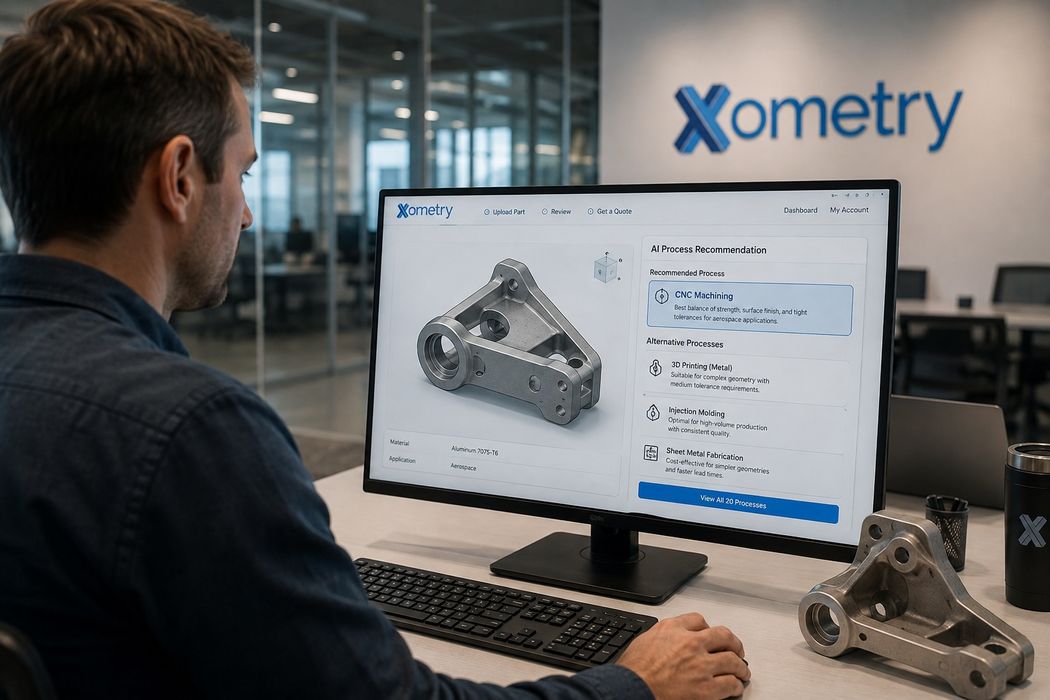
Xometry announced “comprehensive upgrades” to their AI model architecture.
The manufacturing service is one of the largest in the additive manufacturing world, able to accept customer requests and dispatch them to its large network of manufacturers. In addition to 3D printing, the company also offers a number of other manufacturing processes.
The upgrade is intended to simplify and speed up customer processing, which often gets hung up on manufacturing process requirements. This is especially true for their new customers who don’t have a lot of experience in manufacturing.
Here’s how it works, according to Xometry:
“Xometry’s upgraded context-aware AI process recommender understands a part’s industry application – recognizing, for example, that an aerospace component likely calls for tighter tolerances and flight-grade alloys – along with its probable material and geometry, closing the gap for first-time customers who have no order history for the model to draw on. Buyers get a manufacturing recommendation when they upload a part, providing them with the optimal process from among 20 supported manufacturing techniques.”
This will be very useful for many of their new customers, who otherwise might be disappointed in results. Now they would be directed to the optimal manufacturing process, which may or may not be additive manufacturing.
It’s also an incredibly good use of all the manufacturing data Xometry has been collecting from their countless customers and jobs done over the past few years. That data was apparently used to train their latest AI system to provide the best possible result.
But there’s another angle to this: imagine someone submitting a request, and the AI determines that it would be best to use, say, injection molding, for the job instead of 3D printing. That may be quite successful for the customer, but it also short circuits another possible path.
Another way to handle this could be to change the design so that it is compatible with 3D print technology, instead of routing it to a different manufacturing process. However, that would be vastly more complicated to implement.
It seems that Xometry is at a specific level of AI capability here, but one can envision far more complex future levels. Imagine a manufacturing service that could automatically “fix” your design before initiating. Many factors could be incorporated into that decision-making process, including part requirements, costs, turnaround time, part volume, and much more.
These are aspects that a well-staffed engineering firm might be considering when developing a part and its intended manufacturing process. What happens when much of that is automated?
If that happened, we could see organizations with less experience still be able to achieve useful part designs and get them produced in the optimal manner. Even experienced firms could take advantage by using their engineering skills on other parts of the process.
But that’s all future speculation, and we’re definitely not there yet. I can see a path to get there, however, as Xometry has taken a tiny step in that direction.
Via Xometry
