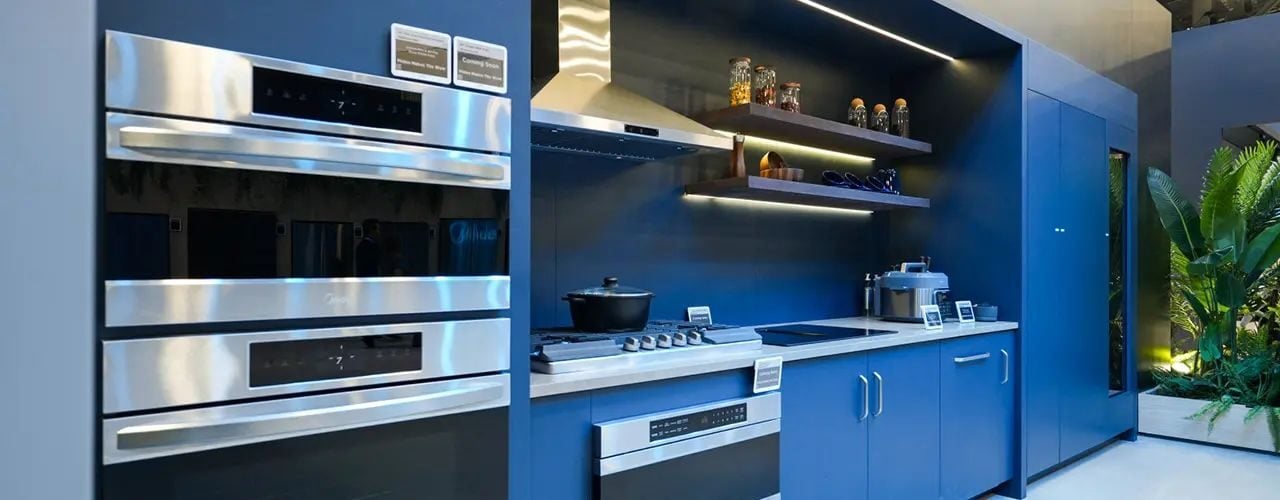
Charles R. Goulding and Preeti Sulibhavi highlight how Midea has evolved from a small workshop into a global appliance powerhouse by harnessing 3D printing to optimize HVAC design, revolutionize manufacturing, and even redefine dental restoration.
Founded in 1968 in Beijiao, Foshan, Guangdong, China, Midea Group has evolved from a small workshop making bottle lids into a Fortune 500 powerhouse and one of the world’s largest appliance manufacturers. Headquartered in China, with over 150,000 employees as of 2021 and operations in more than 200 subsidiaries worldwide, Midea reported approximately US$40.5 billion in revenue for fiscal 2020.
While the latest full-year figures aren’t disclosed at a granular level, the company’s Q1 2025 update shows total revenue of RMB 128.4 billion (≈ US $17.7 billion), up 20.6% year-over-year, and net profit of RMB 12.4 billion, a strong 38% increase. Midea’s core business remains in HVAC (residential and commercial air conditioners), alongside a broad portfolio including kitchen appliances, robotics, refrigeration, floor care, vacuum cleaners, and energy-efficient solutions.
In 2016, Midea completed the acquisition of the majority share of KUKA AG, the leading German warehouse robot company. KUkA is famous for having Amazon as a client.
3D Printing: A Strategic Innovation Enabler
Midea has embraced 3D printing as a supply chain enabler, rapid prototyping tool, and production innovation method. Evidence across multiple industries shows additive manufacturing is expanding far past prototyping into production-grade applications, such as HVAC, aerospace, and medical devices.
1. HVAC System Redesign and Efficiency
In HVAC design, 3D printing allows the creation of components that are complex, lightweight, and custom-optimized for performance—a key advantage as the industry seeks efficiency and compactness. Midea engineers have leveraged these benefits specifically to:
- Redesign compact HVAC units: Using 3D printing to test and build prototypes that are smaller and more aesthetically refined.
- Create custom parts that reduce operational noise and enhance airflow.
- Develop unique “U-shaped” air conditioner units—a design streamlined via additive methods to be both less bulky and more energy-efficient.
This move aligns with broader initiatives—such as Hyperganic and EOS—that have produced highly efficient, 3D printed AC units, demonstrating up to 10× performance gains.

2. Rapid Prototyping & Custom Manufacturing
Across Midea’s manufacturing centers, 3D printing accelerates design validation cycles and enables flexible factory-floor production. Specific use-cases include:
- Hose-adapter prototyping: Midea has developed custom hose adapters via 3D printing to fit its air-conditioning systems—reducing tool lead times and enabling rapid iteration.
- On-demand part fabrication: Instead of stocking specialized parts, Midea can print them as needed—supporting faster repairs and minimizing storage costs.
- Tailored appliance components: 3D printing helps prototype shapes and materials for custom or limited-run appliances, boosting design agility.
This agile manufacturing approach reflects a broader industry shift where additive manufacturing is increasingly used beyond prototyping into short-run production and final-use parts.
3. Specialized Applications: Dental Restorations
One standout example of Midea’s additive footprint is in dental applications. The company supports 3D printing dental restorations using digital‑press stereolithography (DPS) technology, which excels at printing highly filled, viscous resins. These advanced systems enable:
- Fast, chairside production of crowns, bridges, and inlays—ready in under 10 minutes.
- High-resolution, precision parts made possible by DPS capsule systems, enabling accurate resin dosing and simplified workflows.
- Accessible dental manufacturing across clinics thanks to compact systems and minimal setup.
While executed through partners like SprintRay’s Midas printer, Midea’s adoption demonstrates its interest in specialized additive applications beyond appliances—bridging into healthcare innovation.
4. Community Engagement: Sharing STL Models
Midea also embraces open-source engagement through CAD libraries:
- Available STL files enable end-users to 3D print accessories, replacement parts, or custom elements for Midea products.
- These community-contributed models foster customer loyalty, reduce service bottlenecks, and encourage user-led innovation.
This consumer-accessible approach reflects a modern, platform-oriented manufacturing mindset—where users can adapt and print their own components.
Why It Matters for Midea
Midea’s 3D printing efforts help the company in several strategic dimensions:
✦ Speed & Flexibility
Additive manufacturing dramatically reduces prototyping lead times—from weeks or months down to days. This agility is invaluable in fast-moving markets like HVAC and small appliances, where design iteration speed is a competitive strength.
✦ Cost & Waste Reduction
With 3D printing, tooling expenses are eliminated, inventory of specialized parts is minimized, and material efficiency is enhanced—aligning with Midea’s goals for lean, sustainable production.
✦ Design Innovation
Complex geometries, like the U-shaped HVAC units and optimized heat-exchange assemblies, become practicable only through additive means—unlocking next-level efficiency and form-factors for Midea products.
✦ Diversification
By stretching into sectors like dental 3D printing, Midea demonstrates versatility and readiness to leverage internal industrial-scale additive manufacturing capabilities across new product lines and markets.
The Road Ahead: Scaling Additive Excellence
As the global 3D printing market is projected to grow by around US$30 billion between 2024 and 2028, driven largely by customized and AI-enhanced applications, Midea appears well-positioned to scale its additive operations. Key future steps likely include:
- Increased industrial deployment: Building larger build-volume printers for end-use HVAC components.
- Material diversification: Moving from standard polymers to advanced materials like PEEK, viscous resins, or even metal composites.
- Vertical integration: Incorporating STL-sharing platforms or on-site clinics equipped with DPS systems for regional dental partners.
- Collaboration with AM leaders: Partnering with established 3D printing firms could accelerate deployment of certified, production-grade additive solutions.
The Research & Development Tax Credit
The now permanent Research and Development (R&D) Tax Credit is available for companies developing new or improved products, processes and/or software.
3D printing can help boost a company’s R&D Tax Credits. Wages for technical employees creating, testing and revising 3D printed prototypes are typically eligible expenses toward the R&D Tax Credit. Similarly, when used as a method of improving a process, time spent integrating 3D printing hardware and software can also be an eligible R&D expense. Lastly, when used for modeling and preproduction, the costs of filaments consumed during the development process may also be recovered.
Whether it is used for creating and testing prototypes or for final production, 3D printing is a great indicator that R&D Credit-eligible activities are taking place. Companies implementing this technology at any point should consider taking advantage of R&D Tax Credits.
With a California facility, the company will be able to utilize the lucrative California R&D tax credit for its U.S. innovation activities
Conclusion
Midea‘s evolution from domestic appliance powerhouse to additive manufacturing innovator highlights a savvy embrace of technological transformation. By combining rapid prototyping, compact design breakthroughs, specialized applications like dental printing, and consumer-empowered STL libraries, Midea is future-proofing its manufacturing, delivering more efficient, customized, sustainable products.