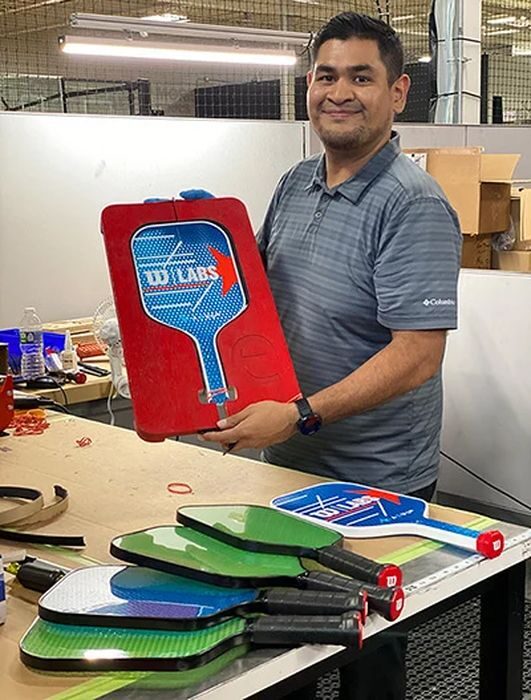
Preeti Sulibhavi and Jacob Nolan dive into the tech transforming America’s fastest-growing sport—where noise reduction and player performance get a high-speed upgrade.
The Fastest-Growing Sport Meets High-Speed Manufacturing
Pickleball has taken off across the U.S., filling parks and recreation centers with a wave of new players. Its rise in popularity has created new demands, from quieter play on neighborhood courts to more personalized paddles for performance-focused athletes. As the sport matures, 3D printing has stepped onto the court, offering a new dimension to how equipment is designed, manufactured, and experienced. Companies and hobbyists alike are turning to additive manufacturing to create custom paddles, sustainable balls, and even personalized gear built around each player’s unique style of play.
Custom Paddles Powered by Lattice Design
Azul 3D and Wilson Sporting Goods have partnered to create cutting-edge pickleball paddles made entirely through 3D printing. These paddles are produced using Azul’s proprietary HARP (High Area Rapid Printing) technology, which prints large, detailed components quickly and on a scale. The Quiet Paddle, one of their flagship innovations, features a dampening lattice structure that reduces the loud “pop” sound traditional paddles produce. This quieter option helps make pickleball more welcome in residential areas where noise complaints have become a concern.
Their second model, the Custom Core Paddle, includes a tunable 3D printed lattice core that can be adjusted to suit a player’s performance needs. By controlling paddle weight, stiffness, and balance, players can get a feel tailored precisely to their play style. These paddles are printed in a single piece, eliminating the need for traditional multi-part assembly, which reduces production time and allows for faster customization.
Quieter, More Sustainable Balls
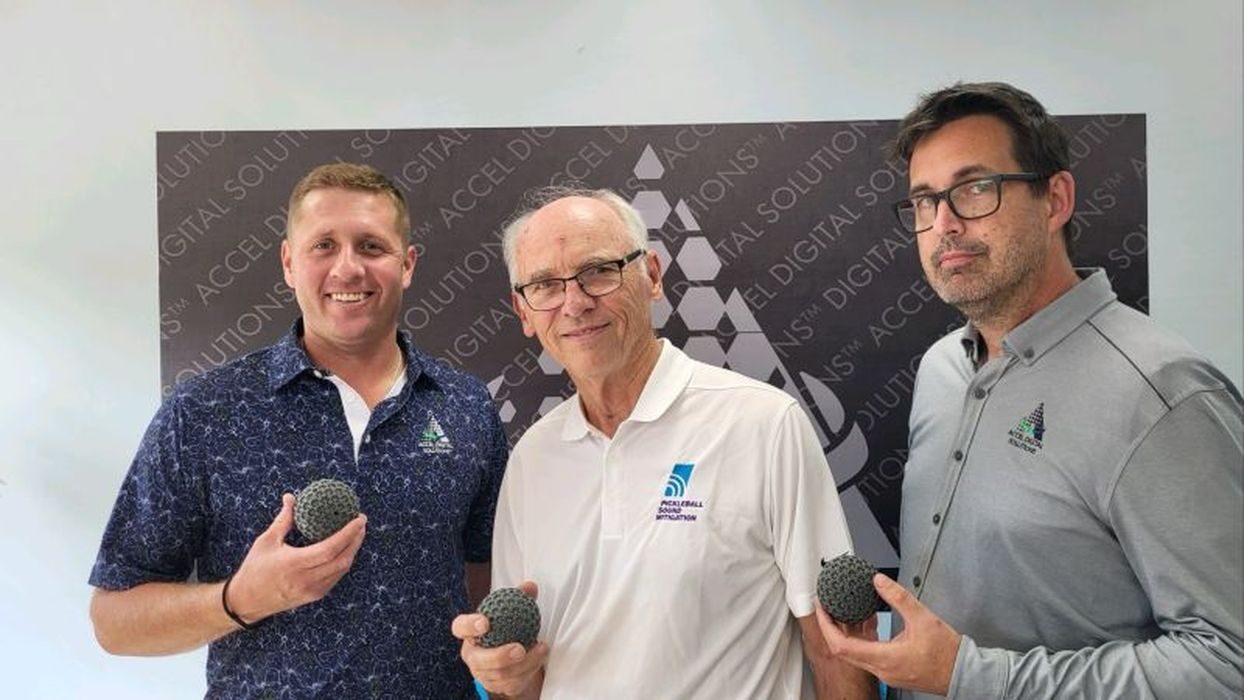
A Michigan-based company called Accel Digital Solutions is applying 3D printing to another crucial part of the game, the pickleball itself. Traditional balls often create loud noise and are difficult to recycle, but Accel’s 3D printed model is designed to fix both issues. Made from thermoplastic elastomers, their printed ball produces a softer “click” instead of the sharp sound associated with standard models. It meets official size, weight, and bounce requirements, and it’s priced higher than mass-market balls due to its durability and noise-reduction advantages.
This ball isn’t just quieter; it’s also more sustainable. Accel is exploring compostable and fully recyclable materials to reduce the environmental impact of used balls. As more cities and clubs seek eco-friendly alternatives, 3D printed balls may become the new standard in sustainable sporting equipment.
Makers and Hobbyists Join the Game
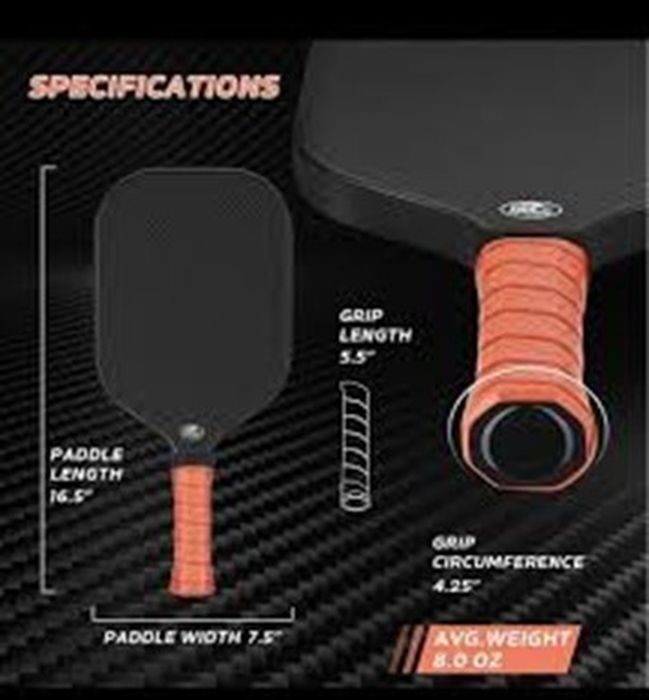
Beyond big-name brands, individual makers and engineers are pushing the boundaries of 3D printing in pickleball. Communities online are sharing STL files and printing their own paddle prototypes using desktop machines and materials like PETG, ABS, and carbon-fiber filament. These user-generated designs may not yet match the performance of commercial paddles, but they show what’s possible when creativity and technology meet. One Reddit user reported using a fully 3D-printed paddle for multiple matches with no issues, highlighting the real-world potential of DIY approaches.
LulzBot has even offered open-source paddle designs, inviting users to experiment and optimize their gear for comfort and playability. The 3D printing community continues to iterate, refine, and challenge the traditional manufacturing model.
Performance and Community Impact
The shift toward 3D printing isn’t just about innovation, it’s solving real problems. Quieter paddles and balls help reduce friction between players and nearby residents. Custom paddle cores provide better ergonomics and improved control, especially for players with specific needs or preferences. And the move toward recyclable gear helps clubs and recreational facilities adopt more sustainable practices. With on-demand production, equipment shortages and shipping delays are also less of a problem, helping local communities gear up faster.
The Research & Development Tax Credit
The now permanent Research & Development Tax Credit (R&D) Tax Credit is available for companies developing new or improved products, processes and/or software.
3D printing can help boost a company’s R&D Tax Credits. Wages for technical employees creating, testing and revising 3D printed prototypes can be included as a percentage of the eligible time spent on the R&D Tax Credit. Similarly, when used as a method of improving a process, time spent integrating 3D printing hardware and software counts as an eligible activity. Lastly, when used for modeling and preproduction, the costs of filaments consumed during the development process may also be recovered.
Whether it is used for creating and testing prototypes or for final production, 3D printing is a great indicator that R&D Credit eligible activities are taking place. Companies implementing this technology at any point should consider taking advantage of R&D Tax Credits.
Conclusion
3D printing is becoming a serious player in the evolution of pickleball. From large-scale partnerships like Azul 3D and Wilson to grassroots innovation among hobbyists, additive manufacturing is redefining what’s possible in paddle and ball design. This technology brings quieter, stronger, and more sustainable options to the court, while also giving players more control over their gear. As sport continues to grow, so will the role of 3D printing in shaping its future, one layer at a time.