
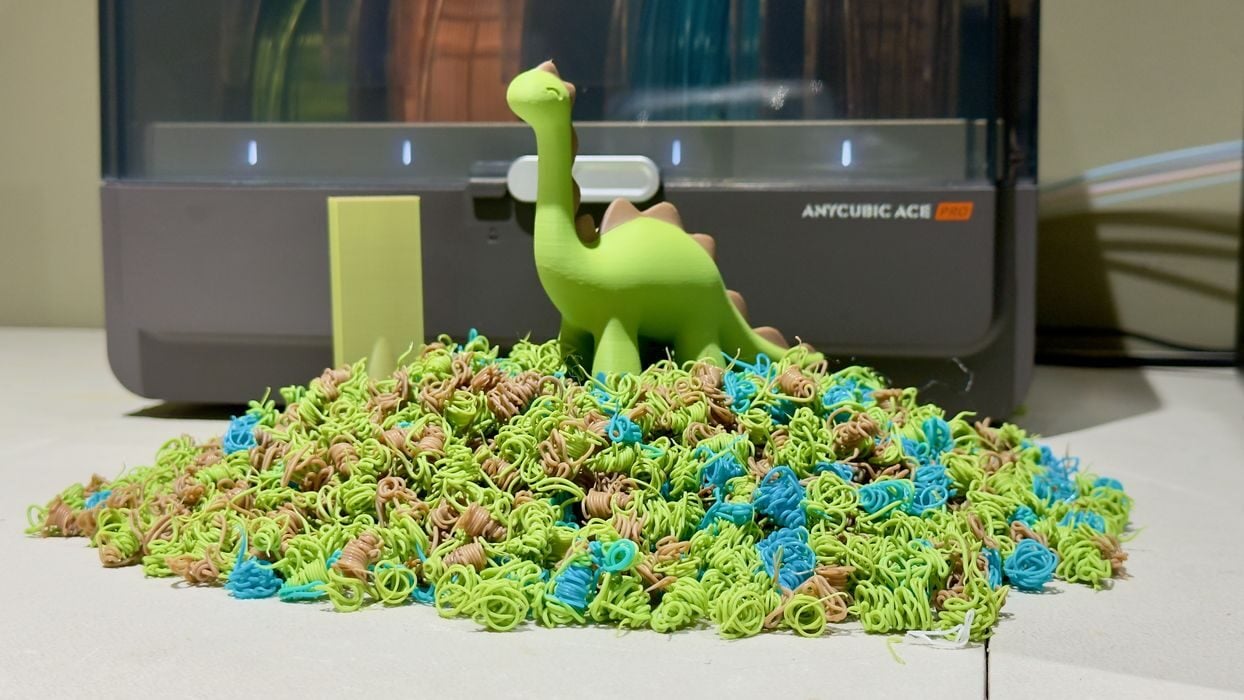
It was a quiet moment, but I believe a significant shift in desktop 3D printing occurred last week.
The shift is caused by Snapmaker’s announcement of their U1 device. This is a desktop FFF 3D printer, able to print in up to four colours. The device’s initial price is as low as US$679.
That doesn’t at first seem remarkable, as there are four-colour desktop FFF 3D printers available today, even at lower prices. The Bambu Lab A1 Combo, for example, would be priced similarly.
But there’s an enormous difference here.
The A1 and many similar machines all use filament switching as their technology to change colours during printing. A filament is retracted, and another inserted, all automatically as the print job proceeds.
But there’s always been an issue with this approach: the old filament material remains in the nozzle, and must be purged before printing can resume. To do this, the 3D printer simply runs some fresh filament through the nozzle until it’s “clean”. This creates what’s called a “poop”, and it is dropped off at the side or back of the machine.
Poop is a problem. It’s a problem because the number of poops in a job equals the number of filament changes, and that could be very large. Hundreds of times on typical multicolor prints.
Usually, the weight of poop produced exceeds the weight of the print itself, sometimes by multiple times. I’ve personally done jobs where the multiple is 10X or greater.
Think about this: in order to print an item that is made of, say, US$1 of material, you must spend US$11 of material to get it.
But this is the 3D print world we’re in today: many people operate single-nozzle multicolor 3D printers and are willing to spend far more money on materials just to get those colourful prints.
They do it because it’s the only way to get those multicolour prints. That is, unless you’re willing to pay far higher costs for a printer that includes multiple toolheads, which completely avoids the poop problem.
That changed last week when Snapmaker’s U1 was announced: it has four independent toolheads, but is priced at a level near today’s filament swapping systems.
The price barrier to a no-poop world just fell down.
In this new world, we’re going to have to look at poop in a very different way, since there is another option.
Printing 10X the material for a print now seems quite ridiculous, when you think about it. It’s like paying 10X as much for the material, when you price it per print.
Poop also contributes to the microplastic problem. Poop does not carry a recycling symbol, so municipal recycling programs will not accept it. It’s going to go to the landfill, aside from those inventive folks that melt it down into something else that’s useful. However, those people are few and far between.
We are in a world where plastic pollution will increasingly be seen as a very negative practice, and a world where low-cost no-poop 3D printers now exist.
The days of filament-swapping desktop 3D printers are numbered.
3D printer operators, particularly those who print a lot, will immediately realize they can achieve significant material savings by using toolchanging equipment like the U1. Others will admit they are generating huge amounts of waste plastic by using those machines.
It seems to me that we’re at a point where 3D printer manufacturers will have to begin switching their machine designs towards toolchanging in order to survive.
This has happened before: when Bambu Lab surprisingly introduced their high-speed equipment a couple of years ago, the rest of the desktop 3D printer manufacturers had to swiftly build new equipment that could match that speed.
Many did. Some did not, and they’re literally out of the business at this point.
I believe the same thing will happen to those that do not switch to toolchanging systems.
My guess is that the engineers at Bambu Lab, Anycubic, Elegoo, Prusa, Creality and others are now looking very carefully at the Snapmaker development and considering what they should do.
I’m particularly concerned about Prusa Research, which does offer a toolchanger — but it’s priced at US$4099. Are they able to somehow lower the manufacturing cost of that system to meet the Snapmaker price point?
I believe we will in six months or so see toolchangers begin to appear at Snapmaker’s competitors.
This is perhaps not the greatest situation for these 3D printer manufacturers — or those selling filament — but it will be a tremendous boost for 3D printer operators, who will see their material costs go down.
