
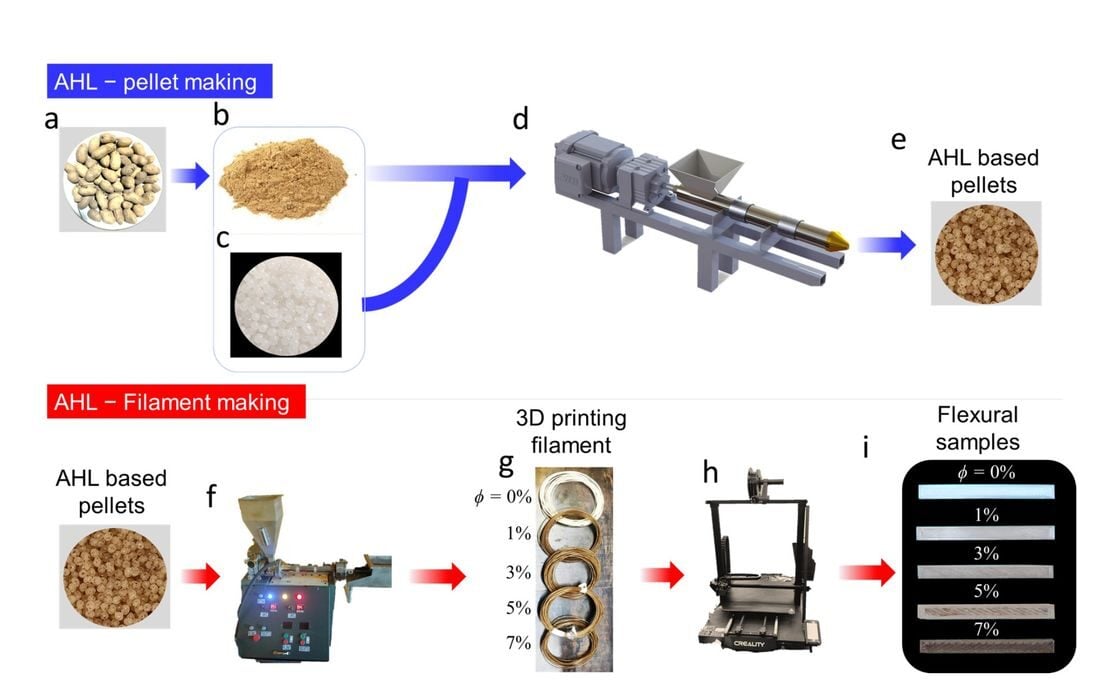
Researchers have developed an antimicrobial 3D printer filament using peanut shells.
Antimicrobial filaments are somewhat scarce on the market, possibly due to the cost of production. Here, the researchers sought an approach to produce an antimicrobial material by leveraging the natural properties of peanut shells.
It turns out that peanut shells contain polyphenols, flavonoids, lectins, and lignin-derived compounds that disrupt bacterial membranes and adhesion. But would these beneficial properties survive the heat of extrusion during 3D printing?
They prepared a custom 3D printer filament by mixing ground-up peanut shells with standard PLA polymers. This is a common technique for making composite materials: carbon fibre, stone, and other reinforcing materials have been used in this way.
Here, however, the researchers weren’t particularly interested in reinforcing the material to produce stronger parts, as they were focused on the antimicrobial aspects. Nevertheless, the presence of peanut shells in the mix would alter the mechanical properties of the PLA composite material.
They tested several different ratios of shell to PLA, all of which were quite small. In the end, they found that PLA reinforced with peanut hulls yields biodegradable, recyclable, antimicrobial, wood-like composites. The trade-off: stronger/harder but also more brittle and prone to fracture. The material was also somewhat more porous.
The antimicrobial effect increased with the ratio of peanut shells, as you might guess. They tested ratios up to seven percent, after which they encountered extrusion challenges. Seven percent seems to be the practical maximum ratio possible.
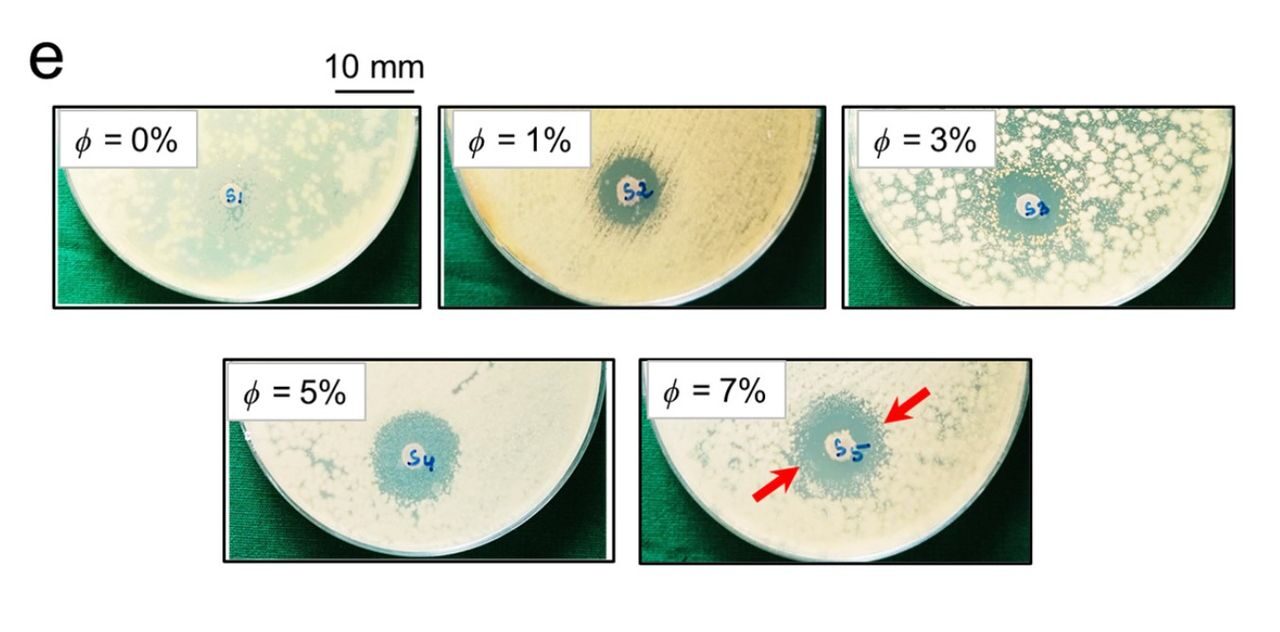
They tested the antimicrobial effect by printing small 6mm diameter discs of material with different peanut shell ratios. A disc with zero percent peanut shell and 100% PLA provides absolutely no antimicrobial properties, whereas increasing the ratio definitely does inhibit the growth of bacteria not only on the disc but nearby.
At a ratio of seven percent, they found bacteria inhibited within a 14.3mm diameter range around the disc. In other words, the material was definitely antimicrobial.
It’s totally unclear whether this approach will be commercialized, but if so, there could be some interesting benefits. We’d have available a new antimicrobial material that provides some strength advantages over PLA and is made from agricultural waste: a more sustainable product.
It’s also possible that this new material could eventually lead to the 3D printing of products that require antimicrobial properties, such as food packaging, some kitchenware, children’s toys, etc.
There’s no shortage of peanut shells, either. Apparently, there are over 40 mt of peanut hull waste produced worldwide each year.
Via ArXiv
