
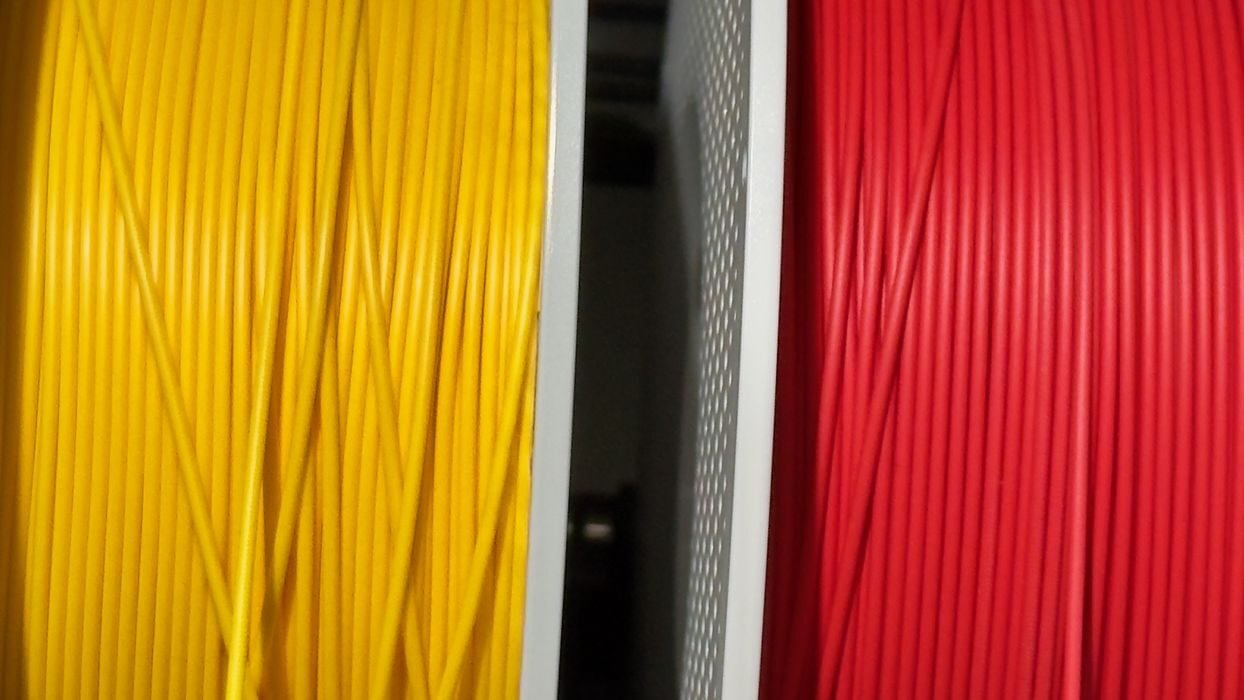
Which 3D printers still use the 2.85mm filament standard?
These days it would appear that 1.75mm filament is the standard for desktop FFF 3D printers, but that’s not quite yet the case.
In the early days of 3D printing the use of 2.85mm filament was very common, and at some point it might have even been in the majority. But those days are long gone, and virtually every desktop FFF 3D printer nowadays uses 1.75mm filament.
With only a couple of exceptions, that is.
The two most notable 2.85mm holdouts are LulzBot and UltiMaker, both of which are long-standing vendors in the industry. Because of their lengthy heritage, they’ve carried forward the 2.85mm standard up to the present day. The only other 3D printers using 2.85mm filament seem to certain models of large format machines, such as those from BigRep. However, most large format machines are quickly switching to pellet materials, which are far less expensive than filament.
In spite of these two companies using 2.85mm, reports suggest that less than 10% of filament produced is now in 2.85mm format.
Why did 2.85mm become a standard long ago? I suspect there were two reasons. First, this diameter was already being sold — as a different product, welding wire. And secondly, PTFE tubes were available with 3mm inner diameter, meaning 2.85mm would fit nicely inside. In other words, the set of available components decades ago led to the use of 2.85mm filament.
But is 2.85mm any better? There are advantages and disadvantages. A big disadvantage is that because the filament is thicker it is harder to bend. This means it could more easily crack if pushed through PTFE tubes at extreme angles, especially if not properly dried.
There is an advantage to 2.85mm, however: printing TPU. TPU filament is by definition flexible. A thicker TPU filament would be easier for extrusion systems to push through PTFE tubes, making faster and more reliable TPU printing possible.
However, the biggest disadvantage these days is the availability of different types of materials. There are many filament providers that now don’t even bother to sell 2.85mm filament, and instead solely market 1.75mm filament. Need a very specific color in 2.85mm format? Good luck!
Some of the major providers, such as Polymaker, still provide 2.85mm formats for many of their products. But it’s entirely possible they may at some point in the future phase out 2.85mm and solely focus on 1.75mm format. In fact, I already see some exotic materials on their product shelf are 1.75mm only.
Sales from booming Asian manufacturers such as Bambu Lab and Creality are placing vast quantities of 1.75mm machines out into the world, and this will continue to tip the ratio of 2.85mm to 1.75mm machines. As time passes, the portion of the market that requires 2.85mm filament will continue to shrink.
I believe LulzBot and UltiMaker both recognize this phenomenon and eventually will switch over. LulzBot already sells 1.75mm capability as an option on some of their products, and there are third party options for converting some UltiMaker models to 1.75mm format.
It may take several more years, but soon we may see a 100% 1.75mm 3D printer world.
