
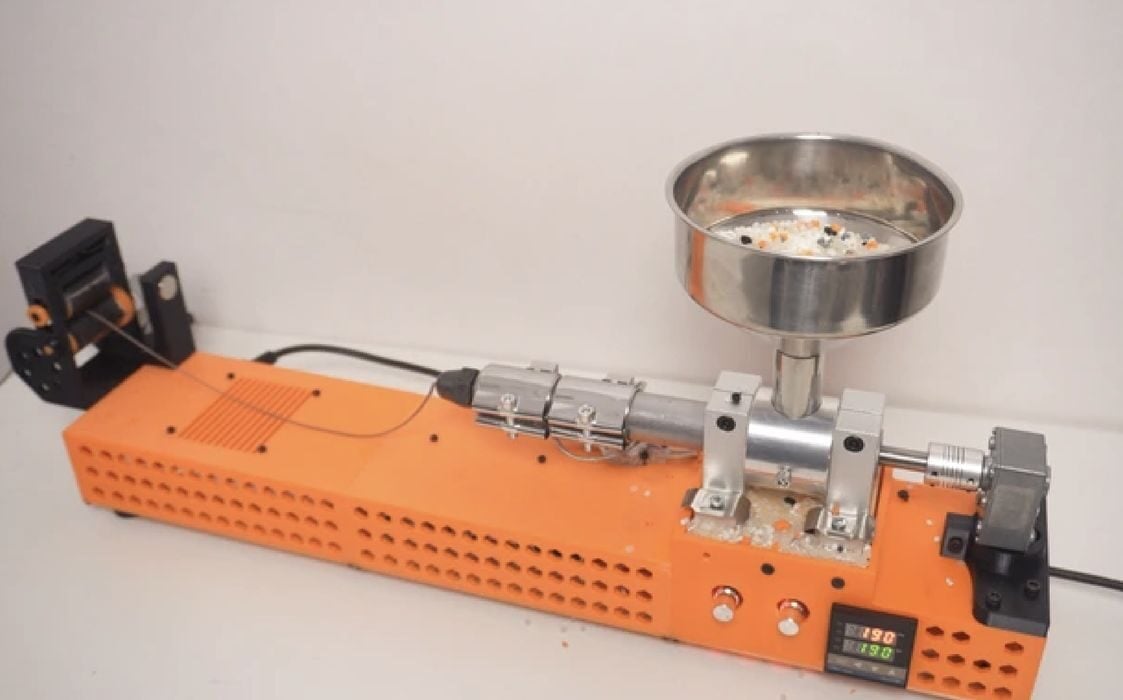
A new desktop filament extruder has appeared on Kickstarter.
The ExtrudeX was launched by Creative3D, and it’s intended to enable home 3D printer operators to re-use some of that endless waste that is produced by 3D printers: failed prints, support structures, purge lines, and, of course, poops.
The goal of the project is to produce a re-extrusion option that is affordable. There are very few low cost extrusion systems available for reasons we will discuss in a moment, but even those cost well over US$10K.
Here, the ExtrudeX is a 3D printable kit, basically a set of STL files and instructions. It’s priced very low, with the maximum option in the Kickstarter being only US$59.
That said, you would still have to print all the parts, purchase all the non-printable items, and then assemble it all together. The project states that the cost of the non-printable parts is typically US$180-250, meaning you could theoretically build one of these units for under US$300 — depending on how you value your time.
The campaign video shows the machine in operation, and it would appear that it is relatively straightforward to recycle your 3D print waste into new filament.
Unfortunately the campaign does not describe a number of challenges to achieving this, factors that have caused countless recycling startups to fail miserably over the past fifteen years.
Correction: they do talk about one key challenge: molecular degradation. I wrote about this the other day, but essentially the problem is that the polymer molecules tend to break apart as they endue the stress and heat of extrusion. This means that remelting and extruding them a second time degrades them even more, weakening the resulting plastic.
The campaign suggests that you mix your 3D printer waste with fresh plastic pellets to solve this problem. It means, however, that you are purchasing far more pellets than you are reusing material. Depending on how much you are printing, this could be a problem, since not everyone wants a pallet of pellets.
The ExtrudeX assumes you have a means to properly chop up your waste. In their video they use some sort of kitchen gadget, but you would have to provide something similar. This would have to be added to the price of the system.
Another major issue is material consistency. It’s a given that you’re not going to have all scraps made from the same material, brand and color. This will require sorting.
Consider how this would work in real life: as you pick through your poop bin, can you recognize which poop is PETG and which is PLA? What about the poops that are a mix of both? Color shouldn’t matter, unless you tend to print only in one color.
It’s important to know that PLA is not always the same. There are multiple brands of material, and even though the badge might say “PLA”, the manufacturers all use slightly different chemical mixes. If you made filament from a mix of these, the optimal print parameters would be unknown and you’d have to redevelop them.
The ExtrudeX does not seem to have a spool take up system. This means that you will have to either make one or do it by hand as the filament is extruded. If you don’t, you’ll end up with a spaghetti mess that could be too brittle to bend around a spool later.
Filament quality is utterly critical. Today’s advanced desktop FFF 3D printers only work well when they have highly precise input filament. If it isn’t, you’ll get blobs, gaps and inconsistent surface quality and strength. Large filament manufacturers have extraordinarily precise equipment that enables them to produce near-identical spools of filament, over and over. The ExtrudeX does not have any of these systems, except the optional laser diameter measurement.
The measurement system appears to be an extra item you would add to the ExtrudeX. It is critical as the diameter of the filament must be consistent. This means that as you start up the system you must iteratively tweak the temperature and speed settings to achieve the desired diameter. Then you have to monitor that readout to make sure it remains constant throughout the process, and make adjustments if things drift. I cannot see how this can be properly done on a desktop machine without considerable attention.
Finally, it seems that the ExtrudeX is designed for both commercial and personal use. The commercial license allows buyers to manufacture units and resell them to others, which is an interesting idea.
Despite its low cost, I am a bit skeptical about whether the ExtrudeX could succeed. Nevertheless, it seems that the campaign has obtained more than a thousand backers so far.
Via Kickstarter
