
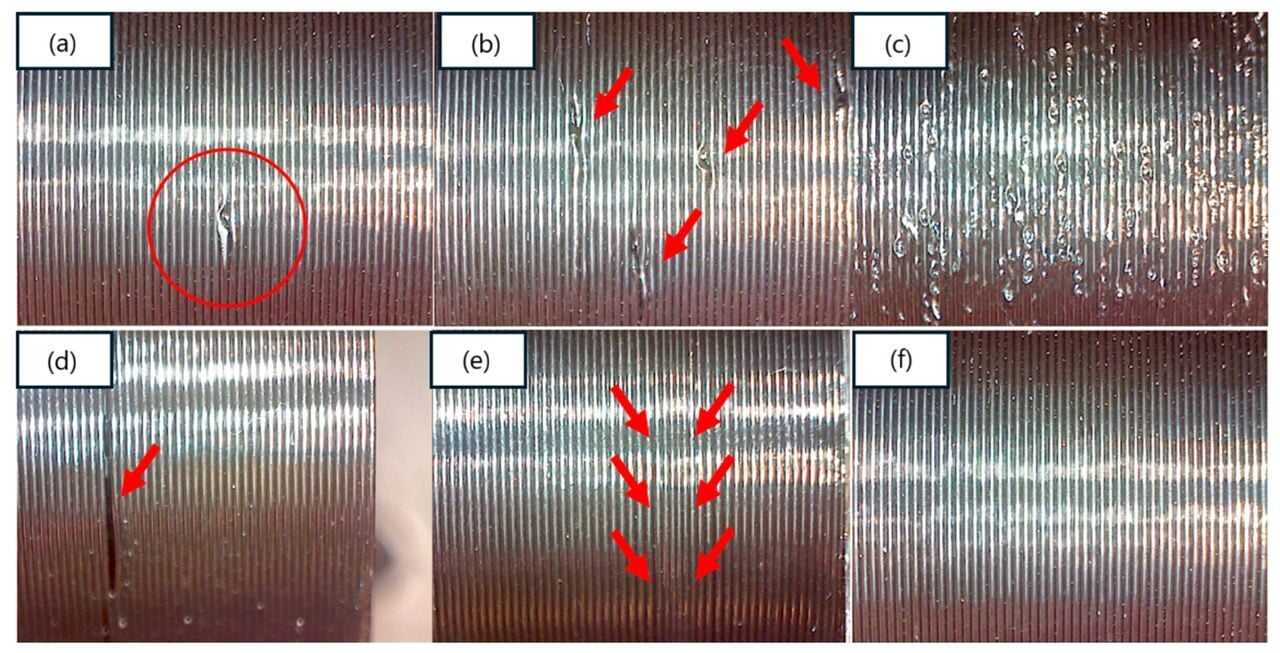
Researchers report that real-time vibration monitoring with active control meaningfully improves the primary profile surface finish on Fused Filament Fabrication (FFF) prints.
The study, published in Applied Sciences, targets a problem every motion-system user knows by sight: ringing or ghosting on outer perimeters after sharp direction changes. Many modern machines mitigate this with careful tuning of acceleration and jerk, while advanced hobby and prosumer setups use accelerometer-based input shaping. The paper moves a step further by pairing direct vibration sensing with an active control strategy focused on the primary profile — the cosmetic outer wall that most determines perceived quality.
In practical terms, the authors place a vibration sensor on the motion system, capture dynamic response during printing, and drive a controller that changes motion commands in response. Rather than passively relying on a once-per-printer calibration, the system adapts as the print runs. The goal is to keep speeds up while suppressing the oscillations that translate into surface ripples on the perimeter.
From Tuning To Sensing: Closing The Loop
Many readers have tried input shapers in Klipper or have seen similar vibration compensation in closed printers from Bambu and others. Those tools typically measure resonance once and then apply a fixed filter to the stepper command stream. The approach described here leans into continuous monitoring: the printer reads vibration during motion and actively adjusts actuation to counter the measured disturbance. In control terms, that can include feedforward terms and filters shaped by what the sensor sees in the moment.
Why focus on the primary profile? In most slicers, the outer perimeter prints at a lower speed to guard finish, but that costs time. If active control can keep the perimeter smooth at higher speeds, you gain throughput without sacrificing finish. The authors report reductions in the amplitude of ringing and improvements in surface roughness metrics on test coupons, though the exact percentages and Ra values depend on the machine and settings used.
What Changes In The Stack
Mechanistically, this requires three pieces: a sensor to capture vibrational energy (typically an accelerometer), firmware capable of ingesting the signal at useful bandwidth, and a control law that maps what the sensor sees to what the steppers should do next. The study does not read like a simple parameter tweak; it implies higher-rate sampling and computation than classic open-loop step generation. That brings constraints: mounting location matters, cable routing can inject noise, and the controller must avoid adding phase lag that would compromise stability.
For shops and service bureaus chasing better cosmetics on consumer-facing parts, the upside is clear. If a closed-loop scheme suppresses ringing without dropping acceleration or outer-wall speed, cost per part falls via shorter cycle times. Designers printing display models, housings or jigs where a clean outer wall matters most would benefit first. The approach is less relevant for internal features and sparse infill, where surface texture is less visible.
There are caveats. The paper focuses on surface finish of the primary profile; it does not claim improved dimensional accuracy across complex geometries or across tall Z builds. Throughput gains are implied rather than benchmarked across a full build plate. The authors do not provide pricing or a commercial path for the sensing and control hardware, and integration with common firmware stacks like Marlin or Klipper is not detailed. Thermal and material variables — such as stiff versus flexible filaments, or high-chamber temperatures — can change system dynamics, and the study does not yet establish robustness across that range.
What To Watch Next
Adoption will hinge on firmware support and turnkey kits. A logical next step would be a reference implementation that can run on common motion controllers without exotic processors, along with standardized calibration prints and datasets that quantify roughness improvement and any speedups on real parts. Cross-printer validation would be particularly useful given the diversity of belt tensions, gantry masses and frame rigidity in the field.
If the community can turn this into a reproducible, low-lift upgrade, active vibration control could become as routine as input shaping — with the difference that it keeps watching while you print. That may be the path to fast and pretty, rather than choosing between them.
Via Applied Sciences
