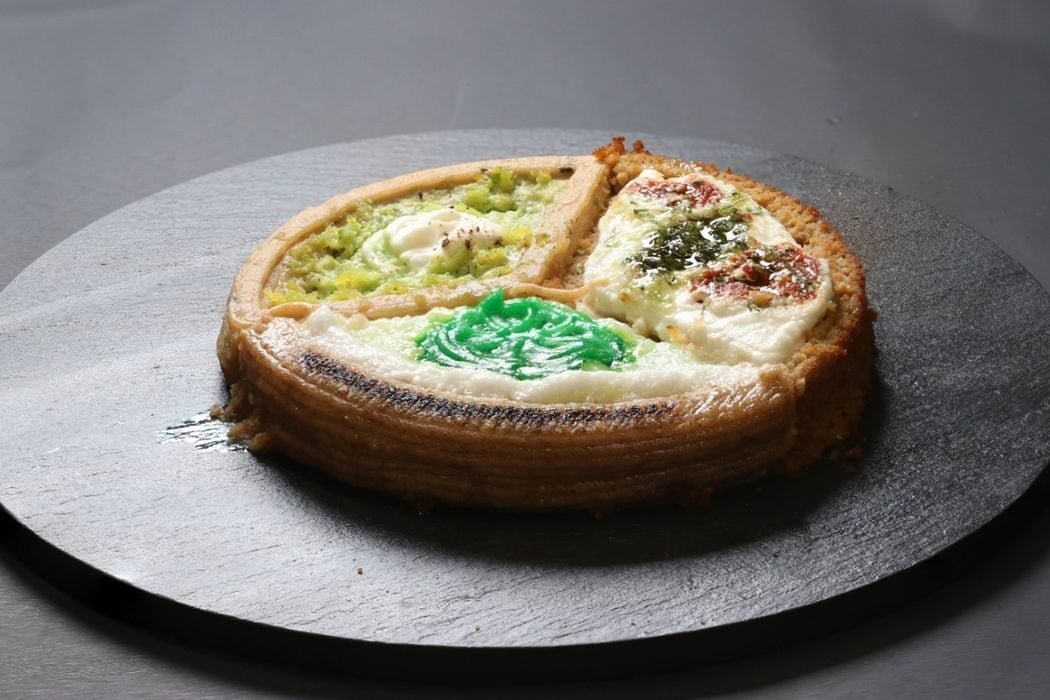
Nimra Shakoor and Charles R. Goulding take readers inside Columbia’s six-year experiment that turned quiche, pizza, and pie into a laser-cooked showcase of how 3D printing could redefine the future of food.
Columbia University engineers have 3D printed an entire three-course meal—a quiche-inspired tart, a cauliflower-dough pizza, and a key lime pie—using fourteen ingredients sourced from local New York City supermarkets, including Appletree Supermarket, Morton Williams, and Whole Foods Market. The work spanned six years and was led by Jonathan Blutinger during his doctoral studies, alongside two other principal contributors and a team of thirty to forty collaborators with expertise in mechanical engineering, computer science, materials science, and culinary techniques. Ingredients were prepared using standard food processors and blenders, demonstrating that cutting-edge digital fabrication can work with accessible, everyday materials (Columbia Spectator).
This achievement extends Columbia’s longstanding tradition in materials science and engineering, which has produced innovations ranging from advanced composites to programmable materials and robotics. The project unites engineering and culinary science, producing dishes that convincingly replicate the appearance and texture of traditionally prepared food. A key innovation was the use of laser-assisted 3D printing, which deposits ingredients in layers while simultaneously cooking or browning them. By adjusting laser intensity and frequency for each layer, the team could control texture and doneness with remarkable precision, overcoming one of the greatest challenges in 3D food printing: creating realistic textures without relying on complex additives or specialty ingredients.
The research builds on earlier experiments with simpler dishes, including a seven-ingredient cheesecake published in npj Science of Food (Blutinger, npj Science of Food, 2023). Those studies helped establish protocols for laser calibration, material preparation, and texture measurement, enabling the team to scale up to a full three-course meal. The methodology involved precise adjustments of laser wavelengths and cooking times for each ingredient, with quantitative evaluation of properties such as elasticity, chewiness, and structural cohesion. These scientific details demonstrate the rigorous engineering foundation behind the project (Blutinger, Journal of Food Engineering, 2025).
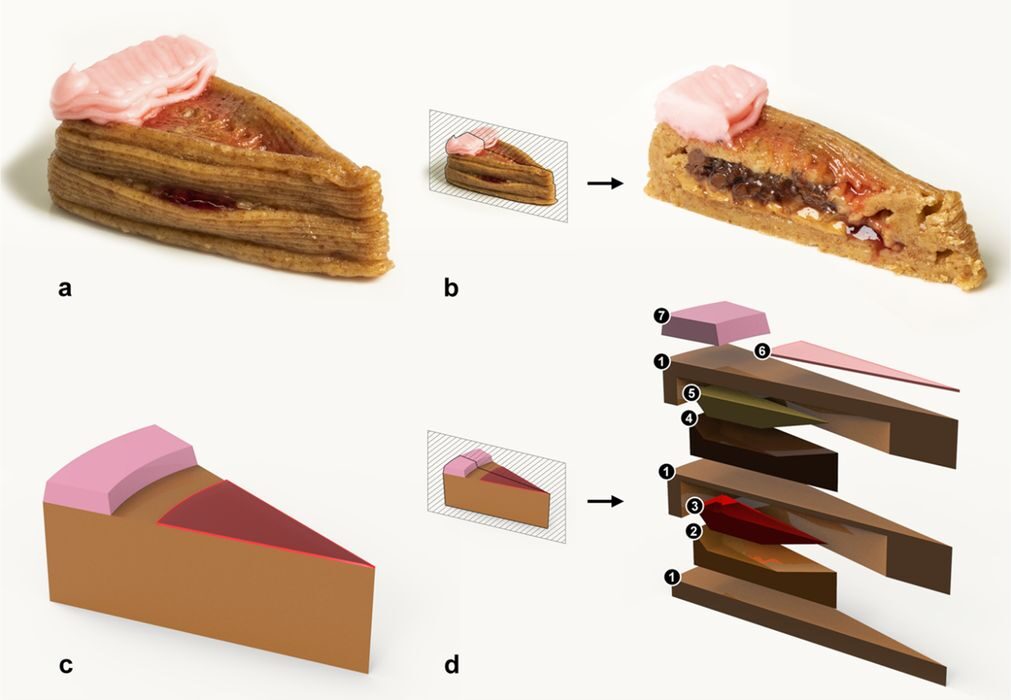
3D food printing presents unique challenges. Ingredients must flow reliably through extrusion mechanisms, maintain shape under gravity, and respond predictably to cooking energy. Many common ingredients fail these tests, making the team’s success with everyday supermarket items particularly noteworthy. Careful preparation combined with real-time laser cooking allowed the engineers to achieve consistent, hyper-realistic textures across all three dishes.
The work also reflects broader ideas advanced by chefs such as Nathan Myhrvold, founder of Modernist Cuisine. Often called the “Godfather” of nutrient-intensive cooking, Myhrvold has explored ways to combine scientific research with culinary creativity to expand the possibilities of flavor, texture, and nutrition. The Columbia team’s experiments demonstrate how these principles can be applied in a digital fabrication context, offering precise control over appearance, flavor, and potentially nutrient content. Blutinger has suggested that such systems could help people “be more deliberate” about what they consume, echoing Myhrvold’s philosophy of combining creativity with scientific rigor in the kitchen; still, he also acknowledges that “research outside Columbia does not yet focus on the same niche of food printing or laser cooking”, meaning that there is a ways to go before this type of technology is commercially available.
Beyond demonstrating technical skill, the project points to a future of personalized and adaptive meals. Laser-assisted printing could produce dishes tailored to individual nutritional needs, textures suitable for patients or elderly populations, or ingredient substitutions for dietary restrictions. This technology also enables experimentation with plant-based or alternative proteins that are difficult to manipulate using conventional methods. On the artistic side, chefs and engineers can explore multi-layered textures, intricate designs, and flavor combinations that would be nearly impossible to produce by hand.
While still largely experimental, Columbia’s achievement shows how interdisciplinary engineering and culinary science can converge to produce results that are both scientifically rigorous and aesthetically compelling. By reframing cooking as a software-driven, data-informed process, this work points toward a future where laboratory innovation and culinary artistry intersect, bringing both precision and creativity to the foods we eat. The project also highlights the broader role of 3D printing in research and development, demonstrating how advanced prototyping and iterative experimentation can drive innovation in any field.
The Research & Development Tax Credit
The now permanent Research & Development Tax Credit (R&D) Tax Credit is available for companies developing new or improved products, processes and/or software.
3D printing can help boost a company’s R&D Tax Credits. Wages for technical employees creating, testing and revising 3D printed prototypes can be included as a percentage of eligible time spent on the R&D Tax Credit. Similarly, when used as a method of improving a process, time spent integrating 3D printing hardware and software counts as an eligible activity. Lastly, when used for modeling and preproduction, the costs of filaments consumed during the development process may also be recovered.
Whether it is used for creating and testing prototypes or for final production, 3D printing is a great indicator that R&D credit-eligible activities are taking place. Companies implementing this technology, at any point, should consider taking advantage of R&D Tax Credits
Final Take
As 3D printing continues to evolve, its applications extend far beyond novelty or lab experiments. From personalized nutrition and sustainable food production to accelerated prototyping in engineering and manufacturing, this technology is shaping a future where creativity, efficiency, and research-driven innovation intersect. Columbia’s three-course meal stands as both a proof of concept and a symbol of the broader potential of 3D printing across industries.