
In this article, Anthony Palumbo and Charles Goulding examine Raven Space Systems’ relocation to Broomfield, Colorado, and how its patented Microwave Assisted Deposition technology could accelerate production of aerospace-grade composite hardware for hypersonic, reentry, and satellite applications.
Introduction
Raven Space Systems, a venture-backed composite 3D printing company, is moving its headquarters and manufacturing operations to Broomfield, Colorado. The relocation positions the company inside one of the nation’s densest aerospace corridors and aligns its patented Microwave Assisted Deposition (MAD) process with regional demand for flight-ready composite hardware. MAD enables rapid, in-situ curing during deposition, which is central to the company’s plan to compress development cycles for high-temperature, high-load environments.
Company Background and Relocation
Founding and contracts. Raven Space Systems was founded by CEO Blake Herren, PhD, and CTO Ryan Cowdrey to advance composite manufacturing for aerospace and defense programs. The company’s technical maturation draws on Small Business Innovation Research (SBIR) and Small Business Technology Transfer (STTR) projects, with non-dilutive awards from AFWERX (the U.S. Air Force’s innovation arm within the Department of Defense), the National Aeronautics and Space Administration (NASA), and the National Science Foundation (NSF). These programs support continued development and flight-relevant validation of the company’s proprietary 3D printing technology.
Growth plan and jobs. In its August 4, 2025 announcement, Raven reported four employees, one already based in Colorado, and outlined plans to create up to 392 jobs over the next eight years. Hiring will scale with facility build-out, certification milestones, and production schedules.
Why Broomfield. Raven evaluated Kansas and Missouri before selecting Broomfield, citing the Front Range’s deep aerospace corridor, proximity to prime contractors and specialized suppliers, and access to university research centers. The move was coordinated with state and local economic development organizations and is supported by performance-based incentives tied to job creation and salaries above the county average.
Facility and supply chain. The company’s planned 17,000-square-foot site at Park 36 will house industrial-scale composite printers, resin and filler mixing systems, and CNC machining lines, with expansion space for additional production bays. Initial operations at 830 Hoyt Street will focus on equipment commissioning, first-article production, and validation against aerospace specifications. Producing high-temperature composite hardware in-state shortens supply chains for Colorado-based integrators, reduces transportation time, and supports secure handling for defense work.
Microwave Assisted Deposition (MAD) Technology
How it works
MAD replaces conventional hand layup and autoclave curing with Direct Ink Write (DIW) deposition of highly filled thermoset or preceramic “inks,” followed by localized microwave energy that cures material immediately after placement. The process supports aerospace-specified matrices and fillers, including epoxy, phenolic, silicone, silicon carbide, and carbon–carbon. Engineers can implement graded material architectures within a single build to tailor thermal and structural behavior through thickness or across the part.
Advantages over conventional manufacturing
- Cycle-time reduction: Curing during deposition removes oven and autoclave queues and compresses production from weeks to days.
- Tooling simplicity: Modular or reusable tooling replaces large, multi-piece molds.
- Design freedom: Complex internal features, integrated stiffeners and ducts, and thermal-protection zones are built without additional layup stages.
- Factory efficiency: Fully consolidated preforms emerge from the printer, reducing floor space and enabling faster design-to-test loops.
- Automation-ready: Integration with software, controls, and data capture aligns with Industry 4.0 strategies for composite manufacturing.
Demonstrated development path
Prior SBIR/STTR efforts have shown microwave-curing of cyanate esters for thermal protection systems (TPS), multi-axis DIW with continuous carbon fiber placement, and integrated thermal-structural components. Cyanate esters are a class of high-performance thermosetting resins known for their excellent thermal stability, low moisture absorption, and resistance to microcracking. In aerospace applications, including additive manufacturing, they are frequently used in thermal protection systems and composite structures where both heat resistance and mechanical integrity are critical. These milestones document progression from lab-scale prototypes toward flight-relevant hardware produced through automated deposition, curing, and consolidation.
Flight-Ready Applications for Microwave-Cured Composite AM
Reentry aeroshells and orbital heat shields
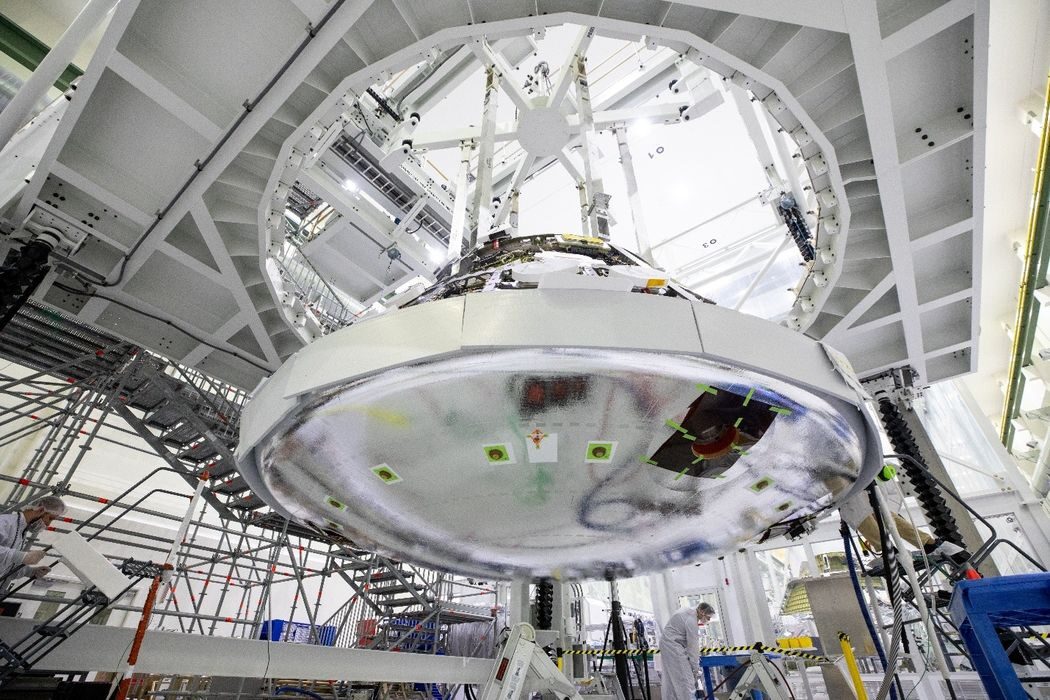
Raven’s AFWERX Open Topic Phase II STTR program, budgeted at approximately US$1.8 million up to 21 months, targets full-scale aeroshells for hypersonic flight testing. The scope advances subscale thermal-vacuum findings toward flight demonstrations, including a non-recoverable Mach3D reentry vehicle for data collection. MAD’s monolithic builds eliminate joints that can fail under heating near 1,600 °C and dynamic pressures above 100 kPa at Mach 3 and beyond. Functionally graded TPS lets engineers place thermal and structural capacity where the flight envelope demands it most.
Solid rocket motor liners and hot-structure internals
Ablative and ultra-high-temperature service requires phenolic, silicone, silicon carbide, and carbon–carbon families. MAD enables complex internal features without tooling changes, and immediate curing helps preserve fiber orientation and resin dispersion while compressing build schedules. Pairing DIW with preceramic precursors provides microwave-assisted routes to silicon-oxycarbide and silicon-carbide components for demanding thermal environments.
Integrated hypersonic test platforms
Instead of printing isolated parts, Raven’s approach includes integrated testbeds that combine aeroshells, internal structures, and sensor housings within a single build. Consolidating multiple tooling and cure stages shortens iteration timelines from months to weeks and better reflects the coupled thermal and structural loads encountered in hypersonic flight.
Satellite and spacecraft hardware
Thermoset and preceramic composites that tolerate UV, radiation, and thermal cycling are suitable for RF-transparent radomes, thermal straps, and lightweight brackets. Topology-optimized architectures commonly yield double-digit mass reductions without compromising stiffness, and controlled porosity can be introduced for passive thermal management without added mass.
Aircraft ducting and elastomeric components
With silicone and elastomeric matrix capability, MAD can produce bleed-air ducting, O-rings, and seals to near-net shape. Lead times that are often four to six weeks with conventional methods can be reduced to under one week. Filler and polymer chemistry can be tuned for chemical or thermal resistance in high-temperature or fuel-vapor environments, consistent with Federal Aviation Administration (FAA) materials guidance for flexible, fire-resistant duct boots.
Reentry capsules and cargo return systems
An NSF SBIR Phase I concept targets single-build reentry capsules that integrate structure and heat shield. The approach seeks an order-of-magnitude reduction in build time with substantial cost savings versus segmented assemblies, while improving dimensional control and enabling reinforcement placement at peak load paths. Targeted performance includes materials comparable to flight-proven heat shields and aluminum-like strength at about half the weight.
Development Milestones and Ramp-Up
Workforce expansion. Raven plans to hire across engineering, technical, and production roles, with average salaries expected to exceed the Broomfield County average. Phased hiring will align with production demand and certification progress.
Production cell installation and certification. Early focus at 830 Hoyt Street includes installing industrial-scale DIW printers, resin and filler mixing stations, and CNC machining lines. Key milestones include equipment commissioning, first-article production, and validation against aerospace specifications. For defense programs, AS9100 certification and compliance with International Traffic in Arms Regulations (ITAR) will be prerequisites for shipping flight hardware at scale.
Flight hardware production. Initial deliveries will prioritize existing contracts, including aeroshell programs and hypersonic testbed components. Customer acceptance testing and environmental qualification will verify MAD’s performance under operational conditions and demonstrate schedule advantages over conventional composite manufacturing.
Partnerships and integration. The Broomfield facility is expected to strengthen partnerships with NASA, the Air Force Research Laboratory, aerospace integrators, and Colorado universities and technical colleges to build a skilled talent pipeline for advanced composites.
The Research & Development Tax Credit
The now permanent Research and Development (R&D) Tax Credit is available for companies developing new or improved products, processes, and/or software. 3D printing can help boost a company’s R&D Tax Credits. Wages for technical employees creating, evaluating, and revising 3D printed prototypes are typically eligible expenses toward the R&D Tax Credit. Similarly, when used as a method of improving a process, time spent integrating 3D printing hardware and software can also be an eligible R&D expense. Lastly, when used for modeling and preproduction, the costs of filaments consumed during the development process may also be recovered.
Whether it is used for creating and testing prototypes or for final production, 3D printing is a great indicator that R&D Credit-eligible activities are taking place. Companies implementing this technology at any point should consider taking advantage of R&D Tax Credits.
Conclusion: Industry Impact and Future Potential
If MAD meets its performance targets, Colorado gains a domestic source of high-temperature composite hardware that is traditionally slow, expensive, and logistically complex to produce. Shorter design-to-delivery timelines can lower schedule risk for hypersonic, reentry, and spaceflight programs while giving Colorado-based integrators a competitive edge in high-heat, high-speed missions. For smaller companies and research teams, access to on-demand aerospace-grade composites can accelerate prototyping, tighten iteration loops, and move technologies up the readiness ladder sooner. Raven’s integration into the state’s manufacturing base would complement Colorado’s historical strength in integration and assembly while advancing the region toward leadership in advanced composite production and the broader additive manufacturing ecosystem.