
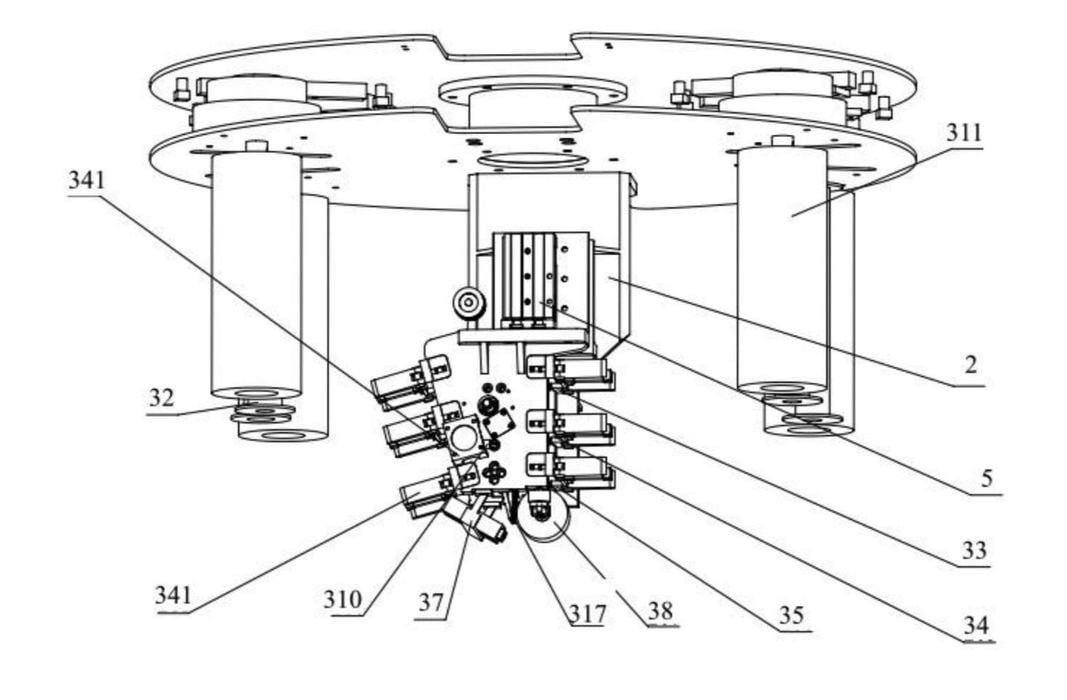
A new Chinese patent describes a robotic toolhead that blends automatic fiber placement with FFF for thermoplastic carbon fiber parts.
The filing, CN121179720A, proposes a compact end-effector that switches between automatic wire laying — better known in industry as automatic fiber placement (AFP) — and Fused Filament Fabrication (FFF) without a manual tool change. The idea is to exploit the high stiffness and strength of continuous carbon fiber tape while using FFF to build complex features, ribs, bosses and transitions that are awkward for AFP alone.
Hybrid composite AM is not new in spirit: Markforged, Anisoprint and 9T Labs all mix fiber reinforcement with polymer extrusion, while aerospace AFP vendors bond laser-consolidated tapes on large robots. This approach, however, separates the AFP and FFF modules on the same base and introduces quick lift-and-retract motion so one process can yield to the other within a single print program. If it works as claimed, it could reduce handling steps, improve consolidation control and cut cycle time.
How The Hybrid Toolhead Works
The device mounts to a six-axis robot via a flange plate and carries two vertical carriages. One side holds the AFP unit; the other carries at least one FFF printhead, and the patent shows two extruders flanking the laying unit. Sliding table cylinders raise and lower the respective modules to avoid interference, effectively acting as a built-in toolchanger.
The AFP path uses four tow channels feeding thermoplastic carbon fiber prepreg from four spools. A tow guide and tensioning assembly combines a brake on each reel, a floating roller (dancer) on linear rails, springs and a displacement sensor to create closed-loop tension control. Before compaction, the four tows are directed to merge into a wide, gapless band.
Consolidation is done with a laser heating element ahead of a compliant compaction roller equipped with a pressure sensor. Upstream, the patent details clamping, dual-feed rollers and an air-cylinder-driven shear to meter or cut individual tows. The FFF side is conventional: spools, drive rollers, throat, a second press roller and a heatsink with a fan. A quick-release linkage lets operators remove or service subassemblies rapidly.
Why This Could Matter In Composite AM
The claimed benefit is agility: lay long fibers for primary load paths, then retract AFP and immediately deposit polymer with FFF to capture geometry AFP struggles with. The authors propose roughly 50 percent higher production efficiency and about 20 percent better mechanical properties versus a baseline flow where AFP parts are built, removed, then bonded to separately printed features. Those numbers lack public test data, but the mechanism — fewer fixtures, fewer heat cycles, better consolidation pressure control — is plausible.
Closed-loop elements are noteworthy. Tension sensing at the dancer and force sensing at the compaction roller address two key failure modes in tape placement: fiber buckling and over-crushing. For service bureaus and aerospace labs, that could improve reliability and reduce scrap. For automotive or industrial users, tighter process control and reduced human touch time help the economics of mid-volume composite brackets and covers.
Compared with CFR-style desktop systems, this approach keeps true AFP attributes — laser consolidation and multi-tow management — while preserving FFF’s versatility. Build volume is effectively defined by the robot reach and the fixture, which suits large and irregular molds. Two FFF heads could also enable dual-material printing or soluble supports for complex overprints.
There are gaps. The patent does not specify deposition rates, tape width, compatible matrices or laser power, so throughput remains an open question. Thermal management at the AFP–FFF interface will be critical; bonding quality between freshly consolidated tape and printed polymer needs validation across PA, PEKK, PEEK or other matrices. Software is another hurdle: path planning that interleaves AFP steering, tension control and extrusion toolpaths is nontrivial, and no CAM stack is named.
If a prototype appears, key data to watch will be lap-shear and open-hole compression across layups that include printed interlayers, as well as repeatability of compaction force under steering. A realistic adoption path would be pilot cells in research labs or Tier 1 tooling shops, then migration to production once sensing, safety for the laser, and programming workflows stabilize.
As ever with composite AM, the promise is in the coupling — and this patent aims to couple two very different strengths without getting in its own way.
Via Google Patents
