
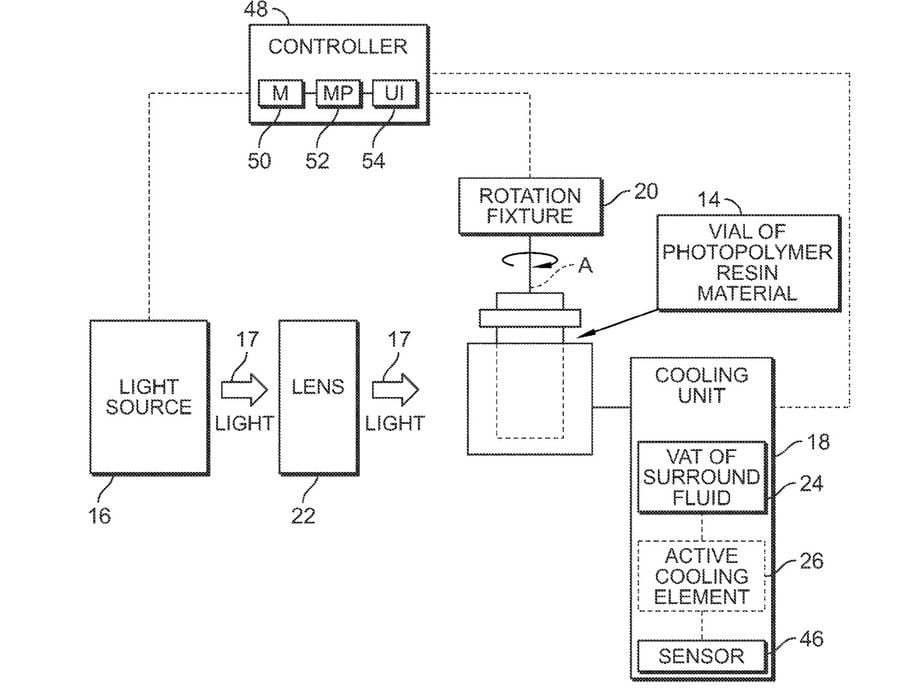
A new patent outlines a cooled volumetric 3D printing architecture that promises bigger parts and faster builds.
Volumetric Additive Manufacturing (VAM), notably Computed Axial Lithography (CAL), projects light into a rotating resin volume to cure a part in minutes. It avoids layer artifacts and can deliver isotropic properties, but scaling beyond centimeter-class parts has been hard. The culprit is heat: photopolymerization is highly exothermic, and in large volumes the resin overheats, accelerating diffusion and reaction kinetics that trigger runaway cure and loss of fidelity.
The invention addresses that bottleneck with an integrated thermal management strategy. It places a glass vial of photopolymer in a vat of index-matched surround fluid, then adds optional active cooling — chilled plates, internal or external cooling pipes, recirculation, and even thermally regulated transparent rods inside the resin. The concept is simple: keep the resin cold enough to hold reaction rates and convection in check while preserving the optical path for projections.
Why Cooling Matters For CAL
The patent quantifies the thermal problem. Polymerizing a 30 millimeter by 50 millimeter cylinder in four minutes releases about 16,452 joules; in a perfectly insulated case the resin could rise roughly 184 C. In practice, the inventors target a 276 K surround bath, often immersion oil, with refractive index closely matched to the resin to minimize refraction and scattering. They report that a 75 millimeter tall model of The Thinker printed cleanly in a 62 millimeter diameter vial when cooled to 276 K, but the same print at 298 K devolved into an overcured blob attached to the vial walls.
The system rotates the vial under a 405 nm light engine while cycling a projection set. The controller reads temperature via contact or non-contact sensors and adjusts light output, rotation, or cooling flows. Example parameters include recirculating the surround fluid at about 80 milliliters per second and using low-absorbing photoinitiators like Irgacure 907 at tuned concentrations to balance absorption depth and cure kinetics.
Beyond passive chilling, several active configurations are claimed: cooling plates under or around the vat (including thermoelectric elements), cooling pipes traversing the surround fluid with secondary coolant, recirculating the surround fluid through a heat exchanger, and optically transparent cooling rods or pipes placed within the resin itself. The optical components, rods, and fluids are specified to be index-matched so projections are not distorted.
Throughput Claims And Practical Details
On performance, the filing claims builds up to 350 cm3 and throughput exceeding 23 cm3 per minute, with parts as large as 9 by 7 by 7 centimeters completed in minutes at sub-millimeter resolution — reportedly over ten times the largest prints and over five times the highest throughput versus prior CAL systems. Test prints used BPA/PEGDA resins with photoinitiator concentrations in the roughly 25–45 millimolar range, and a 405 nm source measured up to about 41 mW cm−2.
The patent also covers production-minded details. Vials can include bottom ports for draining uncured resin and flushing with cleaning solution or air, preserving resin purity. A rotating autoloading carousel shuttles multiple vials to the rotation fixture for sequential exposures, enabling near zero-downtime workflows and minimizing manual touch time. There is also provision for overprinting onto inserts, aligned with ferromagnets to keep the insert on the rotation axis.
As with all patents, caveats apply. This is not a commercial launch; no pricing, software chain, certified materials, or service data are provided. The data focus on a single resin family and immersion oil; expansion to dental, elastomeric, or high-Tg photopolymers is unproven. Index matching can add cost and complicate material handling, and internal cooling features must remain invisible optically while avoiding flow artifacts. Heat removal capacity will scale nonlinearly with part geometry — lattices will be simpler than dense solids.
What to watch next is straightforward: reproducible demonstrations of the stated 350 cm3 volume and 23 cm3 per minute on complex geometries, mechanical property maps across large cross sections, and robust recipes across multiple resins. If the autoloading and drain-clean cycle work as described, service bureaus could gain a new route to rapid, supportless vat photopolymerization for medium-sized parts.
Volumetric systems have long promised sprint-speed prints; if this cooling strategy holds up, CAL might finally outrun its own heat.
Via Google Patents
