
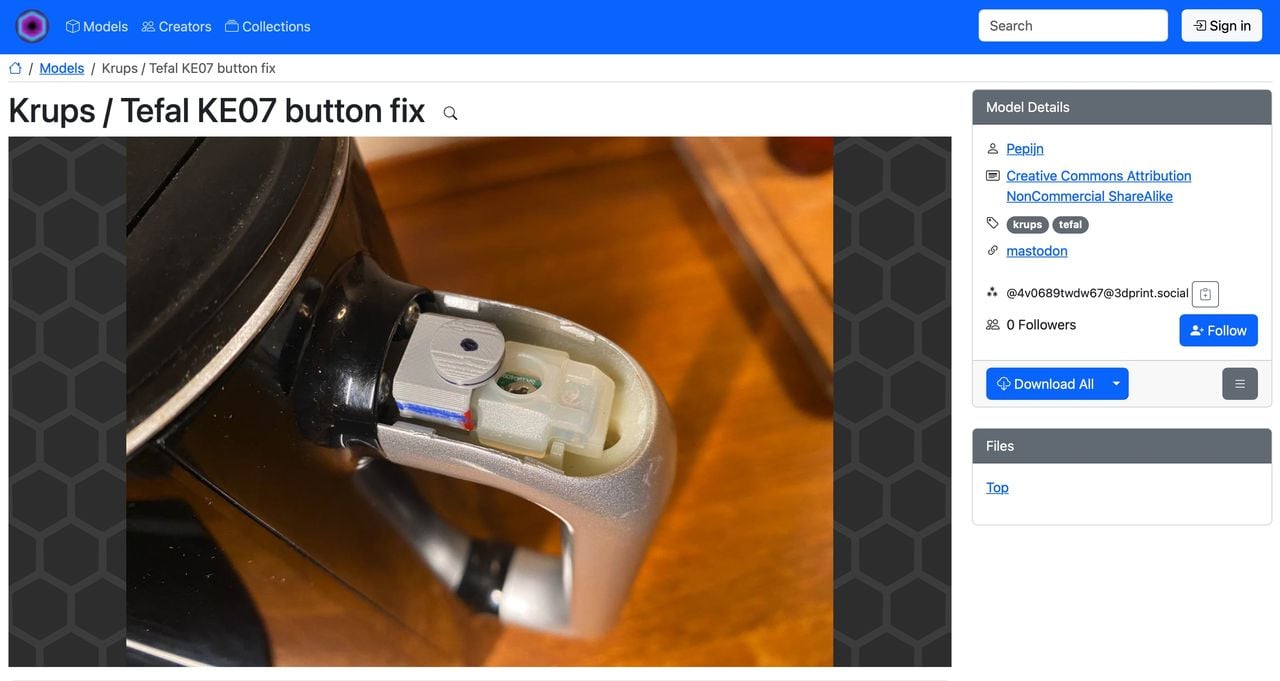
Manyfold issued a big release of new features for their open source, distributed 3D model repository software.
You may not have heard of Manyfold, as it is still getting started. It began as a way to slide content away from the increasingly closed gardens of the 3D printer manufacturers.
You may have noticed this effect. Most of the big 3D model repositories are directly associated with one of the major 3D printer manufacturers:
- Creality Cloud: Creality
- Printables: Prusa Research
- MakerOnline: Anycubic
- MakerWorld: Bambu Lab
- Thingiverse: UltiMaker
There are only a few independent 3D model repositories, such as MyMiniFactory and Cults. These are not subsidized by a printer manufacturer, so they have to go to other ways to generate revenue to keep things going.
Some have concerns with the main repositories because of their association with commercial companies. Even today you see that each of these systems tends to “make life a lot easier” for users of their own equipment. There are even trends where 3D models may be “exclusive” to a platform, and not appear on others.
These are all ways to encourage more sales of the company’s equipment.
But it could get worse. A lot worse. While today we freely bounce around these repositories and (mostly) freely upload and download, things could change. In a future world where only a few repositories exist, an aggressive 3D printer manufacturer might supermonetize their platform by adding all manner of fees and constraints.
This typically happens in situations where near monopolies emerge. Since the company has a near monopoly on equipment and models, they don’t have much room to continue expanding — no more customers. To grow more of that delicious revenue they begin to monetize whatever they have available. In this case, it will be the 3D model repositories.
Manyfold is the outlet to escape that scenario. It is an open source tool intended to be run by anyone, and it provides a 3D model repository similar to the big guys, except with far fewer 3D models and less bells & whistles.
But, you say, “I don’t have that many 3D models, how could this work?” The answer is that Manyfold is Federated. In other words, it automatically connects to other Manyfold instances and shares the content. This means that your local Manyfold instance could “see” 3D models stored on other instances, and download them as if they were local.
The latest release of Manyfold, v0.132.0, includes a bevy of improvements. They explain:
“In the last release, we added “user groups” for creators, letting you more easily manage large groups of users who you want to give permissions on models. This was aimed at supporting creators like the many on Patreon who create models for their subscribers. This release adds the remaining features to support that process.
You can now add people to groups based on their email address, and if they don’t have a local account, they’ll automatically be invited to create one! Existing users are also notified when they’re added to a group.
All this can be achieved through the API as well as manually through a browser, so now OAuth apps and API keys can now be created by any user with “contributor” permission or above; i.e. anyone with upload permission. We’ll be writing a guide soon on exactly how to use the API and a tool like Zapier to connect up a Patreon tier to a Manyfold group, so you can fully automate distributing your content!
There are also a pile of bugfixes and minor improvements, as well as added support for opening 3MF files directly in Bambu Studio (other files formats don’t seem to work directly via their URLs, so you’ll still have to download STLs for now).”
As you can tell, Manyfold is still quite new and lots of features are absent. That’s why it’s a “0” release instead of a “1” release. However, to get somewhere you have to start at zero before you get to one, and this is normal.
At some point Manyfold will get to release 1.0 and it should be robust enough for serious use. By then it may be even more troubles with the commercial repositories, and Manyfold could be a welcome option at that point.
In the meantime, you are free to either install and run your own experimental Manyfold instance, or just use the project’s flagship instance. Manyfold.social.
Via Manyfold, 3D Print.social, and GitHub
