
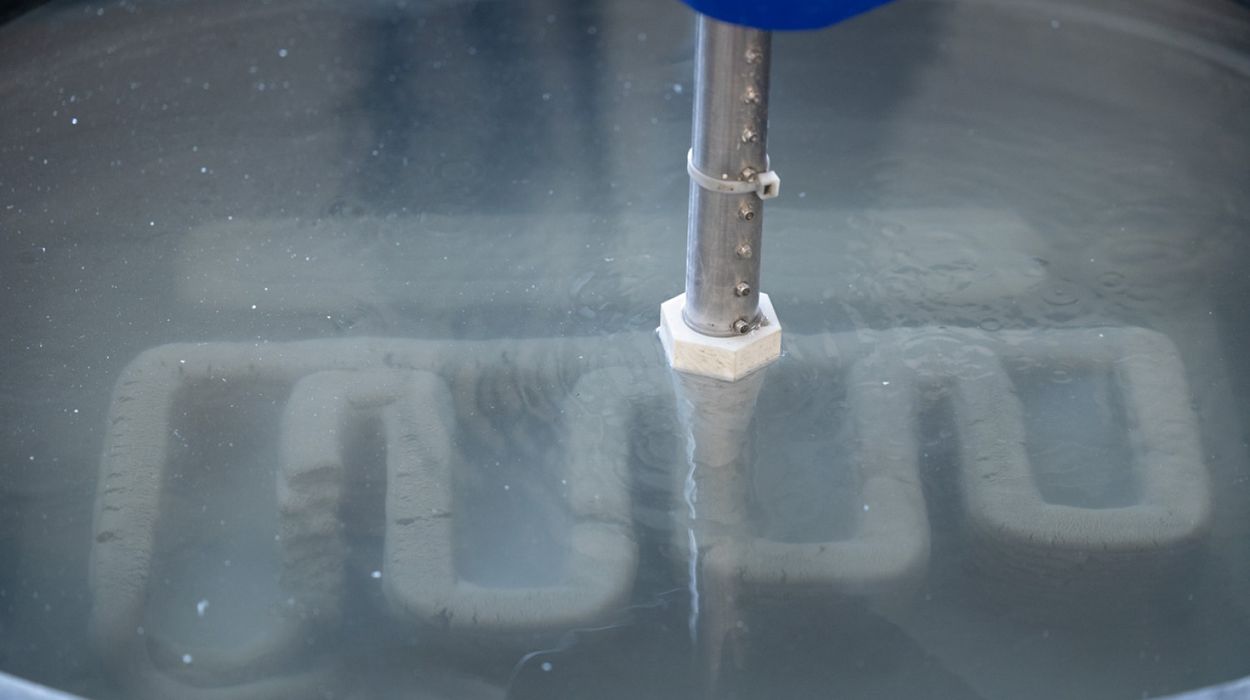
A team from Cornell has successfully 3D printed concrete — underwater.
3DCP is a well-understood technology at this point, with multiple providers of equipment. With that equipment, large concrete structures can be relatively quickly produced layer by layer. But all of that 3DCP activity takes place on land in air.
A team from Cornell took on a challenge from the Defense Advanced Research Projects Agency (DARPA), which asked for a system to 3D print concrete structures underwater — using ocean sediment as the main material. At first, this sounds rather ambitious, and even impossible.
But the Cornell team, who had previous experience using normal 3DCP gear, thought they might be able to get this done with some tweaks.
Underwater 3D Printing Challenges
What tweaks would be required to adapt an air-capable 3DCP system into a water-capable 3DCP system? There are several things to consider.
Flow was the biggest issue. The problem is that in order to make the concrete material flow through the printer to the nozzle, it must be less viscous than typical concretes. This is also a problem with air-based 3DCP systems, where water is typically added to loosen it up. However, underwater that flow will be immediately introduced to even more water. That makes the concrete rather slumpy, so the team had to play with several different additives to strike a balance.
Another issue is that underwater there are most likely no human supervisors. While you could send a diver to the site, their capabilities would be quite limited as compared to a ground-based construction site supervisor. In other words, the system would have to reliably work on its own. That required development of new software control systems — that just might also be useful above the water on ground-based systems.
Finally, there is the issue of sensors. If there are no humans present to supervise, the system must include a set of sensors to understand what’s going on at the site. The deposition must be quite accurate; otherwise, the built object’s strength or function could be compromised.
This is complicated by the fact that sediment is easily disturbed underwater, making visual systems ineffective. Any electromagnetic radiation-based systems, like LIDAR, won’t work underwater. For this, the Cornell team had to devise a number of innovative solutions.
Finally, they also had to figure out how to incorporate ocean sediment into the mix, as per the DARPA request. That alone is a big issue because sediments can vary in properties and must be somehow collected from the nearby area.
The team did manage to solve all of these problems and ultimately was able to successfully 3D print some concrete structures underwater.
Underwater 3D Printing Implications
This is a very important milestone because if commercialized, it could revolutionize how ocean structures are produced. Today’s approaches are difficult and expensive:
- Build on land, transport, and then sink it into the ocean.
- Establish a dry build area by pumping out water and building using conventional methods — but only in shallow areas.
An ocean-capable 3DCP system would be enormously versatile: it would be able to work in a wide range of depths without many of the issues in conventional approaches. It would be easy to transport, especially since the majority of the material — sediment — is already on site. We could see an explosion of underwater facilities, tunnels, energy infrastructure and much more.
I’m hoping this technology is quickly commercialized.
Via Cornell
