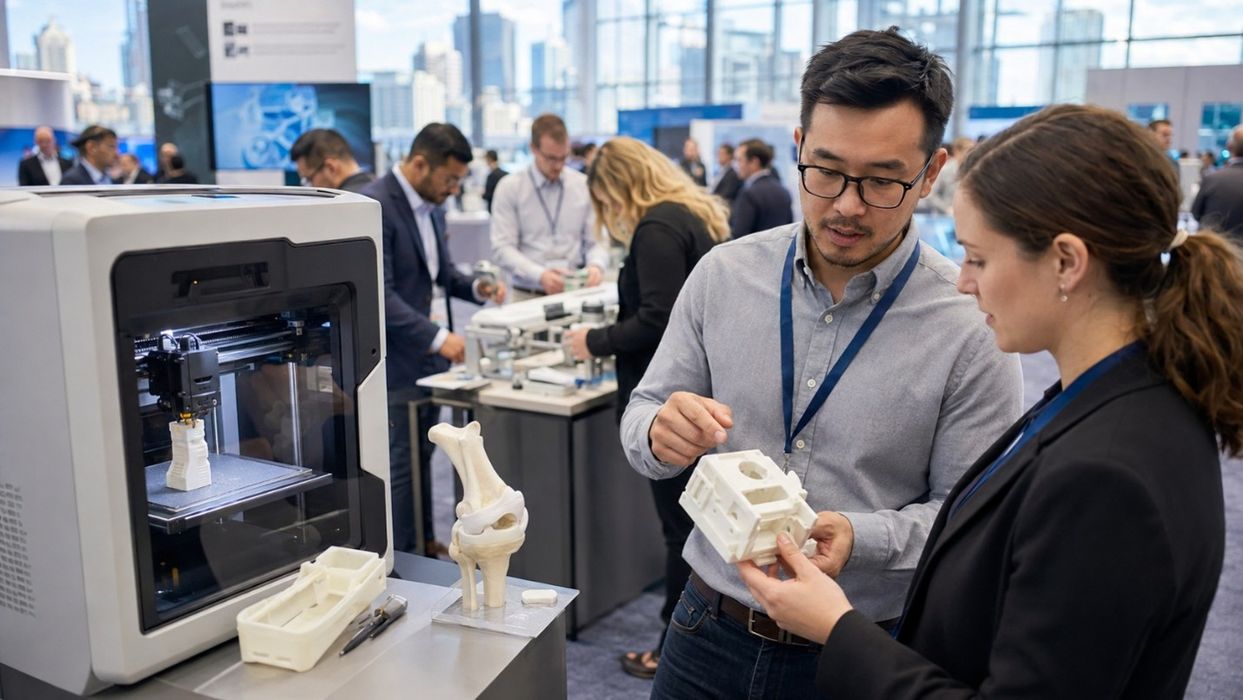
Anthony Palumbo, Mellissa McIntyre, and Charles Goulding look ahead to MEDevice Boston 2026 and the medical-device companies applying additive manufacturing to product development and production.
Introduction
On August 26–27, 2026, the Thomas M. Menino Convention & Exhibition Center in Boston will host MEDevice Boston, one of New England’s leading events for medical-device design and manufacturing. Formerly known as BIOMEDevice, the event is now part of the MD&M portfolio and brings together medical-device original equipment manufacturers (OEMs), startups, engineers, product developers, contract manufacturers, technology providers, and suppliers.
MEDevice Boston is particularly valuable because it covers the entire medical-device development pathway. Exhibitors span R&D and design, components, materials, sensors, electronics, automation, injection molding, testing, packaging, sterilization, quality systems, and regulatory compliance. 3D printing and rapid prototyping are also identified as core areas of the show, reflecting the expanding role of additive manufacturing in medical-product development.
For medical-device companies, additive manufacturing is no longer limited to producing visual concept models. Engineers now use it to evaluate form and fit, test assembly methods, develop functional prototypes, produce anatomical models and surgical guides, create tooling and fixtures, manufacture patient-specific devices, and, in appropriate applications, produce end-use components. The ability to move quickly from a digital model to a physical part can shorten learning cycles while allowing development teams to evaluate geometries that would be difficult or uneconomical to produce through conventional methods.
The conference program reinforces this connection. One scheduled conference session, “Personalized Medical Device Manufacturing: FDA Clearance, and Reshoring for Patient-Specific Devices,” focuses on the shift toward patient-specific devices enabled by additive manufacturing and digital design workflows. This combination of technical development, regulatory strategy, and manufacturing implementation is exactly what makes MEDevice Boston relevant to the 3D printing community.
Why R&D Tax Savers is Attending
R&D Tax Savers will be attending MEDevice Boston to learn directly from the engineers, designers, manufacturers, and technology providers developing the next generation of medical products. Medical-device development often involves extensive technical work long before a product reaches commercial production. Teams may evaluate alternative geometries, materials, manufacturing methods, control strategies, software architectures, assembly processes, and test methods while working to improve device function, performance, reliability, or quality.
Additive manufacturing provides an especially useful window into this work. A series of printed parts can embody months of engineering decisions: wall thicknesses may have changed, internal channels may have been rerouted, materials may have been compared, support strategies may have been altered, and interfaces may have been adjusted after physical testing. The printed object is often only the visible result of a much broader process of technical experimentation.
We are interested in understanding how exhibitors are using additive manufacturing throughout this process, where technical uncertainties arise, how prototype findings influence the final design, and how companies transition from rapid iteration to controlled medical-device production. Those conversations can also help companies recognize potentially credit-eligible R&D activities that may otherwise be viewed simply as ordinary product development.
Several exhibitors stand out for their direct or supporting roles in medical additive manufacturing.
Forj Medical
Among the companies we are most interested in visiting is Forj Medical. Formed in 2025 through the combination of Intricon and Minnetronix Medical, Forj is a vertically integrated medical-device contract design and manufacturing organization. Its capabilities extend from early product development through commercial-scale manufacturing and include system design, microelectronics, precision molding, automation, testing, and supply-chain support.
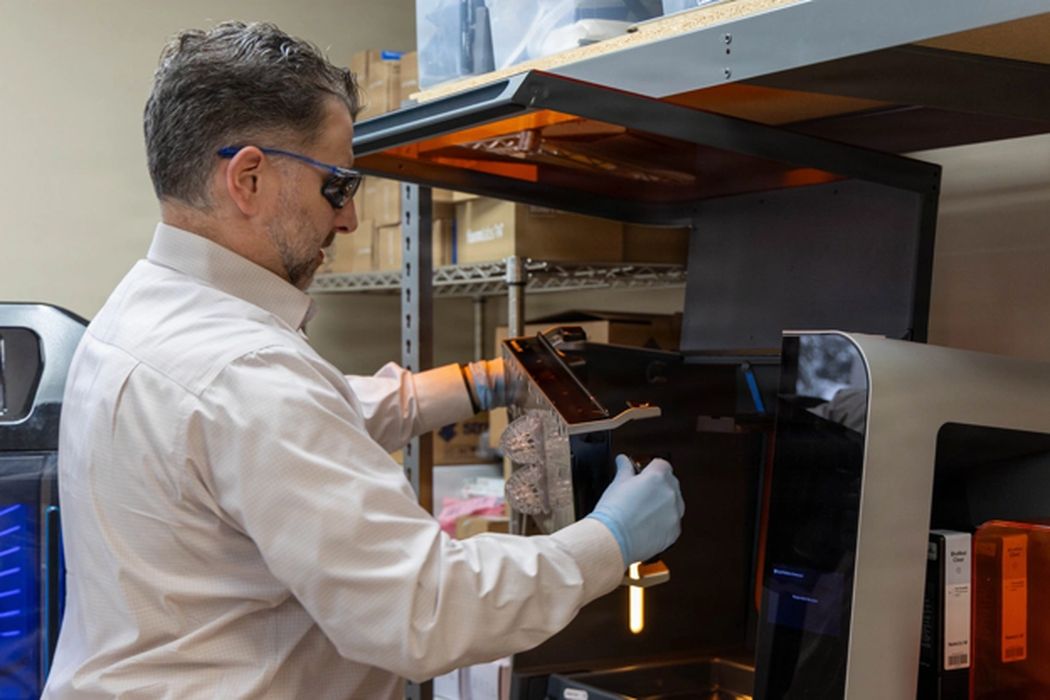
Additive manufacturing is an explicit part of that offering. Forj’s manufacturing capabilities include high-precision polymer and metal 3D printing for intricate medical-device components. These processes can support rapid design iteration without conventional tooling, reduce material waste, and give engineers greater freedom when developing complex features.
A recent Forj tracker case study demonstrates the value of this capability. The company helped develop a segmental tracker used during spinal procedures. The design required highly accurate placement of miniature electromagnetic sensor coils within a molded carrier. Forj used high-resolution resin 3D printing to produce the molded-part geometries during development, issue new design rounds approximately weekly, and validate the required angular tolerances before cutting the production molds. By the time the molded parts arrived, the geometry had already been physically evaluated.
This example captures one of additive manufacturing’s most valuable roles in MedTech. The printed part did not merely communicate appearance; it allowed the development team to evaluate a functionally important geometric requirement before committing to expensive tooling. It also connected additive manufacturing with PCB development, coil winding, molding, assembly planning, and eventual production transfer.
We look forward to learning more about how Forj selects between polymer and metal printing, how it uses printed components to accelerate clinical-readiness builds, and how prototype evidence is carried into design controls and scalable manufacturing.
Goddard Product Development
Goddard Product Development is another exhibitor that deserves attention. Goddard is a full-service product development consultancy working across medical devices, robotic systems, and automation. Its medical-device experience spans surgical instruments, drug-delivery products, endoscopes, imaging hardware, cardiac devices, and surgical robotics, with industrial design, human factors, and multiple engineering disciplines integrated into the development process.
Goddard describes rapid prototype cycles as a means of validating high-risk assumptions and testing mechanical, electrical, and software interactions early in development. Its prototyping services are intended to turn concepts into testable models, identify design deficiencies before production, and establish a foundation for manufacturing transfer.
The company has also specifically highlighted 3D printing’s role in fast product development. In a plastics article, Goddard identifies 3D printing as a leading method for producing prototypes quickly while emphasizing that prototype materials and performance must appropriately represent the intended product. That distinction is particularly important in medical development. A visually accurate model may answer ergonomic or packaging questions, while a functional test article may need different material properties, tolerances, surface characteristics, or sterilization resistance.
Goddard’s multidisciplinary model makes the company an interesting example of how additive manufacturing fits into a larger engineering program. A printed housing may expose an assembly conflict. A device mockup may reveal a human-factors issue. A functional prototype may demonstrate that a wall, joint, or mechanism cannot withstand the expected load. Each result can prompt another design alternative and another round of technical evaluation.
At MEDevice Boston, we are interested in discussing how Goddard determines which prototype method is appropriate for each development question, how it balances print speed against representative material behavior, and how additive prototypes support the transition from early concepts to verified, manufacturing-ready devices.
Nota3D
Of all the exhibitors, Nota3D has one of the most direct connections to the additive manufacturing industry. The company supplies, leases, services, and supports 3D printers, software, and materials while also offering printing services for product development and production. Its technology portfolio includes stereolithography, selective laser sintering, multi-jet printing, digital light processing, direct metal printing, and fused deposition modeling.
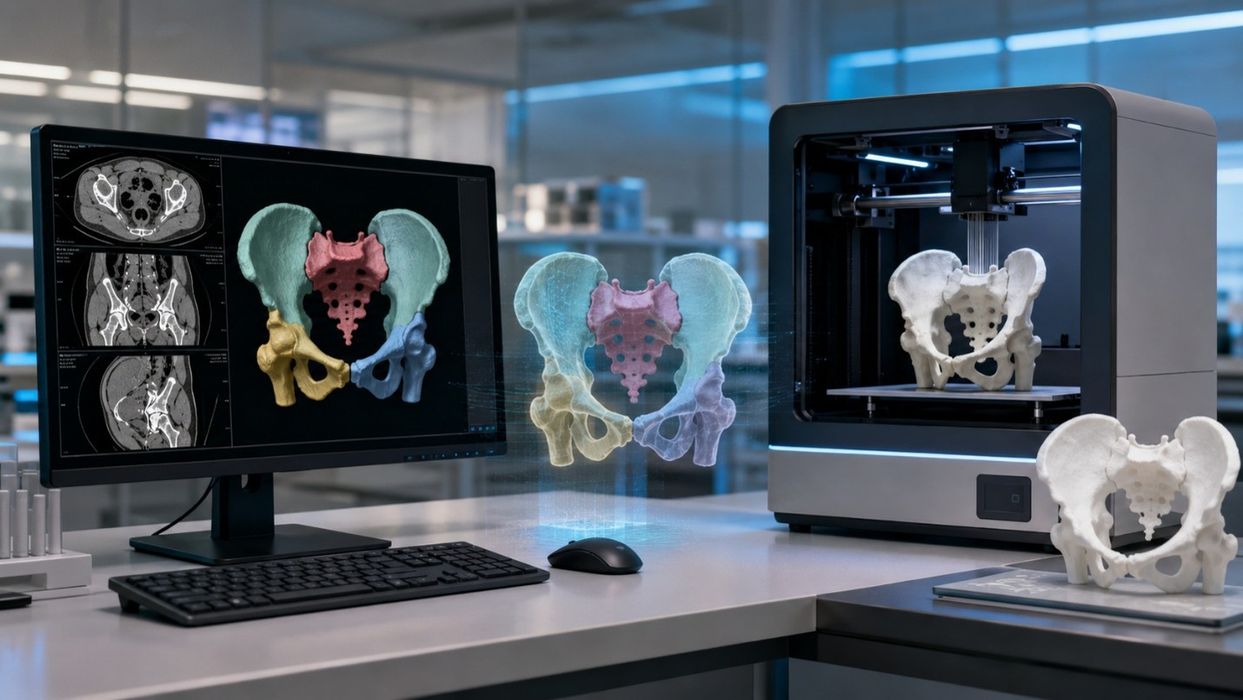
Nota3D’s healthcare offerings are particularly relevant. Its D2P software consolidates medical-image segmentation and model preparation into a single workflow. DICOM imaging data can be converted into digital models used for 3D-printed, patient-specific anatomical models, virtual-reality visualization, surgical planning, and CAD workflows. This is an important reminder that medical 3D printing begins well before the printer. Image segmentation, model preparation, file integrity, and workflow control can be every bit as important as the physical build.
The company also offers the EXT 220 MED, an open-filament extrusion platform designed to manufacture medical devices from high-performance polymers such as PEEK and Radel PPSU. Its controlled build environment, filtration, and qualification support are intended to help integrate additive manufacturing into medical-production settings. These capabilities point toward a future in which high-performance polymer implants and instruments can be produced through controlled digital workflows rather than only through traditional machining or molding.
Nota3D therefore represents more than printer distribution. Its combination of hardware, software, materials, applications knowledge, and support illustrates the complete additive ecosystem required for medical adoption. We look forward to discussing how healthcare organizations decide whether to bring printing in-house, how they qualify materials and workflows, and how point-of-care production will continue to develop.
Protolabs
Protolabs is another exhibitor with extensive additive manufacturing capabilities. The company operates more than 120 additive machines and offers a broad range of processes for polymer, metal, and elastomeric parts. Its portfolio includes direct metal laser sintering (DMLS), stereolithography (SLA), selective laser sintering (SLS), Multi Jet Fusion (MJF), PolyJet, advanced photopolymer processes, and fused deposition modeling.
Its medical capabilities demonstrate how process selection changes with the engineering question. DMLS can produce complex metal instruments and components. SLA can create precise resin parts with fine features and smooth surfaces. SLS and MJF can produce durable nylon prototypes and functional components. PolyJet can combine different colors or material characteristics in a single model, which can be useful for fit testing and realistic device mockups. Advanced photopolymers and printable silicone-like materials further expand the types of behavior that engineers can evaluate before selecting a production process.
Protolabs also supports applications including housings, microfluidic components, prosthetic parts, surgical instruments, implants, diagnostic equipment, and anatomical models. Its ISO 13485 quality certification and certified titanium and cobalt-chrome offerings are especially relevant for medical customers attempting to move beyond early prototypes.
That makes Protolabs particularly interesting is the connection between digital quoting, design-for-additive-manufacturing feedback, rapid production, and quality documentation. Fast access to parts is valuable, but speed alone does not resolve an engineering uncertainty. The larger opportunity is to compare design alternatives quickly, evaluate the resulting data, and then use those findings to make a better technical decision. We look forward to learning how Protolabs continues to close the gap between one-off prototypes, low-volume builds, and repeatable production.
3D Printing Activities and R&D Tax Credit Potential
The activities represented at MEDevice Boston may provide significant federal R&D tax credit opportunities when companies are developing or improving products, processes, software, techniques, or manufacturing methods through technical experimentation. The use of a 3D printer does not qualify an activity by itself. Eligibility depends on the underlying development work.
Under IRC Section 41, qualified research generally must involve domestic research or experimental expenditures, seek technological information useful in developing a new or improved business component, and include a process of experimentation relating to function, performance, reliability, or quality. The requirements are applied separately to each business component.
Potential qualified research expenses can include wages paid to employees performing, directly supervising, or directly supporting qualified research; non-depreciable supplies consumed in that research, including eligible prototype materials; and generally, 65% of qualifying contract-research payments. The purchase price of a 3D printer is generally not a qualified supply expense when the machine is depreciable equipment, even if it is used in research.
Careful analysis remains essential. Routine printing from a completed design, ordinary production, basic quality control, duplication of an existing product, and work performed after the beginning of commercial production generally do not qualify. Contract terms can also affect which party bears the financial risk and retains substantial rights to the research. Companies should document the technical uncertainties encountered, alternatives evaluated, tests performed, results obtained, and resulting design or process decisions rather than relying only on a list of printed parts.
Conclusion
MEDevice Boston offers an unusually concentrated view of the medical-device development ecosystem. Additive manufacturing will appear alongside electronics, sensors, molding, automation, testing, sterilization, quality systems, and regulatory strategy, all of which help determine whether an inventive concept can become a safe and manufacturable medical product.
We are especially looking forward to meeting Forj Medical, Goddard Product Development, Nota3D, Protolabs, and other exhibitors using 3D printing in different ways. Some are developing complete medical devices, some are resolving product-design challenges, some are supplying the additive technology stack, and others are providing rapid access to industrial printing processes. Together, they demonstrate that additive manufacturing is not a single step in medical-device development. It is a flexible engineering tool that can connect digital design, experimentation, validation, tooling, and production.
We expect MEDevice Boston 2026 to provide valuable insight into where medical additive manufacturing is headed next. As patient-specific products, high-performance materials, digital workflows, and localized production continue to advance, 3D printing should remain one of the most important technologies shaping the future of MedTech.