
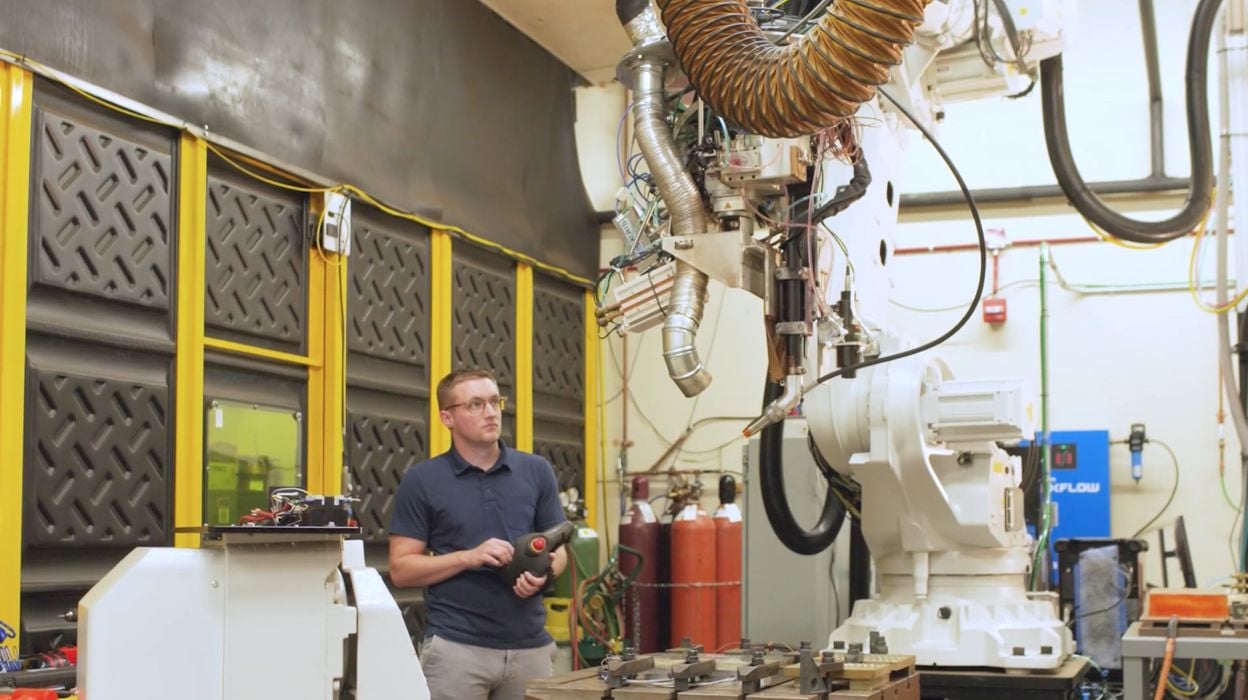
Penn State and the US Army Research Laboratory (ARL) have introduced LAMAR, a large-format robotic Directed Energy Deposition (DED) platform aimed at faster metal additive research and process control.
The system comes from the CIMP-3D (Center for Innovative Materials Processing through Direct Digital Deposition) program at Penn State, and it is positioned explicitly as a mid-TRL environment for both fundamental and applied work. That matters because much of metal DED innovation stalls between lab experiments and production-grade equipment, where repeatability, sensing, and qualification requirements get serious.
Directed Energy Deposition sits in a different spot than powder bed fusion systems such as Laser Powder Bed Fusion (LPBF). Instead of focusing on fine feature detail and tight tolerances, DED is often about adding material quickly onto large parts, repairing or modifying existing components, or building near-net shapes that get machined afterward. In practice, this makes DED a frequent candidate for defense sustainment, large structures, and applications where speed and material flexibility matter more than surface finish.
LAMAR is also a reminder that large-format metal additive is increasingly robot-centric. Compared to fixed-gantry architectures, articulated robots can reach complex toolpaths, approach a part from multiple angles, and potentially reduce the need to split a build into simpler operations. That flexibility is attractive for R&D, where changing a deposition strategy can be as important as printing a specific geometry.
A Big Work Envelope With Synchronized Motion
At the core of LAMAR is a six-degree-of-freedom articulated robot paired with a two-axis rotary positioner. The key is synchronized motion between the processing head and the workpiece, which can expand what is practical for overhangs, transitions, and other geometry challenges that are awkward on more rigid motion systems.
Penn State says the platform supports a 2 m x 3 m x 3.5 m build envelope. That places it firmly in the “large additive” category, where the economics usually depend on high deposition rates and the ability to produce parts that would otherwise require multiple weldments or extensive lead times for casting and forging.
Another notable detail is oxygen-free processing via an integrated argon enclosure. For many alloys, controlling oxygen pickup is not optional if you want credible mechanical performance and a path toward qualification. Enclosures at this scale are not trivial, so it is a meaningful indicator that the team is thinking beyond simple lab demonstrations.
High-Rate Deposition Meets In-Situ Sensing
LAMAR supports both arc-based energy and laser-based energy: an advanced arc-welding power supply and/or a 12 kW laser delivered through a water-cooled, two-axis beam-scanning head. The scanning approach suggests the team wants programmable energy distribution, which can help tune bead shape, manage heat input, and explore deposition strategies that are difficult with a static spot.
On the materials side, LAMAR can run wire and powder feedstock, with claimed deposition rates exceeding 10 kg/hr. The wire subsystem includes dual-wire capability for graded deposition, as well as hot-wire capability aimed at improving efficiency and control. Graded deposition is an especially interesting research lever because it enables functionally changing material composition across a build, but it also raises qualification and inspection challenges that will need careful data.
The platform includes a “multimodal” in-situ monitoring sensor suite and advanced data acquisition. Penn State says ongoing work is focused on turning that stream into real-time, actionable insights for qualification, automated defect detection, and inter- and intra-layer closed-loop process control. In other words, they are not just collecting signals for later analysis, but trying to close the loop while printing, which is where metal DED reliability could improve dramatically.
There are still practical unknowns. The announcement does not specify which alloys are currently supported, what typical bead resolution looks like, or how repeatable the system is across long builds in the full envelope. Pricing is not applicable in the usual product sense, but it also is not yet clear what the engagement model looks like for outside organizations beyond an invitation to collaborate.
What to watch next is evidence of the control stack working under realistic conditions: benchmark parts, defect detection examples, and before-and-after comparisons showing reduced variability or less post-machining. If LAMAR can help transfer sensing and control methods into deployable DED cells for the US Defense Industrial Base, its biggest impact may be the boring stuff: process stability, documentation, and confidence.
Large metal additive rarely fails because it cannot deposit metal; it fails because it cannot deposit trust.
