
Researchers have put metal 3D printed pressure cylinders through a rather unforgiving test.
A new paper in Experimental Mechanics examines how 3D printed metallic cylinders collapse under external hydrostatic pressure. It is the kind of failure mode that matters for submersibles, undersea piping, sensors, and other hardware expected to survive deep water.
In the ocean, pressure rises quickly with depth. Every ten meters adds roughly one atmosphere, and a vehicle operating at 457 m would see about 4.5 MPa of hydrostatic pressure. If a cylindrical pressure structure has the wrong geometry, poor material properties, or a critical flaw, collapse can become a fast and very violent implosion.
That is where additive manufacturing becomes interesting. Laser Powder Bed Fusion (LPBF) can produce internal stiffeners, double hulls, and other features that are difficult or uneconomical with conventional fabrication. The study used 17-4 PH stainless steel printed on a 3D Systems ProX300, then compared three configurations: a single shell, a single shell with internal stiffeners, and a double hull with internal stiffeners and optional filler materials.
What Actually Collapsed
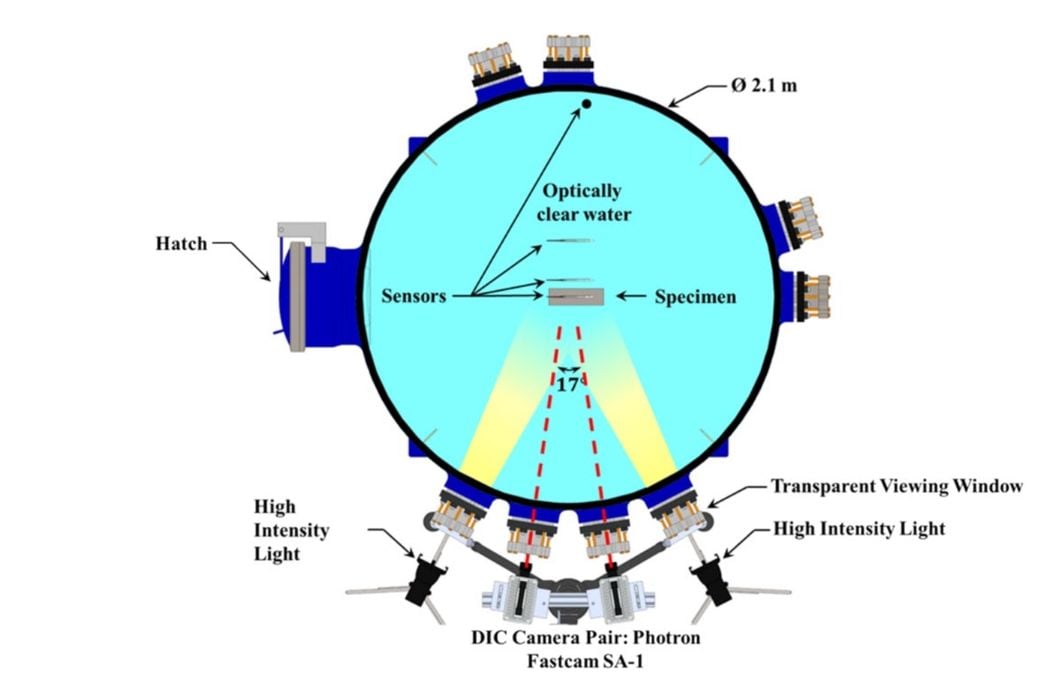
The team designed the specimens around a target collapse pressure of 3.45 MPa, or 500 psi, and used Abaqus finite element models to estimate collapse modes. They then tested the cylinders at the University of Rhode Island Deep Sea Implosion Facility, using high speed imaging, dynamic pressure sensors, and 3D Digital Image Correlation. That setup was able to capture the rapid sequence of deformation, fracture, water motion, and pressure pulses.
The single shell specimens were the most consistent. The stiffened and double hull structures showed more variability because their failures were more localized and more sensitive to flaws. The simulations also overpredicted some single shell collapse pressures by 21.6% and 36.9%, leading the authors to estimate that the actual printed material stiffness was roughly 28.9% lower than initially assumed.
The researchers found that wall thicknesses came out higher than intended, partly due to heat affected zone overlap. They also observed layer bonding weaknesses, layer gaps, and witness line flaws in some builds. Some specimens were unusable, and the authors note that tall, slender geometries are particularly difficult because they must be printed upright through many layers.
This does not mean LPBF cannot make these parts. The paper is careful to say the problems are not inherent to LPBF. Instead, the printer and geometry combination was simply demanding, and newer large format metal LPBF systems with better local geometry correction could reduce some of these issues.
Fillers Helped, But With A Tradeoff
The stiffeners did not succeed. They increased collapse pressure in some cases, but also produced a more chaotic post collapse event. The measured collapse times stretched from about 1.7 ms for the single shell to about 2.6 ms for the empty double hull, suggesting that reinforcement changed how energy was released into the surrounding water.
The filler results are more intriguing. The double hull specimens were tested empty, filled with polyurethane foam, or filled with a rigid polyaspartic polyurea. The polyaspartic filled double hull showed the strongest pressure mitigation, with an 84% reduction in peak pressure and a 73% lower overpressure impulse compared with the single shell case. However, it also carried about 39% more mass.
A component may not merely need to avoid collapse; it may need to fail less violently near sensors, adjacent structures, or crew compartments. In other words, AM may be useful not only for part strength, but also for controlling the consequences of a potential failure.
AM can make pressure vessel geometries that are difficult to fabricate otherwise, but design optimization will not always beat the variability of the printing process. If wall thickness and layer bonding are not controlled, any fancy internal features might become new failure points.
