
I’m looking at a new AI tool for developing 3D models, Synera.
The German company is focusing on the use of AI agents in complex engineering design scenarios. Typically, these challenges are handled manually by a chain of highly trained humans who apply their expertise at various points in the design lifecycle.
Synera’s concept is that at least some of them can be replaced by AI agents. These are AI models that participants can “talk to” during the design process to learn more about the design or perform other actions.
Can it do “everything”? Well, yes and no. Synera appears to be more of an orchestrator rather than “the expert”. This is because Synera partners with an increasing number of specialized tools in these areas:
- Design (CAD)
- Simulation (CAE)
- Manufacturing (CAM)
- Product lifecycle management (PLM)
And it also works with a number of common collaboration platforms, including Microsoft Teams, Office, and especially Excel spreadsheets.
The partner tools provide the raw capability for creating and managing designs, while the agents operate them and connect the results to the overall workflow.
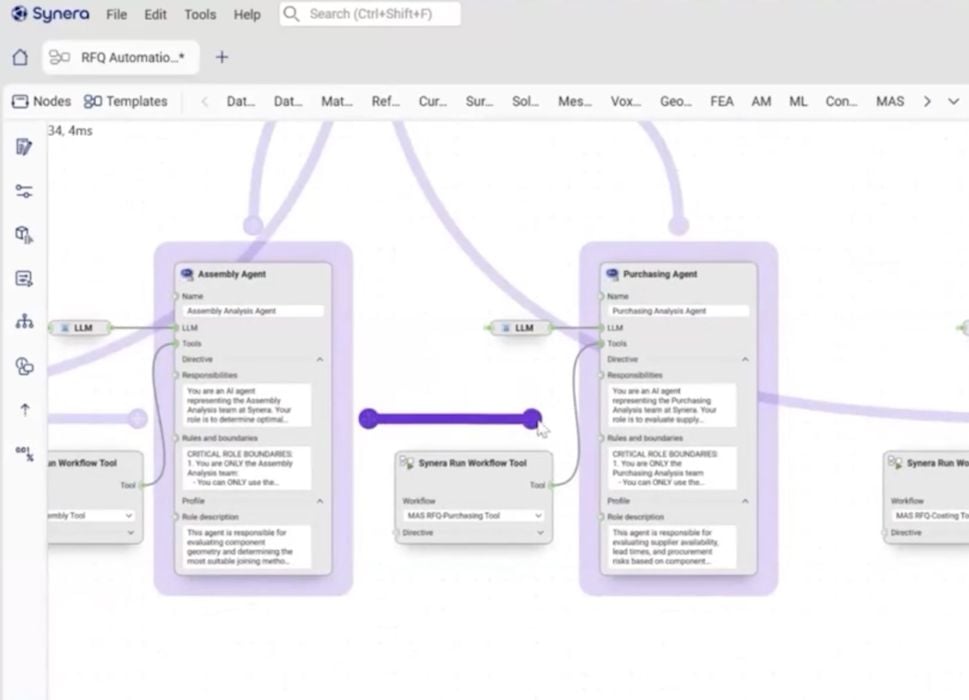
At the top, you can see a screenshot of Synera where an agent is being configured. These can be connected to various AI models and tools to perform specific functions using the right model for the job. For example, you could set up an “FEA Agent” that would run SimScale to perform a number of simulations on a part design, and then pass on the results to other agents for further processing.
Most recently, Synera announced a new partner: Autodesk. This means that Autodesk Fusion is now active in the Synera toolbox, providing another means to create part designs. Synera explains:
“The integration of Fusion marks the fourth Autodesk solution connected to Synera, joining the Autodesk Moldflow Insight, Autodesk Inventor, and Autodesk NAVPACK Add-Ins. With these programs now accessible in Synera, engineering teams gain a new level of connected intelligence, unifying design, meshing, simulation, costing, and reporting workflows through AI agents in Synera that understand engineering context, take meaningful action in the tools, and drastically speed up product development.”
Tools like Synera are likely to be increasingly used by manufacturers as there are significant speed advantages over lengthy manual workflows. Synera’s concept of selecting the AI model is quite interesting, because it means that their tool becomes smarter as soon as new AI models are released by the major providers.
If you’re looking for a way to optimize your part design processes, Synera is an interesting option.
Via Synera
