
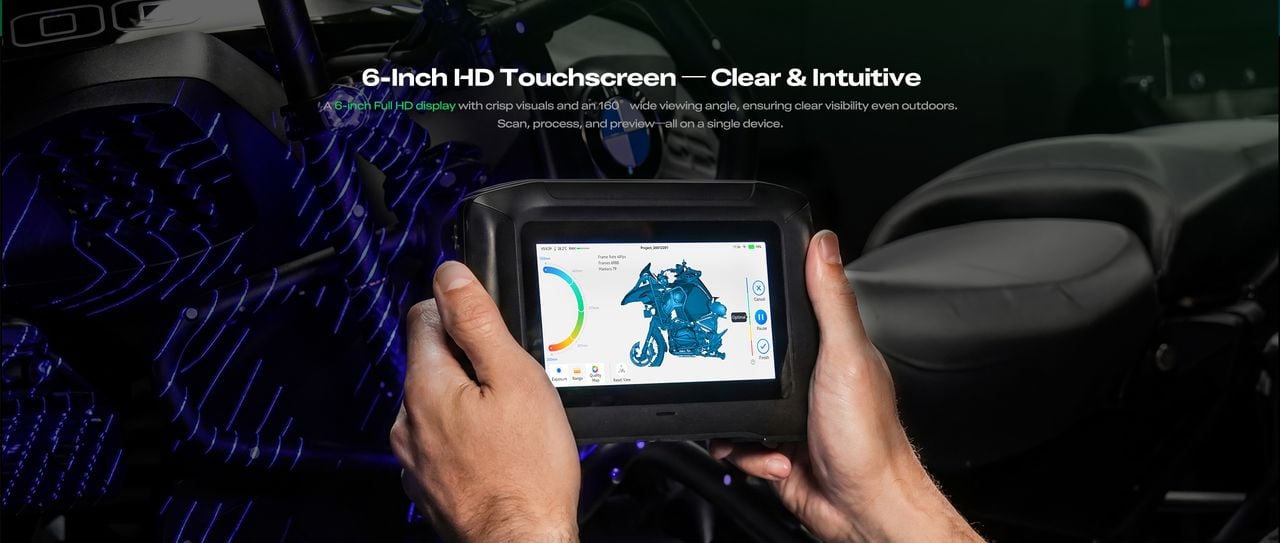
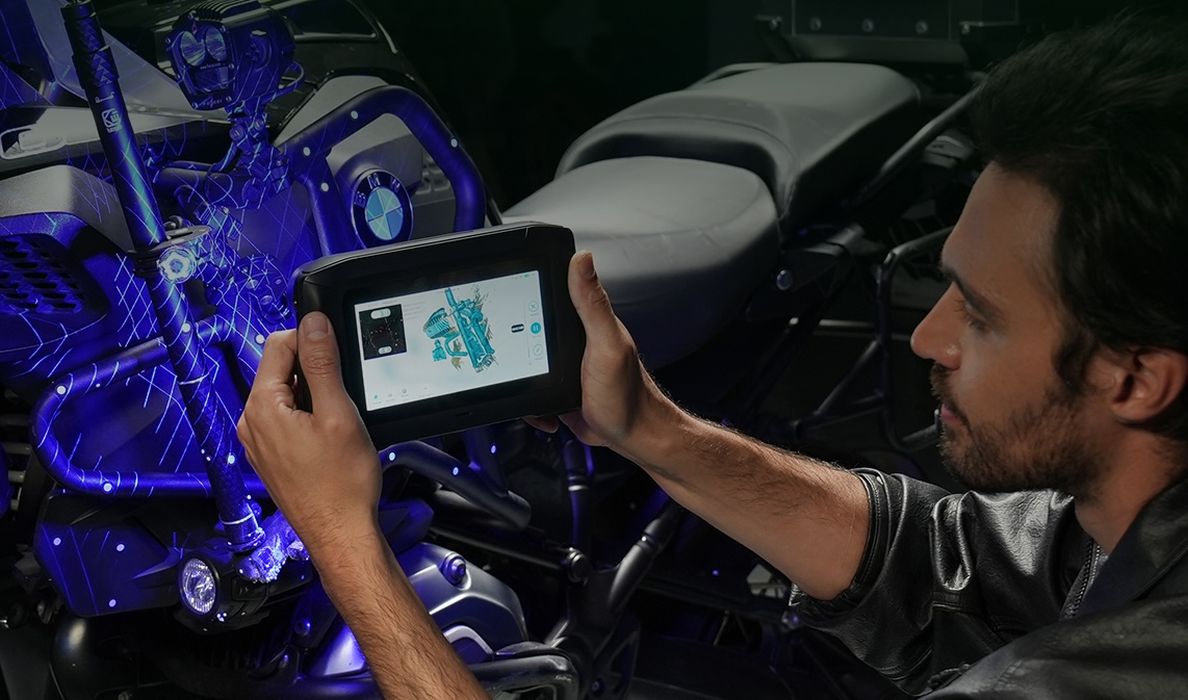
Creality introduced an interesting new 3D scanner, the Sermoon P1.
Creality is most well-known for its 3D printers, but it’s been producing 3D scanners for quite a few years. The Sermoon P1 is its latest device.
The Sermoon P1 is intended as a professional device, as it includes quite a few very powerful features. Let’s take a look at what makes this device different.
Most inexpensive 3D scanners offer a single scanning technique. That might be a structured light system or a laser scanning system. The problem is that no single method can capture all possible subjects due to surface texture, colour, and material.
This is where the Sermoon P1 shines: it includes TWO different scanning systems, a laser scanner and an infrared structured light array. Even better, the laser system can be used in three different configurations, so the device really has four different approaches for 3D scanning.
The laser can operate in “single line” mode, which is ideal for scanning deep crevices, “7 parallel line” mode for capturing extreme details, and “22 Cross line” mode for rapid geometry capture.
By selecting the correct mode, you can capture challenging objects that are very dark or even reflective, and even in bright sunlight. This makes the Sermoon P1 a pretty versatile device.
Fast scanning requires two features: processing power and data transfer. The Sermoon P1 seems to have both. It includes an 8-core Qualcomm CPU and also an Adreno 740 GPU, something you don’t often see in a handheld 3D scanner.
For data transfer, the Sermon P1 has some very interesting features. First, the device can be operated in three different modes: standalone, requiring no attached PC at all; High speed WiFi connection to a PC; and wired directly to an attached PC.
To do all that, the machine includes high-speed memory as well as WiFi 7 capability. This leads to pretty fast scan rates:
- 18 FPS Infrared standalone mode
- 30 FPS Infrared PC mode
- 60 FPS Laser standalone mode
- 100 FPS Laser PC mode
The result of all this technology is the ability to scan objects with a resolution of up to 0.02mm, with plus or minus 0.06mm per meter deviation. That’s highly accurate.
For scanning volume, the Sermoon P1 offers a very good range: five cubic millimetres is the smallest possible volume, and four cubic metres. Of course, you can scan larger objects by combining separate scans later if required.
The Sermoon P1 3D scanner is now available as a pre-order, priced at US$3,219. That’s a bit more than the inexpensive 3D scanners we’ve seen previously, but remember that this device is really several 3D scanners bundled together.
Via Creality
