
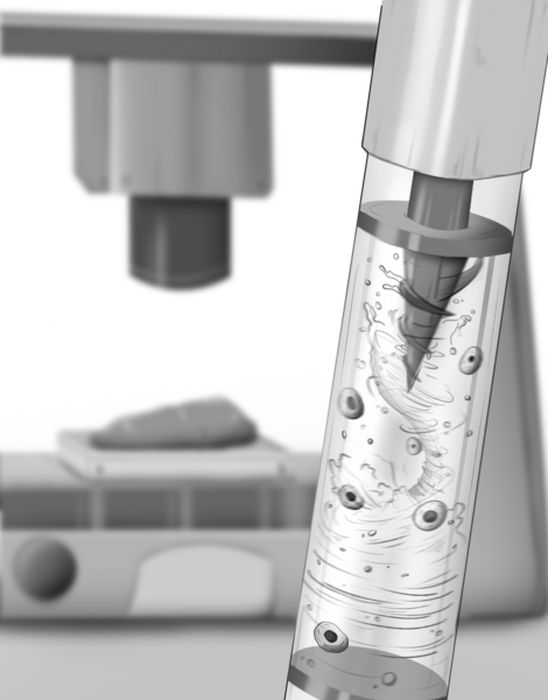
MIT researchers have built a tiny magnetic mixer that keeps cells evenly suspended during extrusion bioprinting, looking to make printed tissues far more repeatable.
Extrusion 3D bioprinting typically uses syringes to deposit soft hydrogels loaded with living cells, and it tends to run into an unglamorous but persistent problem: gravity. Cells are typically denser than the gel around them, so during longer print jobs they sink inside the syringe. Over time that can change the “recipe” coming out of the nozzle, even if the bioink started perfectly mixed.
That settling shows up in ways anyone running a bioprinter will recognize. Sunk cells can increase the chance of clogs, create uneven cell density within a printed structure, and make one print differ from the next for reasons that are hard to diagnose. MIT’s Ritu Raman points out that manual stirring or passive mixing approaches may help at the start, but they do not keep things uniform once a long print is underway.
The new system, called MagMix, is intended as an add-on intended to work with standard bioprinters without changing the bioink formulation or interfering with normal operation. The work comes from Raman’s group in MIT’s Department of Mechanical Engineering.
How MagMix Works In Practice
MagMix is intentionally simple in concept: put a small mixing element inside the syringe and drive it magnetically from outside. The in-syringe component is a small magnetic propeller sized to fit the kind of syringes used by extrusion bioprinters. Outside the syringe, a permanent magnet mounted to a motor moves up and down near the barrel, and that motion actuates the internal propeller.
Because there is no mechanical shaft passing through the syringe wall, the team describes the system as compact and compatible with existing equipment. Mixing speed is tunable, which matters in bioprinting because too much agitation can stress cells, while too little allows sedimentation to return. The group used computer simulations to optimize propeller geometry and operating speed, then validated performance experimentally.
In testing across multiple bioink types, the team reports that MagMix prevented cell settling for more than 45 minutes of continuous printing, while reducing clogging and maintaining high cell viability. As a proof of concept, they also demonstrated printing cells that could mature into muscle tissue over several days, suggesting the mixing approach can be gentle enough for biologically sensitive work.
Why This Matters for Scalable Tissue Printing
In the broader additive manufacturing landscape, this is less about a new printer and more about process control. Bioprinting often fails in the mundane middle ground: not at the first layer, but halfway through a long run when conditions drift. If cell concentration changes during the job, you can end up with a part that looks dimensionally acceptable but behaves differently biologically, which is exactly the kind of variability that slows validation and scale-up.
MagMix is positioned as a low-cost, customizable, easily integrated tool that could help labs and industry groups push toward more standardized tissue manufacturing. Raman’s team also frames the payoff in downstream applications like disease modeling and drug screening, where consistent tissue function matters as much as geometry. They note the growing interest in alternatives to animal testing, including attention from the US Food and Drug Administration toward faster and more informative evaluation methods.
There are still practical questions that will determine adoption. MIT did not provide pricing, detailed bill-of-materials cost, or a commercialization plan, and “works with any standard bioprinter” can hide a lot of integration trivia across syringe sizes and toolhead layouts. It will also be important to see longer-duration data beyond 45 minutes for large constructs, plus results with more demanding bioinks that vary widely in viscosity and shear sensitivity.
Regardless, the concept is pretty compelling because it targets a core failure mode with minimal disruption: keep the syringe contents homogeneous in real time, rather than hoping pre-mixing holds. If that holds up, MagMix could become the kind of small accessory that quietly improves a whole category of machines.
Via MIT News
