
A new research review looks at the technologies behind 3D printed meat and what must happen before it scales.
The paper, titled “Additive Manufacturing in Food Systems: A Comprehensive Review of 3D-printed Meat Technology,” compiles what is currently known about food printing with a focus on meat analogues and cultured tissues. For readers tracking additive’s move from prototyping to production, food is an unusual but fast evolving frontier that blends extrusion hardware, rheology, and sensory science in equal measure.
Food printing is not new — desktop paste extruders have been around for many years — but interest has intensified as alternative protein companies try to engineer bite, juiciness, and marbling on demand. The review positions “edible AM” beside conventional structuring methods like high moisture extrusion and shear cell processing, with layer wise deposition could unlock finer 3D control of fat and fiber alignment than bulk processes can deliver.
Process Landscape And Material Choices
The authors identify extrusion based deposition as the dominant approach for 3D printed meat, essentially a “food grade cousin” of FFF that pushes pastes through nozzles. Typical formulations blend plant proteins, fats, and hydrocolloids to create inks with a yield stress high enough to hold shape but low enough to flow under pressure. Multi material printing is key here: separate cartridges for “muscle,” “fat,” and “connective” phases allow programmable marbling and anisotropy, with toolpaths designed to mimic fiber direction.
Other modalities show up at niche scales. Inkjet style deposition can place flavors, colorants, or oils at high resolution, though viscosity limits keep it from laying down bulk. Binder-based approaches and laser sintering are largely irrelevant for raw meat analogues but may appear in confectionery or brittle foods, which the review notes only to clarify scope. For cultured meat, the paper touches on bioprinting concepts — cell laden gels and edible scaffolds — but keeps the focus on food safe materials rather than clinical bioinks.
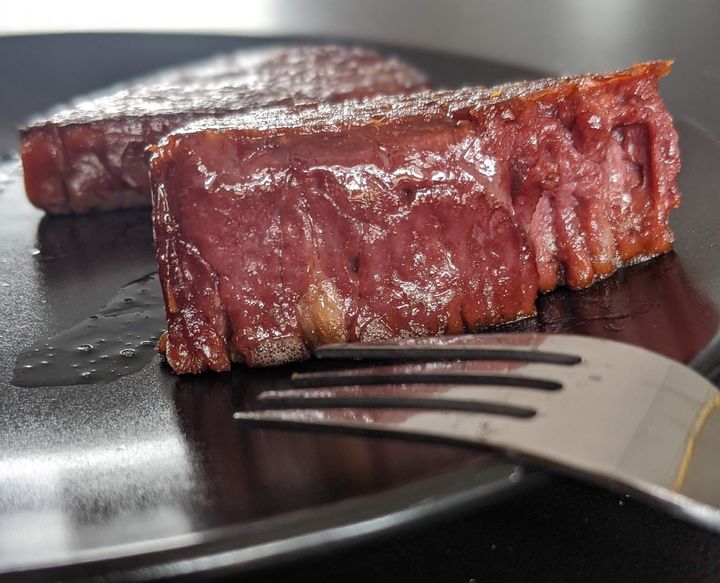
Post processing is another variable in this technology. Printed meat cuts are usually finished by grilling, baking, or searing to set structure, create Maillard reactions, and render fats. That cooking step is not just culinary; it is also a form of post cure that determines final texture, water loss, and shrinkage, which the review flags as critical but is apparently inconsistently measured across studies. You eat the cooked piece, not the raw meat.
Constraints, Throughput, And Food Safety Realities
The review points out constraints that would be familiar to any 3D print operator, except they’re now applied to perishables. Throughput is the elephant in the kitchen: paste extrusion is inherently much slower than stamping or forming, and multi material tool changes add even more elapsed time. Without proper automation — cartridge handling, nozzle cleaning, and on the fly viscosity monitoring — human intervention labor will just rise costs even more.
Rheology is both the enabler and the problem. Small shifts in temperature can clog nozzles or slump layers. The paper point out the need for robust, repeatable inks with stable yield stress and rapid recovery. Closed loop control could help, but the review notes that there is very little standardized sensing in current food printers compared to industrial AM’s melt pool monitoring or powder bed cameras.
Food safety implies even more constraints. Sanitation, allergen control, and Hazard Analysis and Critical Control Points (HACCP) compliance raise design demands that hobby or industrial 3D printers never face. Smooth, cleanable fluid paths, limited dead volumes, and traceable, single use contact parts could add cost but are likely prerequisites for commercial kitchens and retail.
Economics are still unresolved. The review does not present cost per kilogram or comparative life cycle data, and many cited demonstrations are lab scale. That leaves open questions about ingredient prices, energy intensity during post processing, and waste from purges and changeovers.
What should readers watch next? Standardized benchmarks for print speed, layer height, and mechanical surrogates for “chewiness” would allow fair comparisons between printers and recipes. Expect pilots in institutional kitchens or quick service environments where on demand customization adds value, likely paired with proprietary cartridges to control rheology and hygiene. Regulatory clarity around cultured meat ingredients will also shape which formulations are viable in each region. If the field can make marbling programmable and cleanup automatic, dinner may one day be compiled rather than cooked.
Via EJNFS
