
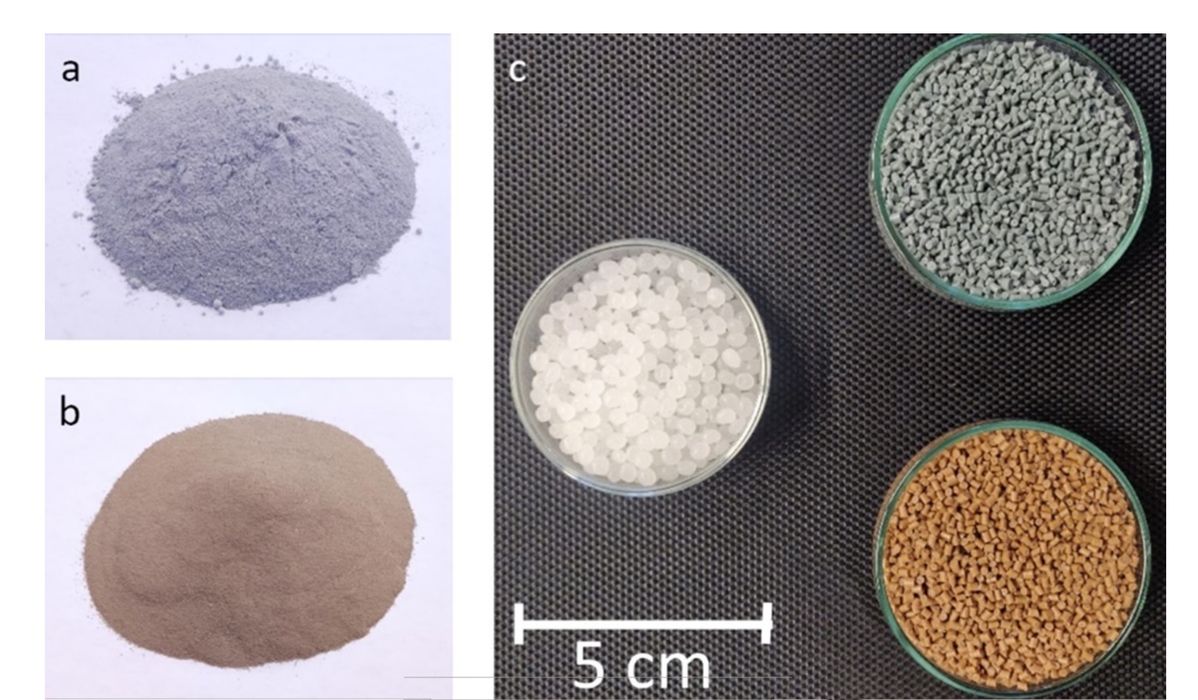
A research team proposes using detoxified asbestos cement as a depolymerization regulating filler in PLA composites for 3D printing.
Asbestos? Isn’t that toxic? It turns out there is a way to do this that could be safe.
There are two problems being solved here: PLA’s tendency to thermally backslide during melt processing, and the environmental burden of asbestos cement waste stockpiles. The paper suggests a single materials strategy could address both by converting hazardous, fiber-laden cement into an inert mineral filler that stabilizes PLA during heating.
PLA is the workhorse polymer of fused filament fabrication (FFF), but it is notorious for chain scission and depolymerization when pushed toward higher temperatures or long residence times. Degradation shows up as lowered viscosity, color shifts, fume spikes, and drifting mechanicals after repeated extrusion cycles. Commodity fillers like talc and calcium carbonate can slightly improve crystallization and stiffness, yet they don’t significantly affect PLA’s depolymerization kinetics directly.
Detoxified asbestos cement (often a thermally or chemically treated material where fibrous asbestos is converted to non-fibrous silicate phases) is an unusual but potentially effective candidate additive for PLA. If the treatment truly renders the asbestos safe, the resulting mineral blend could act as an alkaline, surface-active filler that could slow down polymer chain unzipping in PLA’s melt. That would be a quite a change as compared to typical fillers used in consumer-grade PLA filaments.
From Hazardous Waste To Functional Filler
The paper positions this approach as upcycling: turning a liability into a performance additive. Asbestos cement is a legacy construction material trapped in buildings, roofing, and pipes worldwide; disposal is expensive and heavily regulated. Stabilizing it through detoxification and reintroducing it as a certified non-hazardous filler could divert toxic tonnage from landfills while also lowering virgin polymer content in composites.
If the filler can regulate depolymerization, filament producers may see better viscosity across compounding, extrusion, and multiple print heat cycles. That can translate to steadier extrusion at the nozzle, more consistent bead geometry, and less drift in dimensional accuracy on long jobs. There could also be gains in stiffness and thermal resistance that edge standard PLA closer to workhorse engineering PLA composites without jumping to PETG or ABS.
However, there are immediate constraints to point out. Mineral-filled filaments tend abrade brass nozzles; hardened steel or ruby tips are then required for this approach, and larger nozzle diameters may help if particles are coarse to avoid clogs. Material color will likely lean into gray, which limits aesthetic applications unless pigments can overcome the dull gray look. Drying is essential because PLA and mineral fillers can both misbehave with moisture. Finally, while detoxification eliminates the hazardous fibrous character, market perception will demand unambiguous certification before consumer or healthcare segments embrace such a material: Would you want to use “asbestos filament”? I didn’t think so.
Implications For FFF Printability And Recycling
The most intriguing angle is circularity. Recycled PLA often suffers from viscosity loss and higher melt flow after each recycling iteration. If this filler truly moderates depolymerization, it could potentially enable higher fractions of recycled PLA in filaments and printed goods while holding process windows stable for more cycles. That means service bureaus and design labs running high print hours, where throughput depends on predictable flow and layer bonding from spool to spool could benefit.
Economically, the filler source may be inexpensive compared to engineered minerals, but processing also does introduce some new costs. Detoxification, milling, classification, and quality assurance add cost and energy. The researchers do not disclose cost-per-kilogram targets, maximum loading levels, or how the filler influences crystallization rate, heat deflection, or impact strength. Those tradeoffs will determine whether this is a general-purpose PLA composite or a niche technical grade.
What the AM community needs next is data that maps directly to print outcomes. Melt rheology after multiple extrusions, number-average molecular weight via GPC before and after compounding, nozzle abrasion testing, emissions under typical PLA print temperatures, and part-level benchmarks for tensile, layer adhesion, and creep would make the case. Lifecycle assessment would also show whether the environmental win survives the detoxification energy budget.
If the team can demonstrate reliable printability and verify that no respirable fibers are present post-processing, early adopters will likely be filament producers and research labs exploring high-recycled-content materials. Broader uptake could follow in tooling, jigs, fixtures, and construction-related prints where gray, mineral-filled PLA is acceptable and stiffness is valued over ductility.
Turning a century-old problem into an improved form of recyclable PLA would be a a very cool story — if this actually works.
Via Springer Nature
