
Researchers report laser powder bed fused NiTi TPMS sheet lattices with promising lightweight metrics that could reshape energy-absorbing and compliant structures.
Nickel titanium (NiTi), often called Nitinol, is desirable for its shape memory and superelastic behavior, combining recoverable strain, high damping and useful strength. Those properties make it attractive for impact mitigation, compliant mechanisms and medical devices, but NiTi’s AM processing window is pretty narrow. A new research paper titled On the Lightweight Potential of Laser Additive Manufactured NiTi Triply Periodic Minimal Sheet Lattices investigates how far that approach can be pushed when the alloy is formed into repeating-pattern sheet structures.
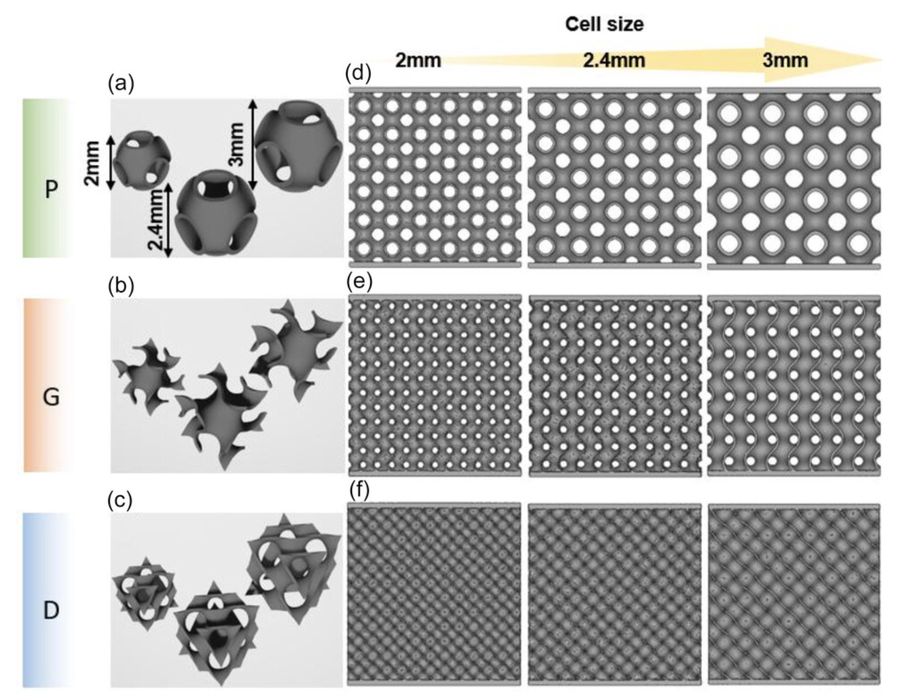
Triply periodic minimal surfaces (TPMS) — think “Gyroid” — are continuous surfaces that separate space efficiently. In additive manufacturing, TPMS can be made with strut lattices or as closed “sheet” shells that deliver higher buckling resistance and smoother stress gradients. Metal AM users have typically used TPMS in Ti-6Al-4V and polymers; applying them to NiTi, where superelastic properties and recoverable strains are involved, could unlock a very different class of lightweight structures.
Laser Powder Bed Fusion (LPBF) is the likely route here, as it offers the resolution needed for thin, continuous sheets. Processing NiTi by LPBF is notoriously sensitive: nickel evaporation, oxygen pickup and melt pool dynamics all skew print outcomes. Heat treatment and aging then tune the austenite–martensite balance, which controls the final mechanical response. The paper’s focus on “sheet lattices” suggests minimum wall thicknesses close to the process limit, where scan strategy and thermal management are critical.
The Lightweight Promise
In sheet-based TPMS, stiffness and strength scale with relative density differently than in traditional strut designs. The continuous shells slow the appearance of local instabilities and distribute load, so specific stiffness and energy absorption can improve for a given mass.
Combining that complex topology with NiTi’s superelastic plateau means deformation can be accommodated with large recoverable strains and hysteresis — useful for crashworthy or vibration-damping parts that need to rebound without permanent damage.
The study appears to quantify these effects across geometries and densities, but full numerical results are not disclosed in the paper. However, thin NiTi sheets seem to act like springy membranes that avoid stress concentrations, and the LPBF process, if controlled, can actually produce those membranes pretty close to design intent.
The big challenge is feature fidelity. Below a few hundred microns, overmelting, stair stepping and surface roughness raise local stress and can dull the expected superelastic response. Print orientation matters too; sheets angled to the recoater and laser vector may print cleaner.
Throughput and post-processing are the other levers. Low relative density should reduce material usage, but scan time can remain high because the laser must trace long, meandering paths over thin features. Support structure strategies are nontrivial for these continuous sheets, and blasting or tumbling can rip apart the delicate sheets. None of these are showstoppers, but they will have to be overcome in some manner.
If validated, the immediate beneficiaries are industrial sectors that trade mass for performance. Aerospace could deploy NiTi TPMS sheets for morphing structures or shock mounts. Medical device teams might see new options for embolic filters, stents or orthopedic spacers that combine porosity with recoverable compliance. Robotics and sporting goods could exploit the high damping and resilience. Service bureaus with LPBF capacity may also find a niche, provided parameter sets for NiTi sheets are robust and certifiable.
Expect follow-up work that pins down density–stiffness scaling, plateau stress stability over cycles and thermal treatments that lock in performance. If those data eventually appear, and if manufacturers can hold composition within tight tolerances across a full build, NiTi sheet lattices could move from intriguing idea to actual flight hardware and clinical tools.
