
Inkbit has published a patent application that describes a different kind of material chemistry for inkjet additive manufacturing.
The application is WO2025041082A1, titled “Materials and Methods for Transmetallation-Activated Ring-Opening Metathesis Polymerization (ROMP).”
Inkbit is best known for Vision Controlled Jetting, its inkjet based 3D printing process. The company’s original approach was not simply “jet material and cure it.” The key feature was machine vision: the system prints material, scans the layer, and uses feedback to correct the process as the part is made.
That is a very different kind of 3D printing process from what is described in this patent.
The original Inkbit concept was mainly about process control. If a droplet spreads, if a layer is not quite where expected, or if a soft material behaves differently than predicted, the system can observe what actually happened and compensate. That can make material jetting more reliable, particularly for geometries and materials that are difficult to control.
This new patent is more about material chemistry.
Inkjet additive manufacturing systems typically deposit liquid materials through printheads. The obvious challenge is that the deposited material must become solid quickly enough to support the next layer. Many systems solve that with photopolymers and ultraviolet curing. That works, but it also limits the scope of materials that work properly using that process.
Inkbit’s patent is a different approach: polymerization that begins only after separate liquid components meet on the build surface. No UV curing is required, apparently.
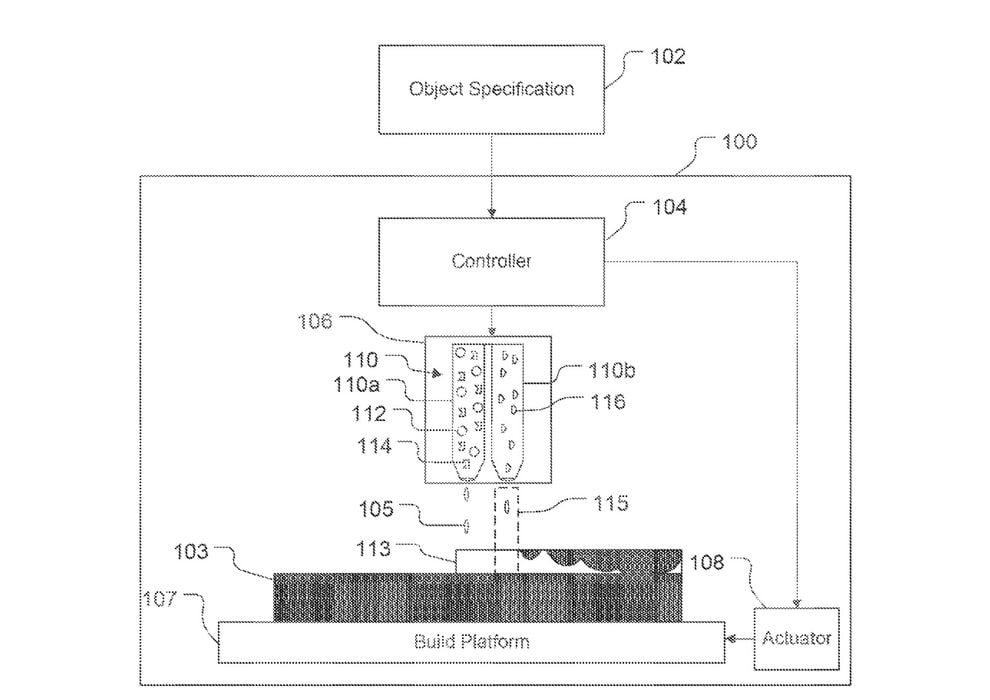
In their method, one printed fluid contains a monomer and an activator. A second printed fluid contains a ROMP pre-catalyst. When the second fluid is deposited, it diffuses through the first fluid. The pre-catalyst reacts with the activator to form a polymerization catalyst, and that catalyst then reacts with the monomer to create the polymer. It’s kind of like a two-part epoxy, except printed through tiny inkjet nozzles.
In other words, the printhead does not need to carry the fully reactive mixed resin. The chemical reaction is triggered after deposition.
The patent specifically notes the problem with these materials: if the catalyst and monomer are mixed too early, polymerization can occur in the printhead or storage tank before the material can be deposited. That would be catastrophic for an inkjet process, where nozzle reliability is everything. Clogs kill.
Inkbit’s solution is to keep the chemistry separated until the last possible moment. The first time the pre-catalyst encounters the monomer is on the print itself, because the liquids are dispensed through separate nozzles. .
This is where the comparison becomes interesting. Inkbit’s original method asked: how can we make inkjet 3D printing more accurate and reliable by watching the build? This patent asks a different question: how can we print reactive polymers that normally cannot safely mix inside an inkjet system?
The two ideas are not mutually exclusive. In fact, they may fit together pretty well.
A delayed reaction chemistry like this would likely require strong process control. The patent emphasizes concentration control: too much activator could cause polymerization to occur too quickly, preventing proper diffusion of the pre-catalyst. Too little activator could leave the layer insufficiently cured before the next layer is deposited.
That sounds exactly like the kind of problem where real time inspection and closed loop control could be valuable. Get the connection here?
The system described in the patent includes printheads, a controller, a moving build platform, and separate jets for the different liquids. The patent also describes an offset printing variant where support material, such as wax, forms a well. The inside of that well can be coated with pre-catalyst before the monomer and activator mixture is deposited.
The patent discusses ROMP precursors, transition metal activators, ROMP pre-catalysts, solvents, dyes, pigments, flame retardants, impact modifiers, reinforcing agents, antioxidants, catalyst inhibitors, and support materials. It also lists mechanical properties such as elongation at break, Young’s modulus, and notched Izod impact strength.
That suggests Inkbit is not merely trying to cure a resin differently. The company appears to be exploring a path to polymers that may be difficult to process with conventional photo curing.
Inkbit’s original process was about controlling inkjet AM more intelligently. This lengthy (118 pages) patent suggests the company may be trying to use that control to unlock a wider class of printable polymers. If that works, we could see future Inkbit machines printing some very unusual materials.
Via Espacenet
