
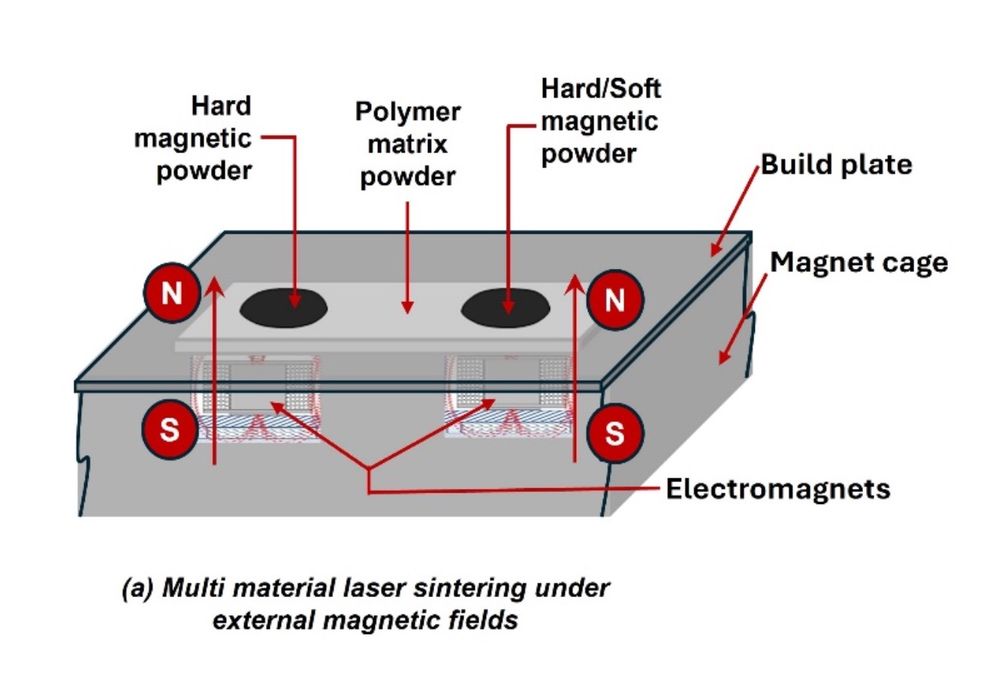
Researchers at Auckland University of Technology’s Additive Manufacturing Research Centre report a field-assisted SLS approach that 3D prints bonded magnets with locally programmable pole patterns.
Polymer-bonded magnets have been 3D printed by FFF, stereolithography and polymer Selective Laser Sintering (SLS), and more recently researchers have aligned anisotropic particles by applying relatively weak fields during consolidation. Those efforts typically yielded global anisotropy, not spatially distinct poles. AUT’s team pushes further by combining multi-material powder placement with localized, timed magnetic fields during SLS to imprint easy-axis orientation and create heterogeneous magnetic regions within a single part.
This research follows prior field-assisted AM in resins and direct ink writing where particles can align more easily in viscous states, yet it avoids SLS’s usual limitation — viscous drag and fast solidification — by placing electromagnets beneath the build plane and synchronizing alignment with point-wise sintering. If scalable, it could let designers print field-shaping designs that have traditionally required post-assembly of many tiles or laminations.
Inside The Field-Assisted SLS Setup
The researchers used a make-shift polymer SLS rig built around a CO2 laser (10.6 μm) with 18 W power, 500–1000 mm/s scan speeds, a 0.27 mm spot and nylon as the matrix. Two electromagnets under the build plate (32 axial and six radial windings) delivered an alignment field around 230 mT; their polarity and timing could be switched to pattern local easy axes. A notable addition is a patent-pending powder-handling bar that rides with the wiper: one nozzle selectively vacuums base polymer from programmed zones while others dispense controlled quantities of magnetic powders into those recesses before sintering each layer.
Proof-of-concept samples were thin bars only five layers thick (reported 50 μm per layer for these builds). The team printed two-island layouts using hard NdFeB on one side and either soft FeSi or FeCo on the other, as well as NdFeB on both sides to probe dipole interaction. Particle alignment and magnetic maps were evaluated by SEM, Bitter ferrofluid imaging and Gauss probe measurements.
Printed parts showed weak remanent flux in the NdFeB regions at roughly 1.5–2 mT, as expected for bonded magnets with modest hard-phase loading. Post-print magnetization produced strong amplification: up to 6 mT north and 3 mT south for NdFeB/FeSi, and 14 mT north and 6 mT south for NdFeB/FeCo, while the soft-magnetic islands retained essentially no remanence. Under an applied external field, differential polarities in both multi-material specimens reached roughly 80–100 mT north and 50–100 mT south, showcasing pronounced, spatially confined responses. Even when magnetized in the opposite direction, a persistent north-upward tendency remained, indicating a sintering-stage easy-axis alignment that biases the final state.
This is new because the team does more than align particles globally; they place different powders point-wise, then program orientation locally with synchronized fields. That combination enables dipoles, multipoles and potential Halbach-like patterns emerging layer by layer.
However, this is a lab system with a small work envelope and custom mechatronics. Throughput, repeatability, powder loading fractions and software choreography for the suction/dispense cycle are not yet quantified, and the flux figures reflect very thin test coupons. Powder handling near moving magnets inside a warm SLS chamber also adds reliability and safety questions for production.
Nevertheless, the use cases line up pretty well. Motor and actuator developers could prototype compact field-shaping inserts; sensor makers may embed hard and soft domains in one print; robotics teams might tune force profiles without post-assembly stacks. For polymer SLS providers, a mature version of this could differentiate service offerings with lower human touch time for complex magnetic assemblies.
What might determine adoption is scale and control. Larger arrays of under-bed electromagnets, closed-loop field sensing, higher hard-phase loading, and robust toolpaths for subtractive powder removal and dosing must come together. If those steps land, printing magnets that already “know” where their flux should go could change how we design electromechanical systems.
