
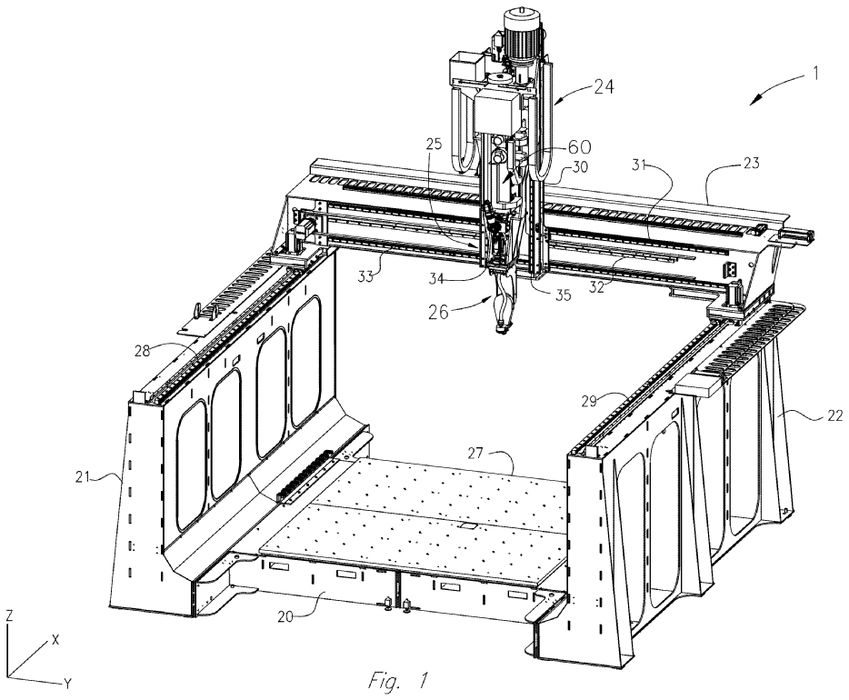
A patent proposal by Thermwood could solve one of large area extrusion’s oldest challenges: keeping bead size consistent when a pellet fed printhead speeds up, slows down, and corners.
That problem occurs most in the large format end of extrusion based additive manufacturing, where systems often skip filament entirely and push pellets through a screw extruder. These machines can deliver far higher throughput than desktop FFF systems, but they also inherit a plastics processing problem: the screw likes to run steadily, while the motion system does not. As the gantry changes speed, especially in arcs and corners, a constant extrusion rate produces thick beads in slow zones and thin beads in fast ones.
Many developers have tried the obvious fix, namely servo controlling the screw so extrusion output follows motion speed. The patent text argues that this only works up to a point because screw rotation does two jobs at once: it pumps material and helps generate heat through friction. Change screw speed, and you also change melt temperature, viscosity, and lag. In practice, that means output at a given screw speed depends partly on what the screw was doing a few moments earlier. That is not ideal when you are trying to place wide thermoplastic extrusions accurately on a large toolpath.
Synchronizing Flow Without Choking Throughput
The core idea here is to place a fixed displacement polymer pump, specifically a gear pump, between the screw extruder and the nozzle. The controller then synchronizes pump speed and screw speed together, while also watching inlet pressure. Instead of asking the screw alone to respond to every motion change, the pump meters a more predictable flow and the extruder is biased to maintain target pressure at the pump inlet.
That might sound straightforward, but it could be meaningful for large scale pellet extrusion. Gear pumps are well known in plastics processing, yet the patent argues that 3D printing introduces more abrupt and frequent speed changes than steady state extrusion. The proposed control strategy therefore changes both pump and screw speeds simultaneously and proportionally, then trims behavior with pressure feedback. In other words, the system tries to keep the melt supply stable before the nozzle ever sees it.
The patent goes further by suggesting this pressure control could reduce or eliminate traditional breaker plates, screens, and even special screw mixing sections. That is important because those components often add restriction, reduce throughput, and may need to be swapped for different polymers. If software and pump control can generate the required operating pressure instead, the result could be a simpler melt path with fewer material specific hardware changes. That claim is pretty enticing, although the patent provides no production data on flow rate, pressure range, energy use, or print quality.
The other interesting angle is toolpath compensation. The patent describes dynamically changing bead width to manage overlap between adjacent extrusions, reduce squeeze out, and fill boundary gaps that would otherwise leave voids. That is not just extrusion hardware; it edges into slicer and process control territory. If implemented well, it could benefit applications where voids are unacceptable, including tooling or autoclave ready composite molds. Service bureaus printing large thermoplastic structures might care more about that than about the pump itself.
There is no commercial timeline mentioned in the patent, but one can easily imagine Thermwood implementing this technology on their equipment in the near future.
Via Patentscope
