
Apple’s new LiTo research is not about 3D printers — at first glance, but it could point toward a more 3D print friendly content pipeline if the company ever decides to connect image based 3D capture, asset generation, and physical output into one ecosystem.
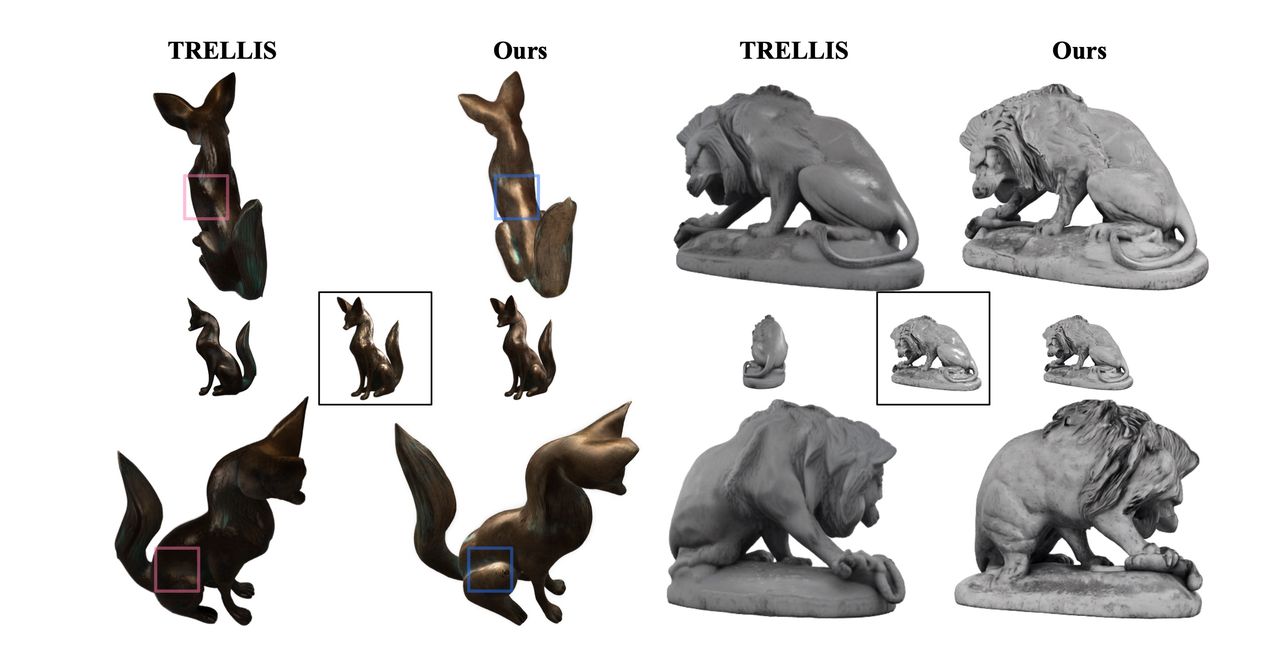
Apple researchers have proposed a new 3D representation, “LiTo”, that tries to capture not only shape, but also the shiny, angle dependent appearance cues that usually break today’s image to 3D methods.
From Images To Printable Objects
On the surface, LiTo looks like a computer vision project. Apple describes it as a 3D latent representation that jointly models object geometry and view dependent appearance, using surface points, color, and viewing direction rather than geometry alone. The goal is to generate or reconstruct 3D assets from images with better fidelity, especially for reflective and glossy objects that usually confuse existing systems. 
That sounds far from extrusion, resin, or powder bed 3D print workflows, but the connection to 3D printing is not hard to see. One of the long standing barriers to broad consumer 3D printing has been the very challenging gap between “I see an object” and “I have a printable 3D model.”
Most people cannot model from scratch in CAD, and current image to 3D systems often create geometry that looks plausible in renders but may not hold up once converted into a mesh for editing or 3D printing. Apple is at least working on the front end of that problem: making image derived 3D assets more faithful to what the user actually sees. 
That could matter in a 3D print sense because better geometry acquisition usually expands 3D printing activity. If casual users can generate cleaner 3D assets from a phone image, the next step could be cleanup, scale adjustment, wall thickening, and print preparation. LiTo does not do those manufacturing steps, but it could become part of an upstream pipeline that feeds them.
Consider that if Apple were to include this technology in their systems, then third parties could far more easily develop 3D apps that, for example, might capture 3D objects cleanly, and then process them into printable form. All Apple has to do is include the technology, and other developers could finish the rest of the workflow.
The Printable Opportunity Is In Capture
The research paper’s main feature is view dependent appearance, including specular highlights and Fresnel effects. That is mostly useful for realism in digital assets, not for a printed part, because an FFF or resin print does not need the software to preserve mirror like reflections from the source object. 
However, there is a more practical angle. Systems that better separate true shape from lighting artifacts may eventually improve image based reconstruction of tricky surfaces. If the system better understands that a bright streak is a reflection instead of a physical edge, that could reduce a frequent cause of bad 3D reconstructions. However, Apple does not claim LiTo is a reverse engineering tool for manufacturing, at least not yet. 
Apple also reports stronger conditioning view fidelity than competing approaches such as TRELLIS, meaning the generated object more closely respects the source image. For 3D printing, that is no doubt more important than prettier rendering. A printable workflow needs the shape first. 
Apple’s Ecosystem Angle
The more interesting question is strategic. Apple already has strong hardware, imaging, silicon, and AR infrastructure. If it ever wanted a consumer friendly 3D pipeline, it has many of the necessary pieces: cameras for capture, local processing on Apple Silicon, 3D asset generation research, and operating system level control over apps and file workflows. LiTo by itself does not signal a 3D printing push, but it does strongly hint that Apple is investing deeper into 3D object representations. That can only be good for 3D printing. 
We are not going to see Apple branded 3D printers as a result of LiTo. We will see a more capable 3D asset ecosystem with more of the parts needed for for scanning, previewing, and editing. , Eventually third party apps or even Apple itself could combine these parts into a 3D print workflow.
For now, LiTo is not specifically a 3D printing breakthrough. But if Apple ever decides that “take a photo, get a model, make a thing” should be a normal consumer experience, this technology could be a key component of that workflow.
