
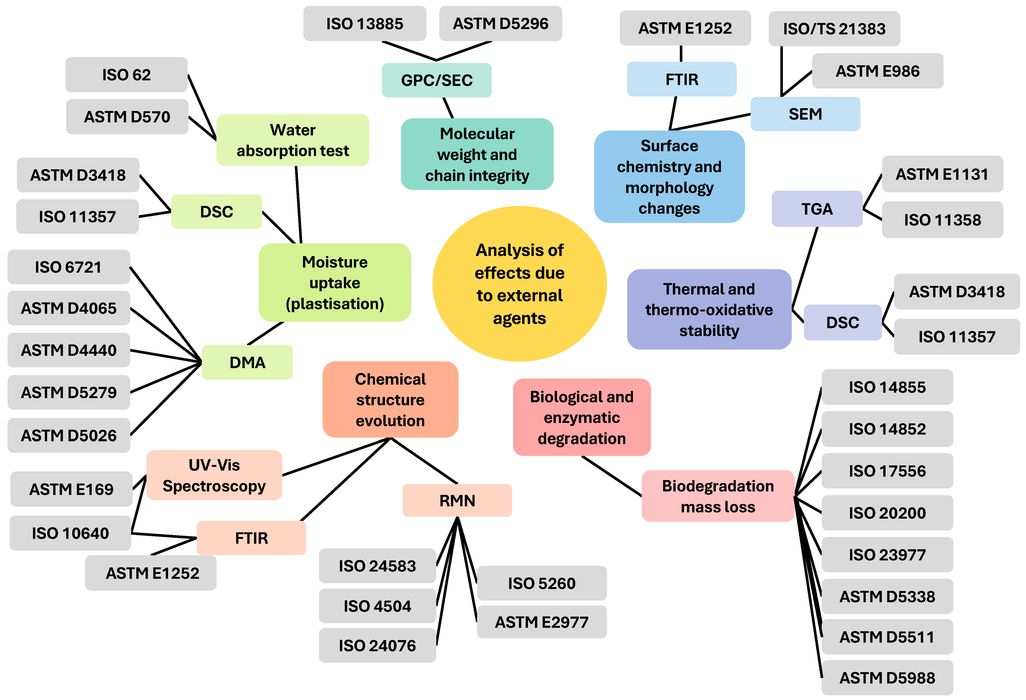
A new research paper looks at how 3D printed polymers degrade over time and what that means for real-world part reliability.
Why Aging Data Matters For AM Polymers
Most polymer datasheets still focus on 3D printed tensile bars and a few thermal numbers, but production users really need to know what happens after months or years in heat, humidity, UV, chemicals, or cyclic loads. This new study, published in the Journal of Manufacturing and Materials Processing, focuses directly on that gap by evaluating degradation and long-term response in polymer components made by additive manufacturing.
Unlike injection molded parts, which benefit from decades of standardized durability data, 3D printed polymers bring forward new variables that change how and how fast they degrade. FFF parts can have porosity and interlayer interfaces that allow moisture ingress. Selective Laser Sintering (SLS) parts often retain unsintered powder surfaces and have humidity sensitivity. Vat photopolymer systems (resins) trade higher resolution for cross-linked chemistries that can become brittle under UV or creep differently under sustained load. Further complicating things, the same base resin can behave very differently depending on orientation, infill, and post-processing.
This matters for any application where failure modes evolve over time: snap fits that loosen, fixtures that drift under preload, housings that craze after solvent wipes, or outdoor parts that chalk and crack. Regulated industries such as medical, aerospace, and transportation need defensible life predictions and qualification evidence. Even for consumer goods, warranty costs and product liability hinge on knowing not only initial strength but also the rate and trajectory of performance decay.
By focusing on degradation, the paper connects lab measurements with service life modeling. The practical value to designers and quality teams will be strongest if the authors quantify creep and stress relaxation under constant strain or stress, report fatigue life shifts across humidity and temperature, and map environmental stress cracking for common solvents. Acceleration models can translate elevated-temperature aging into room-temperature predictions; activation energies, time-to-50 percent property loss, and confidence bounds would let engineers set reliable safety factors instead of just guessing.
Equally important is methodological transparency. Degradation in AM is highly parameter-sensitive, so exposure conditions, print parameters, build orientation, surface preparation, and post-cures should be quite explicit to make any results reproducible. Cross-process comparisons are valuable only if geometry and stress states are controlled, for example. Ideally, the AM community needs raw datasets, not just summary charts, so service bureaus and OEMs can plug real numbers into their digital thread and perform sensitivity analyses.
If that happens, the impact could be strong and immediate. Material selection changes when you know a that photopolymer loses fracture toughness after long UV exposure, while a nylon’s stiffness drops mainly with moisture uptake. Qualification plans can add targeted soak tests instead of broad, expensive mechanical tests. Most of all, design guides can begin to include time-dependent properties for 3D printed parts, moving from swags to production-grade practices.
However, accelerated aging can misrepresent some mechanisms, and coupon tests may not capture all the stresses in complex geometries. Throughput and cost are examined indirectly — tighter environmental control and post-processing to mitigate aging will add steps and possibly reduce yield. And while the study framework is promising, this area still lacks specific reference parts and harmonized test sequences across FFF, SLS, and vat photopolymerization.
For readers deciding when to use this type of research, watch for three happenings: open, downloadable datasets; clear acceleration factors tied to failure mechanisms rather than just temperature; and evidence that results generalize beyond just a single printer or resin. If those appear, expect standards groups in ASTM and ISO to consider creating new standards, and expect more vendors to publish time-dependent curves in addition to the usual stress–strain plots.
Reliability of parts in 3D printing has long been a wild card, but with more studies of this type we may get a handle on how our parts perform.
