
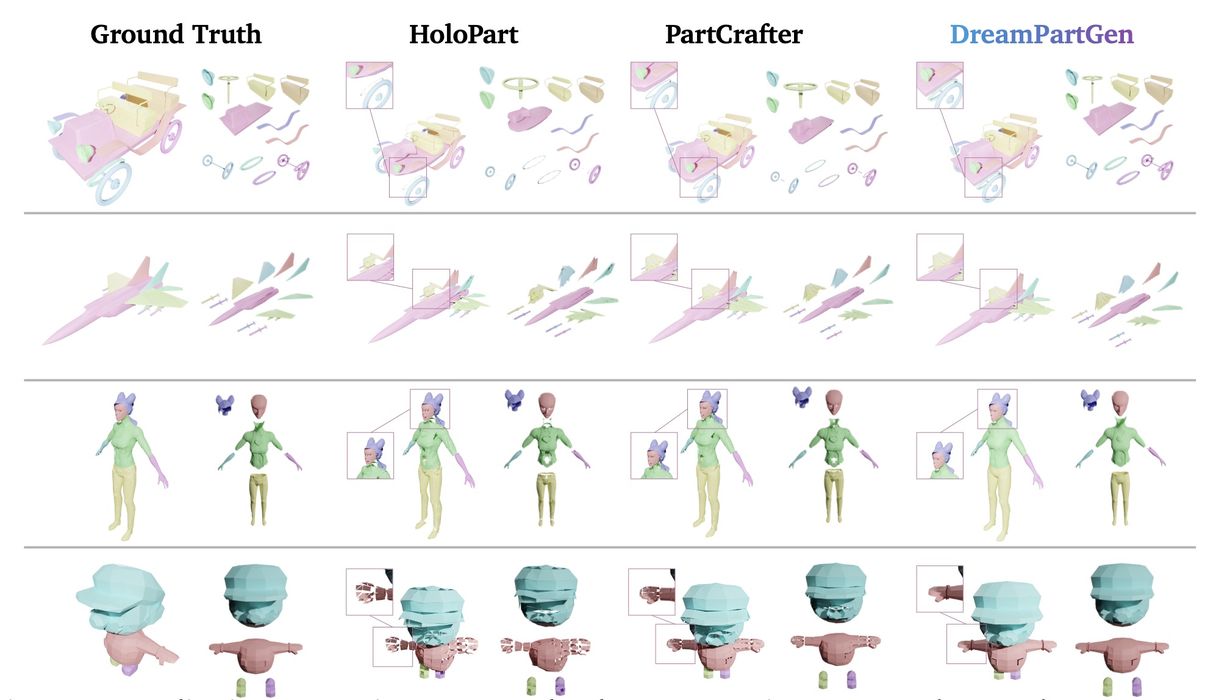
A new research model called DreamPartGen could make text generated 3D models far more usable for printing and assembly.
Most text to 3D systems today are terrific when generating evocative, organic shapes but fail miserably when a prompt requires function, joints, or multi part structure. That gap matters to additive manufacturing, where a model without separate parts is just a static object. The new paper positions DreamPartGen as a semantically grounded, part level generator that keeps geometry and language aligned right from the start.
Rather than generate a monolithic object and attempt segmentation afterwards, the approach represents each part on its own and also later models how those parts relate using natural language. The researchers report state of the art results on geometric fidelity and text shape alignment across multiple benchmarks, which, if they hold up, could reduce the manual labor that is usually required when using today’s generative 3D outputs.
Why Part Semantics Matter For AM
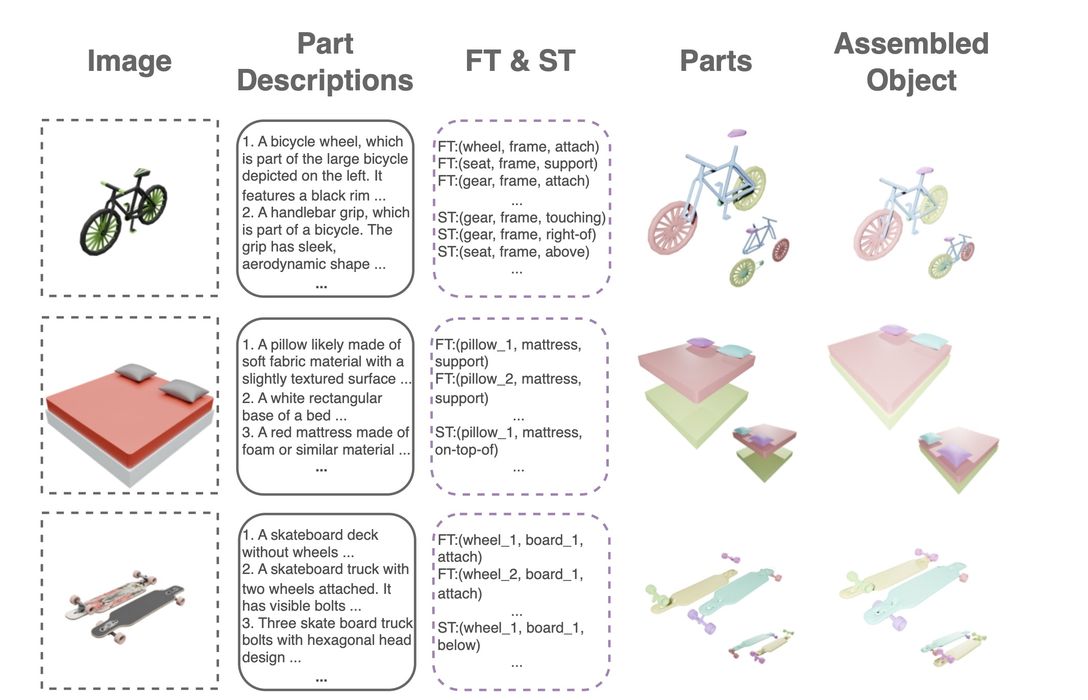
Most 3D printing is not about single parts, but parts that are assembled into a machine. For polymer powder systems like Selective Laser Sintering (SLS) or Multi Jet Fusion (MJF), labeled subcomponents can assist with orientation, nesting, and per part QA, and in FFF or resin workflows they can dictate split strategies, support planning, and multi material choices. A single mesh with no part boundaries forces technicians to redesign separate features, wasting time and slowing overall throughput.
Part aware generation also opens the door to constraints that map to the print constraints: minimum wall thickness, clearance for press fits, living hinges that respect material strain, or tolerances that survive sintering and post processing, etc. If a model “knows” that a wheel must rotate around an axle, the system can create a clearance volume before the slicer ever sees the file. That is the promise that DreamPartGen is working towards.
Another benefit is downstream interoperability. Many AM teams are moving beyond STL toward STEP or feature aware meshes because they preserve the design intent. A generator that outputs components with roles and relations could make translation to CAD features or assemblies more simplified and reliable, and thus accelerate design to print workflows for jigs, fixtures, consumer devices, or robotics brackets. Or anything.
How DreamPartGen Works
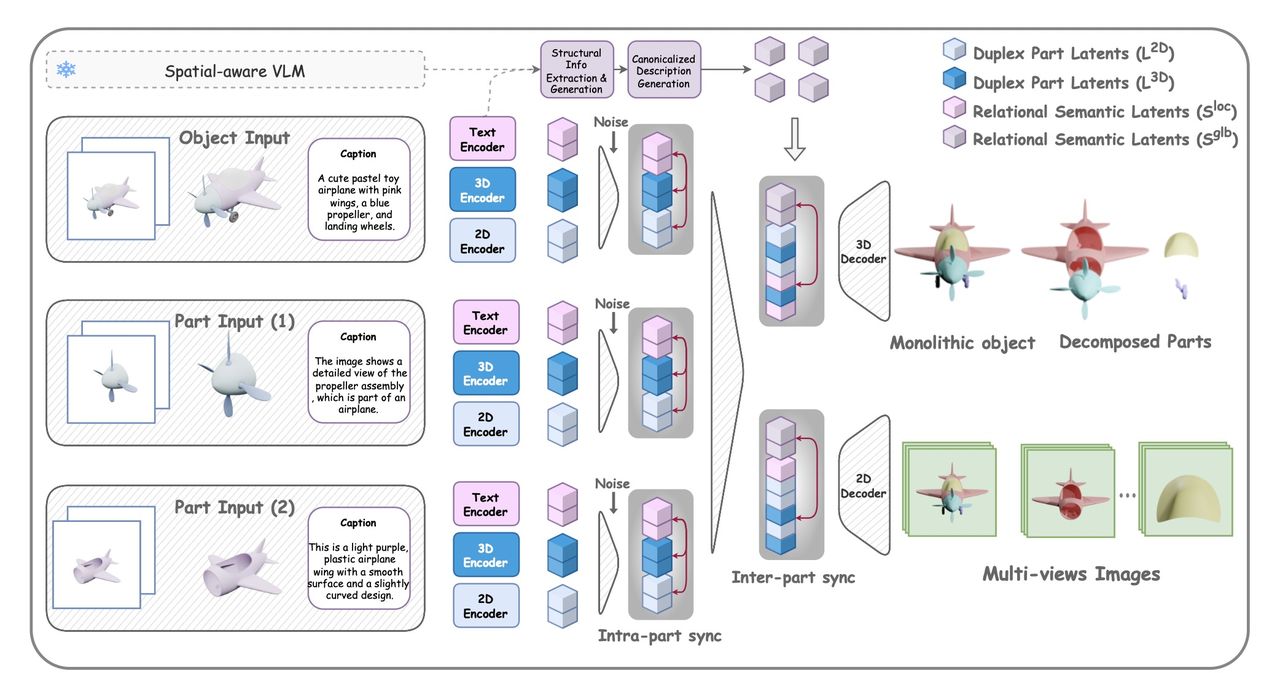
The paper introduces two key ingredients. Duplex Part Latents (DPLs) encode each part’s geometry and appearance jointly, avoiding the common split where shape is modeled first and texture is painted on later. Relational Semantic Latents (RSLs) capture dependencies described in text — above, attached to, concentric with — so that parts are not optimized in isolation. A synchronized denoising process then updates part latents and relation latents together, enforcing mutual consistency as the 3D structure emerges.
In other words, the model treats an object like a small assembly and denoises its components collaboratively under language guidance. The researchers claim this yields coherent, interpretable, text aligned synthesis, and their benchmarks confirm this. The interesting bit is cleaner, labeled outputs that may cut hours of manual segmentation, booleans, and other manual repairs before slicing.
There are, however, a lot of unknowns. The paper does not specify output representation or resolution — mesh, implicit, point cloud, or CAD like surfaces — which determines how easily models enter real print pipelines. Manufacturability constraints, minimum feature sizes, and tolerance handling are not specifically discussed; without them, prints risk fused joints or fragile walls, especially in SLS or LPBF where thermal stress and sintering shrinkage can occur. Throughput is another open question: denoising multiple parts may improve reliability but could also increase compute time and cost.
Service bureaus and in house teams will want STEP or at the very least watertight, manifold meshes per part, consistent naming, and a simple path to assign materials and print parameters. Code availability, licensing, and dataset provenance are not noted in the abstract; if the team releases weights and a permissive license, expect rapid experiments connecting DreamPartGen to CAD kernels, constraint solvers, or slicers that can honor semantic relations during toolpathing.
What’s next? I hope for some quantitative tests that include clearance gauges, fastener fit checks, and printability metrics across materials; a demo exporting multi part models that round trip through a mainstream CAD and a slicer; and evidence that relation latents survive downstream edits. If those are achieved, this could be a practical step towards generative text prompts that build ready assemblies.
Via arXiv
