
Researchers unveiled a vat-free thin-film DLP method that can print sealed cavities and clean multi-material parts.
Digital Light Processing (DLP) is fast and precise, but traditional vat photopolymerization struggles with closed internal voids. Trapped resin inflates weight, hurts accuracy, creates a toxic problem and limits functionality. Multimaterial runs add another headache: carry-over and cross-contamination when hopping between vats or dip stations.
Film-based approaches have emerged to get around vat problems, including tape-cast and meniscus-assisted coaters, with commercial flavors from Admatec and BCN3D’s VLM lineage via Supernova. Yet these systems have rarely shown both clean multi-material switching and truly sealed voids without residual resin. The new thin-film DLP reported by CUHK with collaborators from MIT and Manchester attempted to control resin as a metered thin film, not a pool.
How The Thin-Film DLP Works
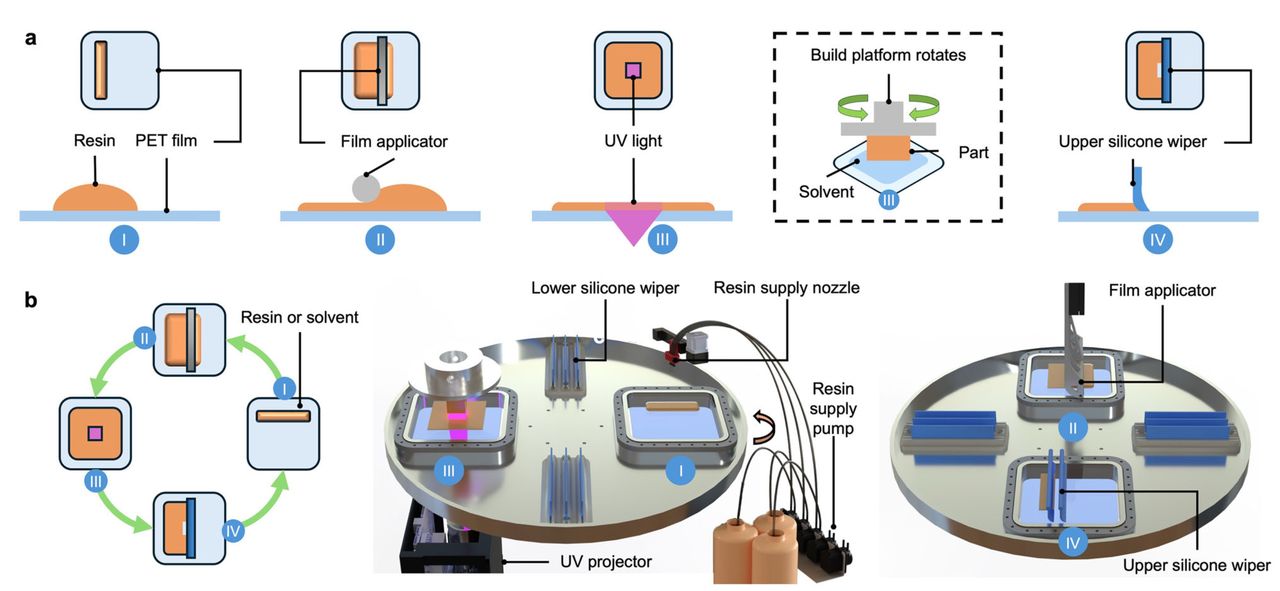
Instead of dipping into a vat, the machine casts a uniform resin film onto a PET release sheet using a fixed blade as a circular build platform rotates. Layers as thin as about 25 microns can be laid down; the team typically formed roughly 100 micron films for 50 micron layer heights to ensure coverage. A 4K 405 nm projector (about 50 micron pixel pitch, 192 x 108 mm exposure area) cures only what is needed. After separation, silicone wipers clear stray resin. An optional rinse cycle dispenses a mild solvent blend (seventy five percent ethanol, twenty five percent water) and performs brief reciprocating rotations to purge residues.
Because resin exists only as a controlled film, not a bulk bath, there is almost nothing to trap inside when a cavity gets sealed. The group reports entrapped resin under one percent of part mass, versus more than one hundred fifty percent for comparable vat builds. Without rinsing, cavities from about two to ten millimeters printed consistently, with a mean diameter error near 0.36 mm. Adding interlayer solvent washing pushed the lower limit to roughly 750 microns for designed features near 1.3 mm.
Why Sealed Voids And Multi-Material Matter
Closed cells unlock stiffness-to-weight advantages and damp vibration, but they were off limits to vat DLP. Here, the team printed face-centered cubic arrays of enclosed spheres inside cubes using both soft and stiff resins, tuning equivalent modulus by up to twenty five times simply by changing cavity diameter. They also demonstrated a fully printed capacitive proximity sensor using an ionic conductive resin embedded in a standard resin substrate, with a sensitivity peak of about 17.9 fF/mm within zero to ten millimeters.
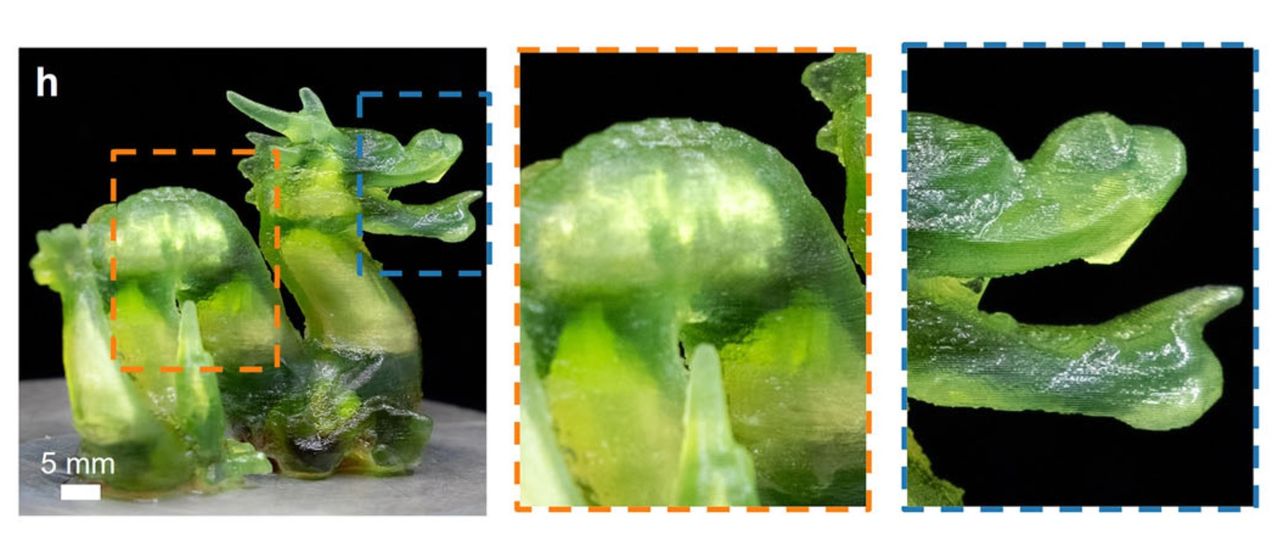
The same film-first approach stops cross-contamination between materials. With solvent rinses, dual-material layers took about fifty to seventy seconds, which is competitive with the best multi-material DLP clearing methods that often rely on longer high-pressure air, spin or ultrasonic steps. The team also showed dissolvable supports using a water-soluble resin: a space-filling Hilbert curve, a three-material denture (soft gums, rigid teeth, soluble base), and a hollowed dragon model that printed with no internal supports and weighed only about one percent over the theoretical hollow mass.
Sub-millimeter multi-material checkerboards merged at around 0.5 mm tiles despite thinner layers, pointing to projector resolution, resin optics and wetting as the real limits of this process. The water-soluble resin was too low in viscosity to form stable thin films on PET and was instead dispensed as beads to fully encase parts. Cycle time today is dominated by rotation and resin supply; exposure per layer was about two to five seconds, but switches still cost roughly ten seconds per material aside from washing.
The commercial implications depend on reliability and materials. PET’s surface energy is a key enabler for uniform films; other films like FEP. Resin compatibility will depend as much on wetting and interfacial stability as viscosity. If resin vendors tune formulations for film stability and cure confinement, thin-film DLP could become a practical route to sealed channels, buoyant lattices and embedded conductors without the usual vat baggage.
