
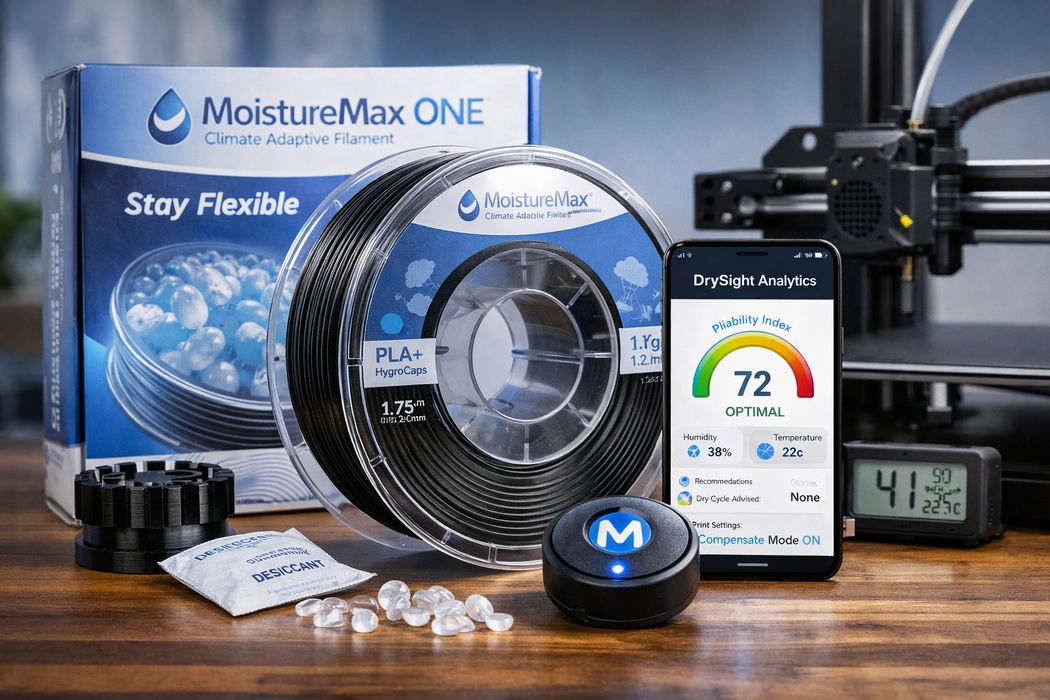
MoistureMax has introduced a filament platform that intentionally manages moisture instead of merely fighting it.
That sounds backwards, but the company’s pitch is at least more technically coherent than the usual “wet filament is good, actually” nonsense. Its new MoistureMax One material is a premium FFF filament that incorporates microscopic hygroscopic capsules inside a PLA based carrier resin. Those capsules do not simply soak up random humidity forever. Instead, MoistureMax says they act as local moisture buffers, absorbing limited ambient water when the spool is stored in very dry air and then releasing it slowly inside the polymer matrix to keep the filament from becoming brittle during handling and feeding.
In other words, the company is not claiming that steam improves printing. It is claiming that controlled micro level moisture stabilization can preserve flexibility and reduce cracking on spools that are repeatedly opened, resealed, and left in marginal storage conditions. That is a much narrower claim, and one that at least fits real shop behavior. Plenty of desktop users do not run dry cabinets, and brittle snap prone filament is a genuine annoyance, particularly for older PLA blends and certain filled materials.
MoistureMax says the system works only within a defined storage window of 20 to 55 percent relative humidity. Above that range, the capsules saturate and the filament behaves like any other moisture exposed spool. Below that range, they slowly give back retained moisture to maintain what the company calls “feed pliability”. That may sound like marketing fog, but the basic idea is clear enough: the capsules are supposed to keep the filament from turning into uncooked spaghetti one day and aquarium tubing the next.
Moisture Buffering, Not Moisture Worship
The first release is available in 1.75mm PLA and PLA CF variants, with PETG slated for later this year. MoistureMax claims the filament showed a 23 percent reduction in spool edge fractures during internal handling tests and fewer feed interruptions in long Bowden setups after repeated dry room exposure. That could matter for print farms, schools, and design studios where half the operators still think “resealed” means placing the spool beside a zip bag.
But there is an obvious catch. The same moisture buffering system that improves flexibility in storage can become a liability once printing starts. If the capsules are even slightly overcharged from humid exposure, the filament reportedly produces minor bubbling, extra stringing, and inconsistent surface finish. In plain language, it prints badly in moist rooms, badly in dry rooms after overcorrection, and acceptably only in a fairly narrow middle band. So MoistureMax has not eliminated the moisture problem. It has industrialized it.
That is where the real product appears: a subscription cloud tool called DrySight Analytics. Users scan the spool, log room conditions through a small Bluetooth sensor puck, and upload slicer profiles to receive a “Pliability Index” score and a recommended print window. DrySight then advises whether to dry the spool, rest it, seal it, or proceed with “compensated extrusion parameters”. There is something wonderfully modern about selling filament that requires telemetry to decide whether Tuesday is safe.
A New Revenue Stream From Bad Storage Habits
MoistureMax prices MoistureMax One at US$64 per kilogram, while DrySight starts at US$15 monthly for hobby users and climbs to US$89 monthly for fleet management. The company says the dashboard can predict when a spool is likely to become too stiff for reliable feeding or too saturated for stable extrusion. It did not provide a full technical data sheet, long term mechanical results, or benchmark comparisons against standard dry stored PLA from the better known suppliers.
That leaves the market position somewhat awkward. MoistureMax is not really competing with commodity filament brands on print quality. It is selling a managed materials workflow for users who are bad at storage and willing to pay software to confirm it. There may actually be buyers for that. Education, shared makerspaces, and light duty farms often struggle more with handling discipline than nozzle temperature.
Still, the larger lesson is hard to miss. The rest of the industry sells dry boxes to keep filament out of trouble. MoistureMax seems to have built a filament that creates just enough trouble to justify a dashboard. That is not quite materials science magic, but it is undeniably elegant business engineering.
