
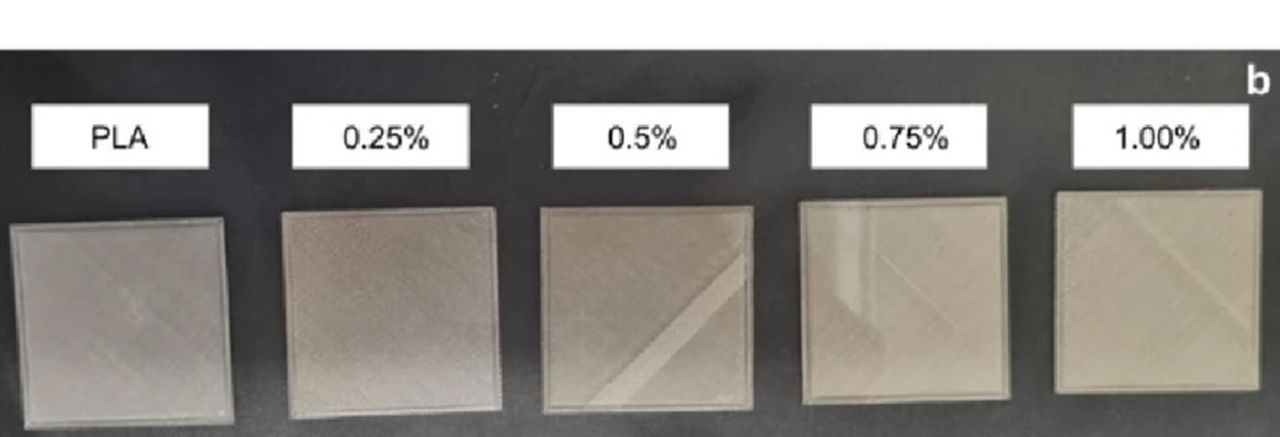
Researchers report on PLA filaments infused with vitamin E and their behavior in FFF printing.
Even though this paper was published on April 1st, it does appear to be quite real. It was submitted for publication months ago and unfortunately appeared in print on April Fool’s Day.
The study is titled “Incorporation of vitamin E in poly(lactic acid) filaments: a 3D printing study”, and it examines what happens when alpha-tocopherol, better known as vitamin E, is mixed into PLA, and then extruded into filament for FFF 3D printing. This is an interesting concept: blending a mainstream polymer with a familiar, biocompatible antioxidant that could alter processing, part performance and even potential medical or consumer applications.
PLA is ubiquitous in desktop and professional FFF due to its low print temperatures, low warp and supposedly renewable material. Its drawbacks are also well known: brittleness, limited heat resistance and susceptibility to hydrolysis and oxidative degradation. Materials researchers often address these limits by adding plasticizers, nucleating agents or stabilizers. Meanwhile, Vitamin E is a common antioxidant in polymers and pharmaceuticals.
Why Add Vitamin E To PLA?
From a polymer science standpoint, vitamin E could play two roles. First, as an antioxidant it may scavenge radicals that drive thermo-oxidative aging in PLA during extrusion, printing and service. Second, as a small, oily molecule it can behave like a mild plasticizer, potentially lowering glass transition temperature (Tg) and melt viscosity. In FFF terms, that combination might widen or shift the processing window, improve interlayer bonding at lower nozzle temperatures, or increase ductility — with the common trade-off of reduced stiffness and possibly lower yield strength.
Biocompatibility adds another angle. If vitamin E remains in the matrix and can migrate to the surface, it could create parts with antioxidant surface activity, which is important for tissue-contact prototypes, wearables or packaging.
What This Could Change On The Print Bed
For 3D printer operators, the first questions are processing and reliability. A plasticized PLA typically prints at the low end of the usual 190 to 220C range and flows more readily through small nozzles, which can help with interlayer adhesion and surface finish. However, any additive must survive compounding and extrusion without volatilizing, discoloring or blooming. Vitamin E begins to degrade at elevated temperatures, so retention after double heat histories (filament extrusion during manufacturing plus the subsequent 3D printing) is a big unknown. If retention is high, it could also influence long-term dimensional stability, especially near the glass transition temperature.
Mechanically, you would expect a modest increase in elongation and impact resistance coupled with a drop in modulus. That might be a positive for consumer goods and jigs that benefit from toughness but do not see high loads. For dimensionally critical parts, altered crystallization behavior could affect shrinkage and annealing responses.
Economically, the idea is attractive because vitamin E is widely available and non-hazardous, which could simplify handling compared to exotic additives. If the compounding is straightforward and the additive loading is low, material cost increases should be minor. The bigger question is throughput: if melt viscosity drops, the same printer might push higher flow at comparable quality. Conversely, if the filament softens at lower temperatures, spool handling and hot-end heat creep could become failure modes on poorly cooled systems.
Potential beneficiaries include research labs exploring bioactive surfaces, designers of consumer wearables that contact skin, and education programs seeking a safer route to demonstrate additives and property tuning. Regulated medical devices would be a different story: even with biocompatible materials, full material characterization, sterilization compatibility and leachables studies are mandatory. The paper does not talk about regulatory readiness.
If follow-up work shows antioxidant retention after multiple heat cycles and they determine the mechanical trade-offs, filament makers could have a recipe for a gentler, tougher PLA variant.
Via Springer
